What is Agent.ai
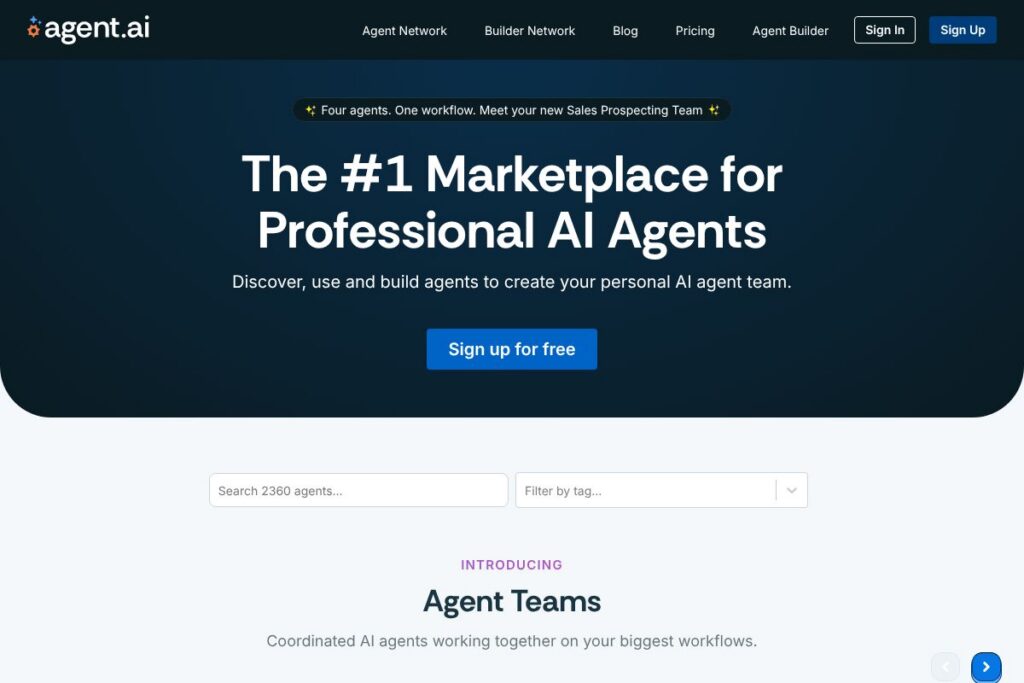
Agent.ai is a marketplace and orchestration layer for AI agents that combines discovery, ready-to-run agents, and a visual builder to create multi-agent workflows. The product is focused on assembling small teams of agents that each perform specialized tasks, for example a four-agent sales prospecting workflow that finds leads, enriches data, drafts outreach, and sequences follow-ups.
Compared with AgentGPT, which is oriented toward open-source, single-agent experiments and local deployments, Agent.ai emphasizes a curated marketplace and team orchestration features designed for business workflows. Against Auto-GPT, which targets autonomous single-agent chains and developer experimentation, Agent.ai provides a more structured environment for composing and reusing agent sequences. Compared with automation platforms like Zapier, Agent.ai centers on goal-driven AI agents rather than rule-based triggers and actions, although it overlaps with automation platforms when integrating external apps and data.
All of this makes Agent.ai particularly useful for small to medium teams that need prebuilt AI agents and a way to coordinate them into repeatable workflows. It is best suited for teams that want a low-code way to deploy specialized agents for tasks such as sales prospecting, research, and content drafting, while keeping the option to customize agent behavior and data sources.
How Agent.ai Works
Agent.ai organizes work around agents, agent collections, and workflows. Users browse the marketplace to find specialized agents, add them to a workspace, and connect agents into a directed workflow so outputs from one agent feed the next.
Building an agent uses a visual composer where you define the agent’s role, prompt templates, data connectors, and execution rules. Once a workflow is saved, it runs on demand or on a schedule, producing outputs such as lead lists, enriched records, drafts, or automated messages.
A typical implementation for a sales team uses a four-agent chain: a discovery agent sources prospects, an enrichment agent augments contact data, a copy agent prepares outreach messages, and a sequencing agent schedules follow-ups. The platform includes run history and logs so teams can audit agent decisions and iterate on prompts.
Agent.ai features
Agent.ai’s core capabilities focus on agent discovery, multi-agent workflows, and a visual builder. The platform combines a searchable marketplace of prebuilt agents, a low-code composer for creating new agents, and orchestration tools to run agent teams. Recent additions emphasize workflow templates for common use cases such as sales prospecting and outreach automation.
The platform includes several powerful capabilities:
Marketplace of prebuilt agents
A searchable catalog exposes agents organized by use case, such as research, data enrichment, and outreach. Each agent listing typically includes a description, input/output types, usage examples, and ratings so teams can evaluate suitability before adding an agent to a workflow. This reduces the work needed to assemble common automation patterns.
Visual workflow composer
The composer provides a drag-and-drop canvas to link agents in series or in parallel, mapping outputs to inputs and adding conditional logic. This makes it straightforward to prototype multi-step processes without writing orchestration code, and to iterate on prompt templates and data mappings. The visual approach also helps non-technical users understand flow logic.
Agent builder and templates
Builders let users define an agent’s role, base prompt, available tools or APIs, and execution constraints like rate limits or retry rules. Templates for common activities, for example a sales prospecting collection, accelerate setup and provide starting points that teams can customize to match their data and workflows.
Data connectors and integrations
Agents can connect to external data sources such as CRMs, spreadsheets, and cloud storage to read and write records during execution. Built-in connectors reduce integration work and let agents access the context they need to produce actionable outputs. Connectors also allow teams to persist agent outputs into existing systems of record.
Team collaboration and access controls
Workspaces support role-based access so organizations can control who can discover agents, publish workflows, or run production jobs. Audit logs and run histories help teams review agent outputs and troubleshoot failures, which is important when using agents for customer-facing tasks.
With these features, Agent.ai is focused on making multi-agent automation accessible to teams. The biggest benefit is the ability to combine specialized agents into repeatable workflows with minimal orchestration code.