Alive5: An Overview
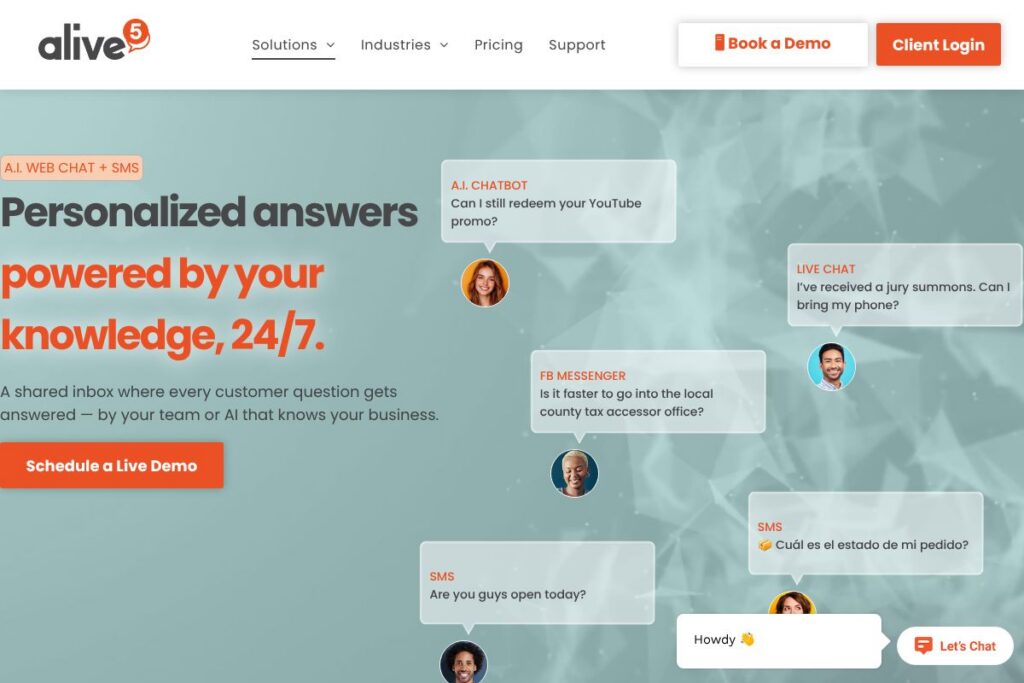
Alive5 provides AI chatbots for customer service that respond using only the content you specify, such as website pages, FAQs, and uploaded documents. The platform is built to reduce routine ticket volume by answering common questions instantly across web chat, SMS, and social messaging while routing higher-value or complex conversations to human agents.
Compared to Intercom, which combines a broader customer messaging suite with built-in CRM tools, Alive5 emphasizes private, source-restricted answers and document ingestion for high-accuracy replies. Against Drift, Alive5 focuses less on conversational marketing and more on accuracy and data privacy for sensitive sectors like government and higher education. Versus Ada, Alive5 offers similar automation but highlights team inbox workflows and explicit citation links back to the source content.
All of this makes Alive5 particularly useful for organizations that need reliable, auditable answers from their own content rather than probabilistic responses from general-purpose models. It is a fit for enterprise support teams in sports organizations, government agencies, universities, and retail operations that must keep data private and answers closely aligned with official information.
How Alive5 Works
Alive5 ingests documents, public website URLs, and FAQ pages that you designate, then builds retrieval layers so the AI replies strictly from those sources. The system can be configured to attach citation links to each response so agents or customers can see where an answer originated.
In practice, a support workflow looks like this: a customer opens the website chat or messages via SMS, the bot attempts to resolve the inquiry using the indexed content, and if the question requires a human touch the platform escalates the conversation to the team inbox with context and source links. Integrations exchange metadata and conversation history with your CRM to update records or create tickets automatically.
Alive5 features
The platform centers on private, source-driven conversational AI plus multi-channel delivery and team collaboration tools. Core capabilities include website and document ingestion, citation-based answers, follow-up question handling for personalization, a shared team inbox, and CRM integrations. These elements aim to increase first-contact resolution while preserving auditability and data control.
Key functionality includes:
Private, source-restricted AI
The chatbot replies only from URLs and documents you specify, preventing the model from fabricating answers outside your knowledge base. This approach reduces hallucinations and makes responses easier to verify during audits or compliance reviews.
Source citations in replies
Every answer can include citation links back to the exact page or document used, giving customers and agents clear evidence for the response and enabling quick follow-up. Citations help support teams correct or expand the knowledge base when gaps appear.
Document and PDF ingestion
You can upload PDFs, pricing tables, schedules, and internal documents so the AI extracts structured answers from them. This is useful for handling product, policy, and scheduling questions that are otherwise hard to encode in simple FAQ systems.
Multi-channel support
The system supports live web chat, SMS, and social messaging channels so you can meet customers where they already communicate. Channel support ensures a consistent knowledge-backed experience across phone-less and mobile-first interactions.
Follow-up questioning and personalization
When a question is ambiguous or requires context, the AI asks targeted follow-ups to narrow the user’s intent and deliver a more personalized answer. That reduces back-and-forth and increases the chance of resolving requests without human handoff.
Team inbox and collaboration
Conversations that require human attention are routed to a shared inbox accessible via web and mobile, with role-based access and assignment controls. Agents receive full context, prior bot attempts, and source links to handle escalations faster.
CRM and platform integrations
The platform can push conversation data, create tickets, and synchronize customer records with major CRMs so your support workflows remain consolidated. Integrations enable automated ticket creation, contact enrichment, and post-conversation analytics.
Analytics and success metrics
Built-in reporting measures metrics such as AI answer rate, escalation frequency, and customer satisfaction so you can track ROI and identify knowledge gaps. These analytics help prioritize documentation updates and training for human agents.
With this feature set, the biggest benefit is accurate, auditable automation that reduces routine volume while preserving clear provenance for every answer. That combination is particularly valuable where regulatory or institutional accuracy is required.
Alive5 pricing
Alive5 uses a custom, enterprise-focused pricing model tailored to organization size, channel volume, and integration needs. For up-to-date pricing, deployment options, and to request a tailored quote, see Alive5’s contact and demo options.
Alive5 Use Cases
Alive5 is commonly deployed to handle high volumes of routine customer questions such as ticketing and scheduling for sports organizations, admissions and policy questions for higher education, citizen services for government agencies, and product or order inquiries for retail. The source-restricted model makes it suitable where accurate, auditable answers matter most.
Operationally, teams use Alive5 to reduce after-hours load by providing 24/7 responses, to maintain consistent answers across channels, and to lower training overhead since the AI relies on documented content rather than extensive agent onboarding. It is ideal for support teams that need a predictable, privacy-first automation layer.
Pros and Cons of Alive5
Pros
- Source-restricted answers: The AI replies from specified URLs and uploaded documents, which reduces hallucinations and improves traceability. This is valuable in regulated environments and when consistent messaging is essential.
- Data privacy controls: Your data is not used to train external models, helping organizations with strict data handling policies maintain compliance. Teams can enforce which content the bot may access.
- Multi-channel and inbox routing: The platform supports web chat, SMS, and social messaging while routing complex issues to a shared team inbox for human follow-up. This unifies customer conversations across channels.
- Document ingestion and citations: Ability to upload PDFs and other assets allows the bot to answer complex, document-based questions with source links for verification.
Cons
- Custom pricing model: Enterprise-focused pricing means no simple public price list, which can slow initial evaluation for smaller teams or startups. Prospective buyers will typically need a demo and quote.
- Implementation effort: Building an accurate knowledge base requires deliberate curation of documents and URLs; poorly organized or incomplete content will reduce AI answer rates. Teams may need time to optimize sources.
- Potential integration complexity: Deep CRM or legacy system integrations can require technical setup and mapping work, especially in organizations with bespoke workflows.
Does Alive5 Offer a Free Trial?
Alive5 offers demos and custom trial options rather than a standardized free plan. Organizations typically request a demo or pilot to validate the AI against their own content; contact the team to arrange a pilot that fits your use case.
Alive5 API and Integrations
Alive5 provides integrations with CRMs and messaging platforms to sync conversations and create tickets, and it exposes developer hooks for automation and routing. For detailed developer capabilities and integration options, consult the platform’s developer documentation and integration guide.
If you need specific connectors, the platform commonly integrates with enterprise CRMs, analytics tools, and messaging gateways to support full production deployments and bi-directional data flows.
10 Alive5 alternatives
Paid alternatives to Alive5
- Intercom – Customer messaging platform with chat, bots, and a broader suite for sales and support automation. Well suited for B2B SaaS teams that want tight product messaging integration.
- Drift – Conversational marketing and sales-focused chatbot solution that emphasizes lead qualification and routing. Best for organizations focused on real-time sales engagement.
- Ada – AI customer service automation tool with a no-code builder and multilingual support. Good for teams that want fast time to value with less technical setup.
- Zendesk – Offers chat, support ticketing, and bot-assisted responses as part of a mature customer service suite. Strong choice when combining bot automation with established ticketing workflows.
- Freshdesk – Includes AI chatbots, ticketing, and multi-channel support with an emphasis on SMB to mid-market customers. Balances ease of use with essential ticketing features.
- HubSpot Service Hub – Combines chatbots with a CRM-first approach for teams already using HubSpot for marketing or sales. Offers a unified customer record across tools.
- LivePerson – Enterprise-grade conversational platform that supports AI, messaging, and voice across channels. Suited for high-scale deployments with complex routing needs.
Open source alternatives to Alive5
- Rasa – Open source conversational AI framework for building highly customized chatbots with on-premises deployment options. Favored by teams that require full control over models and data.
- Botpress – Modular open source bot-building platform with a visual flow editor and support for on-prem hosting. Useful for developers who want a self-hosted solution.
- Rocket.Chat – Open source messaging platform with bot integrations; can be extended to serve as a customer messaging channel with custom bots.
- Chatwoot – Open source customer engagement platform with multi-channel inbox and bot integration options. Good for teams that prefer self-hosted customer support infrastructure.
Frequently asked questions about Alive5
What is Alive5 used for?
Alive5 is used to automate customer and citizen inquiries using AI that responds from your specified content. Organizations deploy it to provide 24/7 answers, reduce support volume, and maintain accurate, auditable responses.
Does Alive5 integrate with CRMs like Salesforce?
Yes, Alive5 integrates with major CRMs to sync conversation data and create tickets. Integrations allow the platform to enrich records, automate ticket creation, and keep support workflows consolidated.
How accurate are Alive5 responses?
Accuracy depends on the quality and coverage of the content you provide to the system. When the knowledge base is comprehensive and well-structured, Alive5 reports high AI answer rates and provides citations for verification.
Can Alive5 handle confidential or regulated data?
Alive5 supports privacy controls that restrict responses to specified sources and prevents sharing your data with external LLM training pipelines. That makes it suitable for sectors with strict data handling requirements.
Does Alive5 offer a developer API for automation?
Yes, Alive5 exposes integration hooks and developer endpoints to automate routing, CRM updates, and analytics exports. Refer to the platform’s developer documentation for endpoint details and webhook examples.
Final Verdict: Alive5
Alive5 stands out for its source-restricted approach to conversational AI and its emphasis on data privacy and citation-based answers. That focus makes it a strong option for institutions and enterprises that cannot tolerate unverified or invented responses and that require clear provenance for each reply.
Compared with Intercom, which publishes tiered plans and bundles messaging with sales and marketing features, Alive5 follows a custom pricing model oriented toward enterprise pilots and integrations. If you need a privacy-first, document-driven chatbot and are prepared to run a pilot or custom deployment, Alive5 is a solid choice; if you prefer an out-of-the-box messaging platform with transparent tiered pricing, Intercom may be simpler to evaluate.