Altametrics: An Overview
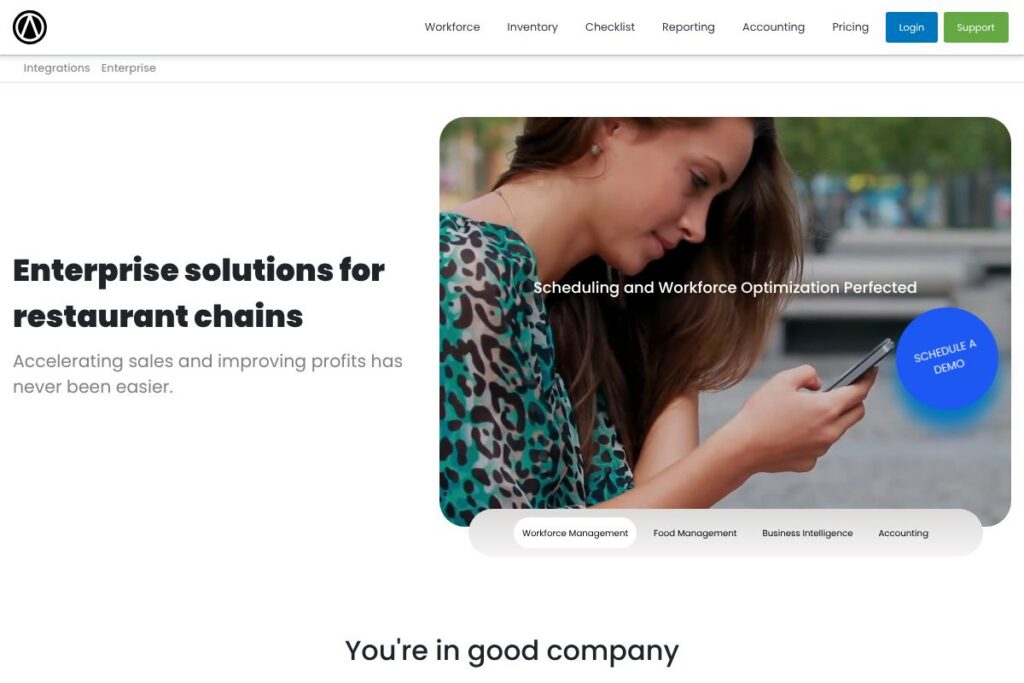
Altametrics provides a unified platform for managing day-to-day restaurant operations, including POS, inventory, supply chain, and workforce scheduling. The product targets multi-unit restaurants and convenience store chains that need centralized control over operations, ordering, and labor costs.
Compared with competitors, Toast emphasizes an integrated payment and POS bundle focused on independent and mid-sized restaurants, while Square for Restaurants targets smaller operations with simple hardware and transparent subscription tiers. Revel Systems competes on enterprise-grade POS and custom integrations; Altametrics differentiates by coupling POS with deeper inventory and supply chain controls geared to higher-volume, multi-site operations.
Altametrics is best suited for operators who need inventory-driven purchasing, labor forecasting tied to sales, and a POS that reports back into supply and payroll workflows. The platform’s strength is the alignment of purchasing, receiving, and labor with sales data to reduce waste and control costs across locations.
How Altametrics Works
The system links point-of-sale transactions to inventory movements so sales automatically decrement stock and trigger reorder workflows. Managers can set par levels and automated purchase orders, which flow to suppliers or a central purchasing team for consolidation.
Workforce modules integrate scheduling, timekeeping, and payroll exports so labor costs reconcile to hourly sales and forecasted demand. Implementations typically begin with POS and inventory sync, then add supplier routing and labor forecasting as operators validate the data flows.
Altametrics features
Altametrics centers around POS, inventory, purchasing, and workforce modules with reporting that ties those areas together. Recent product directions emphasize tighter supplier workflows, better mobile receiving, and role-based dashboards for operations and finance teams.
Point of Sale
The POS handles order entry, payment processing, and menu management with support for modifiers, combos, and multi-location price controls. It benefits teams by keeping menu changes synchronized across sites and feeding sales data back to inventory and labor modules.
Inventory Management
Inventory tracks ingredient-level usage, supports cycle counts, and converts recipes into unit-level purchasing quantities. This reduces manual counting, improves usage accuracy, and helps operations plan orders based on actual consumption.
Supply Chain and Purchasing
Purchase workflows allow centralized or decentralized ordering, approval routing, and electronic purchase order transmission to suppliers. The feature helps consolidate purchases across locations to capture volume pricing and reduce supplier fragmentation.
Workforce Management
Scheduling and timekeeping connect labor hours to sales forecasts, enabling managers to create schedules based on projected demand. The module exports to payroll systems and reduces overstaffing through demand-driven scheduling.
Receiving and Mobile Tools
Mobile receiving and invoice-matching capabilities streamline the receiving process and ensure delivered goods match purchase orders. This minimizes discrepancies between received inventory and accounting records.
Reporting and Analytics
Built-in reports cover cost of goods sold, vendor performance, labor variance, and margin analysis across locations. These reports support operations and finance teams when evaluating promotions, menu changes, or supplier negotiations.
Integrations
Altametrics connects with payment processors, accounting systems, and third-party labor platforms to create an end-to-end flow from sale to ledger. Integration options make it easier to export payroll and accounting data to systems like QuickBooks or other ERP tools.
Altametrics’ biggest benefit is the way sales, inventory, purchasing, and labor data are tied together, which helps multi-unit operators control costs and reduce waste across locations.
Altametrics pricing
Altametrics uses a custom enterprise pricing model that is tailored to the number of locations, modules required, and deployment needs. Pricing is usually structured around module selection and implementation scope rather than fixed public tiers.
For a detailed quote and the best-fit package, review Altametrics’ enterprise options or request a demo via Altametrics’ contact and demo page. This helps operators get a proposal that reflects their site count, integration needs, and support requirements.
What is Altametrics Used For?
Operators use Altametrics to align purchasing, inventory, and labor with real sales data so costs are visible and controllable across all locations. Typical use cases include automated purchase ordering, per-location par management, and consolidated supplier reporting.
The platform is also used to reduce inventory shrinkage, improve invoice reconciliation, and create schedules tied to forecasted demand. It is especially useful for restaurant groups and convenience store chains that manage multiple outlets and centralized procurement.
Pros and cons of Altametrics
Pros
- Integrated inventory to POS: Tightly links sales to ingredient-level inventory so usage, waste, and ordering are more accurate and auditable.
- Centralized purchasing workflows: Supports consolidated buying and approval routing, which helps multi-unit operators negotiate better pricing and reduce supplier fragmentation.
- Labor and scheduling tied to sales: Forecast-driven scheduling reduces labor waste and simplifies payroll exports to downstream accounting systems.
- Enterprise reporting: Multi-site analytics provide visibility into vendor performance, COGS, and margin by location, aiding financial planning.
Cons
- Custom deployment required: Implementation commonly involves configuration and data mapping, which can extend time to value compared to out-of-the-box POS solutions.
- Enterprise focus may exceed small operations’ needs: Smaller independent restaurants may find the platform more than they require in terms of functionality and cost.
- Potential integration work: Connecting with legacy accounting or HR systems may require professional services to ensure a smooth data flow.
Is Altametrics Free to Try?
Altametrics typically offers demos and trial or pilot options for prospective enterprise customers. These are arranged through sales and often include configuration of a subset of locations to validate workflows; contact the team through Altametrics’ contact and demo page to request trial or pilot details.
Altametrics API and Integrations
Altametrics provides integration options and developer endpoints for exchanging sales, inventory, and labor data with external systems. Review Altametrics’ integration resources to see supported accounting and payroll connectors.
Common integrations include payment processors, accounting platforms like QuickBooks, and third-party labor systems, which let operators move data from Altametrics into finance and HR workflows. Use the integrations documentation to plan data mappings and test environments.
10 Altametrics alternatives
Paid alternatives to Altametrics
- Toast — An all-in-one POS and payments platform with add-on inventory and payroll features for restaurants; strong support for front-of-house and online ordering. See Toast’s pricing page for subscription and hardware options.
- Square for Restaurants — A modular POS that scales from single-location cafes to multi-register restaurants with simple subscription tiers and integrated payments.
- Lightspeed — POS with inventory, multi-location stock management, and reporting that supports restaurants and retail chains.
- Revel Systems — Enterprise-focused POS with extensive customization, offline mode, and API integrations for complex operations.
- TouchBistro — iPad-native POS built for restaurants with table management, menu controls, and inventory add-ons.
- Upserve — Restaurant management platform with POS, analytics, and loyalty features aimed at improving operations and guest experience.
- Clover — Flexible POS hardware and app ecosystem suited to small to mid-size restaurants with a wide partner app marketplace.
Open source alternatives to Altametrics
- Odoo POS — Part of a larger open-source ERP that can handle POS, inventory, and purchasing with modular apps that can be self-hosted or run in the cloud.
- Unicenta — Open-source POS focused on retail and hospitality that supports multi-terminal setups and inventory tracking.
- Floreant POS — Java-based open-source restaurant POS with table management and kitchen printing suitable for small restaurants.
- Chromis POS — Forked from Unicenta, provides multi-language support and basic inventory features for self-hosted environments.
- SambaPOS — A community-driven POS with a flexible rules engine and inventory modules, often used in smaller hospitality environments.
Frequently asked questions about Altametrics
What is Altametrics all-in-one restaurant management software?
Altametrics is a platform that combines POS, inventory, purchasing, and workforce management into one system. It connects sales to inventory consumption and purchasing so operators can manage costs across multiple locations.
Can Altametrics integrate with my accounting system?
Yes, Altametrics offers integrations with accounting and payroll systems. Typical connections include exports and API-based integrations for systems like QuickBooks and other common finance platforms.
Does Altametrics support offline POS operations?
Altametrics supports offline transaction capture for its POS functionality in many deployments. Offline mode ensures sales continue during network interruptions and then reconcile back to central systems when connectivity returns.
How does Altametrics help control inventory costs?
Altametrics ties POS sales to ingredient-level inventory and automated purchasing. That linkage enables accurate usage reporting, cycle counts, and reorder triggers that reduce overordering and waste.
Is Altametrics suitable for single-location restaurants?
Altametrics is designed primarily for multi-unit and enterprise operators, but it can be configured for single locations that require advanced inventory and purchasing controls. Smaller sites should evaluate whether the platform’s capabilities align with their operational needs and budget.
Final verdict: Altametrics
Altametrics stands out for operators who need ERP-level control over purchasing, inventory, and labor tied directly to POS sales. Its strength is the end-to-end flow from menu item sale through inventory decrement, supplier ordering, and labor reconciliation, which helps multi-location operators reduce waste and align costs with revenue.
Compared with Toast, which offers clear subscription tiers and an integrated payments stack tailored to small and mid-sized restaurants, Altametrics leans toward custom enterprise deployments. For organizations that require centralized purchasing, advanced inventory accuracy, and multi-site reporting, Altametrics provides deeper operational controls, while operators seeking transparent per-terminal pricing and bundled payments may prefer Toast. For deployment and exact pricing, contact Altametrics via their contact and demo page to request a tailored proposal.