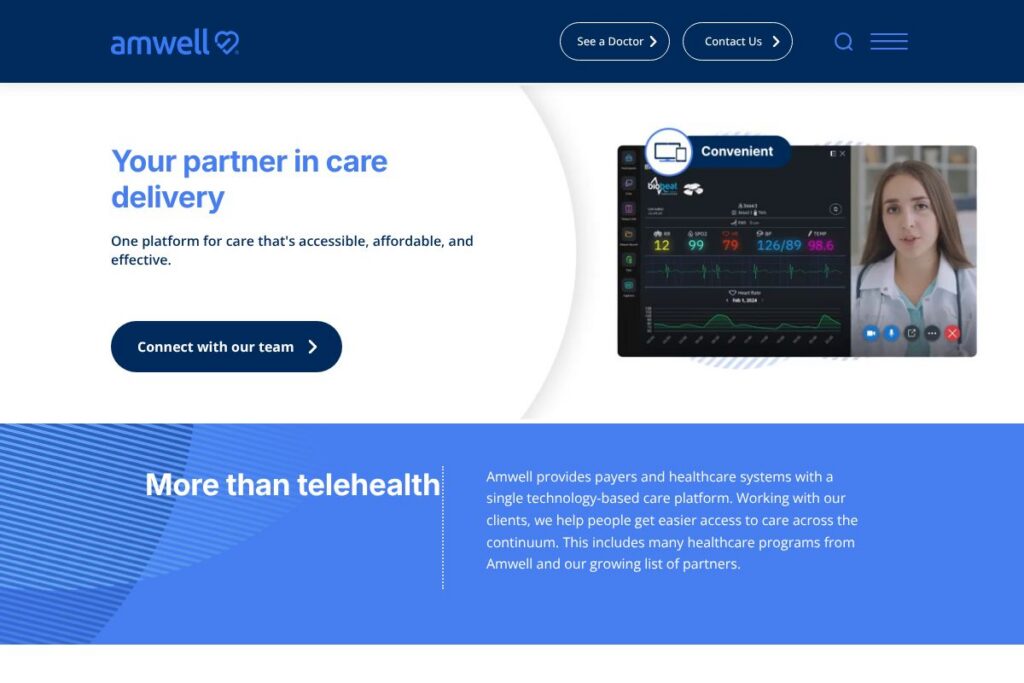
What is Amwell
Amwell is a technology-based care platform for payers and healthcare systems that centralizes virtual care delivery, provider networks, and digital care programs. The platform supports synchronous and asynchronous visits, virtual primary care, behavioral health, and automated follow-up programs while connecting to existing electronic health records and enterprise workflows.
Compared with competitors, Amwell focuses on enterprise deployments and payer-health system partnerships rather than direct-to-consumer branding alone. For example, Teladoc provides a strong consumer-facing virtual care service with national scale, but Amwell emphasizes integration with health systems and payer programs. Large EHR vendors such as Epic and Oracle Cerner provide embedded telehealth capabilities; Amwell competes by offering a neutral, platform-level option that integrates across multiple EHRs and partner ecosystems.
Amwell performs well when organizations need an end-to-end, technology-enabled care strategy that spans on-demand visits, virtual primary care, and automated digital care programs. It is well suited for payers, integrated delivery networks, and large health systems that require customizable workflows, broad provider networks, and enterprise-grade integrations. See Amwell’s solutions page for an overview of offerings and program examples (https://amwell.com/solutions).
How Amwell Works
Amwell runs as a platform that connects member or patient access points, clinician workflows, and partner services through a configurable layer. Patients access care via web or mobile interfaces, get routed to in-network or Amwell Medical Group clinicians, and receive follow-up through automated care programs where applicable.
For health systems and payers, Amwell integrates with electronic health records to surface virtual visits inside clinician workflows, synchronizes documentation, and supports single sign-on and scheduling. Implementation commonly starts with pilot programs such as virtual urgent care or behavioral health, expands to virtual primary care, and then layers automated remote monitoring and care-gap closure tools.
Workflows include on-demand visits routed to the nearest available clinician, scheduled virtual primary care visits with care-team handoffs, and automated post-discharge monitoring that triggers alerts to care managers. Organizations typically run iterative pilots, collect utilization and outcomes data, and scale the modules that deliver measurable clinical or operational value.
What does Amwell do?
Amwell’s platform is organized around virtual visit delivery, provider network services, and digital care programs that extend care beyond the visit. Core capabilities include a HIPAA-ready telehealth platform, the Amwell Medical Group network, Automated Care programs for monitoring and transitions, and EHR integrations that keep clinician workflows aligned. Recent emphasis is on combining clinician-led care with digital automation to reduce readmissions and close care gaps.
The platform includes several powerful capabilities worth highlighting:
Virtual visit platform
The core telehealth environment supports video and audio visits from web and mobile clients, waiting-room workflows, content sharing, and multi-participant sessions for group therapy or family involvement. This provides a consistent, clinician-friendly interface that integrates scheduling, documentation, and billing workflows to reduce friction for providers.
Amwell Medical Group
Amwell Medical Group provides an on-network roster of clinicians that clients can route to when they need coverage or capacity beyond their internal staff. This offering helps payers and health systems expand access quickly while maintaining clinical oversight and consistency in protocols.
Automated Care programs
Automated Care programs use digital monitoring, alerts, and patient education to support transitions of care, chronic disease management, and post-discharge follow-up. These programs are designed to reduce readmissions, improve engagement for high-risk populations, and surface actionable alerts for care teams.
EHR integration and single sign-on
Amwell integrates with major electronic health records to allow clinicians to launch virtual visits from the EHR, sync encounter documentation, and reduce duplicate data entry. Single sign-on and scheduling synchronization reduce administrative overhead for clinical teams.
Analytics and population health tools
The platform collects utilization and outcome data and presents dashboards for clinical and operational teams to monitor program performance. Analytics support targeted outreach, readmission reduction, and measurement of digital program impact on cost and outcomes.
Provider and partner network
Amwell supports partnerships with national payers, regional health systems, and third-party service providers to create multi-channel access models. The network architecture lets organizations mix internal clinicians with Amwell Medical Group providers and partner services depending on use case and capacity needs.
With these capabilities, Amwell helps organizations scale virtual care while preserving integration with core clinical systems. The biggest benefit is the combination of a configurable telehealth platform, provider network, and automated digital programs that together address access, continuity, and follow-up care.
Amwell pricing
Amwell uses a custom enterprise pricing model tailored to payer and health system deployments, rather than publicly listed consumer subscription tiers. Pricing typically depends on scope, number of members or covered lives, level of integration with electronic health records, and which modules or provider network services are included. For details on enterprise pricing and commercial options, contact Amwell through Amwell’s enterprise contact page (https://amwell.com/contact) or review their solutions and deployment options.
What is Amwell Used For?
Amwell is commonly used by payers to extend covered benefits into virtual care, by health systems to provide on-demand and scheduled telehealth, and by integrated delivery networks to add digital programs that reduce readmissions. Typical use cases include urgent care triage, virtual primary care, behavioral health, and specialist consultations when geographic access is limited.
The platform is also used for population health and care management tasks: automated monitoring for chronic disease, post-discharge follow-up to reduce readmissions, and analytics-driven outreach for care-gap closure. Organizations that need a unified technology layer to run multiple digital care programs find Amwell useful for orchestrating workflows across partners and internal teams.
Pros and Cons of Amwell
Pros
- Enterprise-grade integrations: Amwell offers EHR and identity integrations that reduce friction for clinicians and allow virtual visits to be part of existing workflows.
- Comprehensive provider network: Access to the Amwell Medical Group and partner clinicians helps organizations scale capacity without long hiring timelines.
- Digital care programs: Automated Care and monitoring modules provide structured follow-up and can help reduce readmissions and improve outcomes for high-risk patients.
- Flexible deployment models: Clients can run a mix of internal clinicians, Amwell Medical Group clinicians, and third-party partners depending on use-case requirements.
Cons
- Custom pricing and procurement: Enterprise-focused pricing and contract processes may be lengthy for smaller organizations that want faster onboarding.
- Implementation complexity: Integrating with multiple EHRs and customizing workflows requires planning and resources from both IT and clinical teams.
- Vendor coordination: Large health systems may need to coordinate Amwell with existing telehealth tools and EHR vendor roadmaps, which adds project management overhead.
- Feature overlap with EHRs: Organizations using EHRs with built-in telehealth may find feature overlap and need to decide whether to consolidate or run parallel systems.
Does Amwell Offer a Free Trial?
Amwell offers demos and enterprise pilots rather than a public free plan. Prospective clients typically evaluate Amwell through product demonstrations, proof-of-concept pilots, or time-limited enterprise engagements that validate clinical workflows and integration before a broader rollout.
Amwell API and Integrations
Amwell provides APIs and integration options for connecting virtual visits, scheduling, and documentation with existing clinical systems. The company documents integration approaches and deployment models for enterprise partners; see Amwell’s solutions and integration information for developer and integration guidance (https://amwell.com/solutions).
Key integrations include major electronic health records such as Epic and Oracle Cerner, single sign-on providers, and analytics platforms. Many clients use a mix of native EHR connectors and Amwell APIs to automate scheduling, populate clinical notes, and surface visit outcomes to population health teams.
10 Amwell alternatives
Paid alternatives to Amwell
- Teladoc — A national virtual care provider that offers direct-to-consumer services and enterprise solutions for employers and health plans, with a strong brand in consumer telemedicine.
- MDLive — Telehealth platform focused on urgent care, behavioral health, and chronic condition support, often used by health plans and employer programs.
- Doctor On Demand — Virtual care provider specializing in urgent care, mental health, and chronic care management with both consumer and enterprise offerings.
- Zoom for Healthcare — A secure video platform adapted for clinical workflows, often used by health systems to enable telehealth visits embedded in their own portals.
- Epic Telehealth — Telehealth capabilities embedded within Epic’s EHR that allow health systems already on Epic to run virtual visits inside the patient record.
- Cerner Virtual Health — Telehealth tools provided by Oracle Cerner that integrate with Cerner’s EHR and are oriented to health system workflows.
Open source alternatives to Amwell
- OpenEMR — An open source electronic health record that can be extended with telehealth integrations and custom modules for virtual care workflows.
- Jitsi Meet — An open source video conferencing project that organizations can deploy and secure for telehealth visits with appropriate HIPAA controls.
- BigBlueButton — An open source web conferencing system geared toward real-time collaboration that can be adapted for group telehealth sessions and education.
- OpenMRS — An open source medical record platform that can serve as the clinical backend for telemedicine deployments in resource-constrained settings.
Frequently asked questions about Amwell
What is Amwell used for?
Amwell is used to deliver virtual care, coordinate provider networks, and run digital care programs for payers and health systems. Common uses include urgent care, virtual primary care, behavioral health, and automated post-discharge monitoring.
Does Amwell integrate with Epic or Cerner?
Yes, Amwell integrates with major EHRs such as Epic and Oracle Cerner. Integrations support launching visits from the EHR, syncing documentation, and maintaining clinician workflows.
How does Amwell support payers?
Amwell provides payer-focused solutions including provider networks, member access portals, and automated care programs. These capabilities let payers extend covered virtual benefits and run targeted outreach and monitoring programs.
Can Amwell support behavioral health programs?
Yes, Amwell supports behavioral health with scheduled and group therapy workflows and integrations that enable clinicians to run sessions from web or mobile. The platform includes features like chat, group view, and patient-facing access without complex downloads.
Is Amwell suitable for small health systems?
Amwell is designed for enterprise and regional deployments but can be configured for smaller health systems through scoped pilots and modular implementations. Many clients begin with a pilot for urgent care or behavioral health before expanding platform usage.
Final verdict: Amwell
Amwell is a mature, enterprise-oriented virtual care platform that combines a telehealth infrastructure, a provider network, and automated digital care programs to help payers and health systems scale virtual services. Its strengths lie in EHR integrations, configurable deployment models, and a clinician-accessible interface that supports both on-demand and longitudinal care.
Compared with a competitor like Teladoc, Amwell centers on enterprise integrations and payer-health system partnerships, while Teladoc places more emphasis on consumer-facing services and broad direct-to-consumer reach. Pricing for Amwell is handled through tailored enterprise contracts, whereas some competitors provide more transparent consumer pricing; for enterprise pricing discussions, contact Amwell via their enterprise contact page (https://amwell.com/contact). Overall, Amwell is a strong choice for organizations that need a configurable platform to run multiple virtual care programs across partners and internal teams.