AspenTech: An Overview
AspenTech develops enterprise-grade software for process industries, combining process modeling, AI-driven optimization, asset performance management, and digital grid capabilities. The platform is used by chemical, oil and gas, power generation, utilities, and other heavy industries to reduce operating costs, improve reliability, and support sustainability goals across the asset lifecycle.
Compared with competitors such as AVEVA, Emerson, and Schneider Electric, AspenTech emphasizes physics-based process modeling and adaptive AI for continuous optimization. AVEVA is often chosen for engineering data management and visualization, Emerson for control systems and integrated automation, and Schneider Electric for electrical distribution and energy management. AspenTech’s strength is the integration of simulation, AI, and asset performance workflows that link engineering decisions to run-time operations.
All of this makes AspenTech well suited for large industrial organizations that need model-driven optimization, predictive asset management, and integrated grid or plant-level automation. For teams focused on continuous process improvement and long-term lifecycle value, AspenTech provides tools to close the loop between engineering, operations, and maintenance.
How AspenTech Works
AspenTech unifies engineering models, time-series operational data, and machine learning into applications that run on-premises or in the cloud. Engineers create process models and digital twins, while operations consume real-time optimizers and control strategies that adapt to changing feedstocks, equipment conditions, and market constraints.
A typical workflow starts with data ingestion from historians, DCS/SCADA, and business systems; models are calibrated against historical data; AI and model-predictive controllers generate control actions or maintenance alerts; and visualization surfaces actionable guidance to engineers and operators. Deployment often includes continuous monitoring loops so models and controllers update as conditions evolve.
AspenTech features
AspenTech’s product set spans process control, asset performance management, grid operations, and data integration. Core capabilities include advanced process control and model predictive control, AI/ML-driven optimization, enterprise asset performance management, and a real-time process historian with visualization. Recent investments focus on distributed energy resource optimization and automation features to support the energy transition; see AspenTech’s product overviews for more detail.
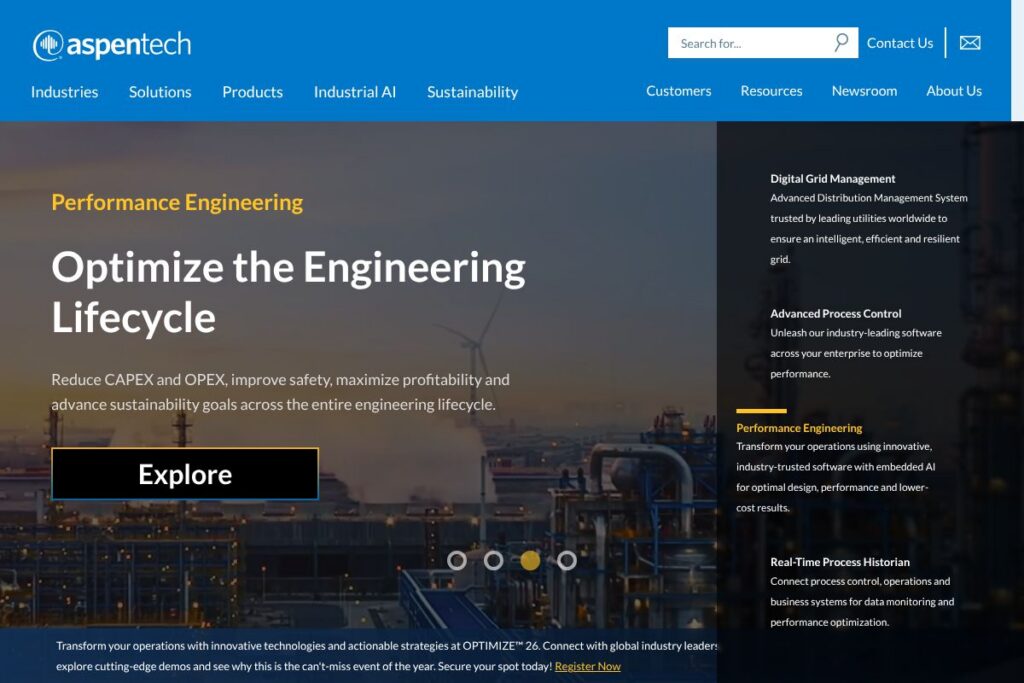
Digital Grid Management
This capability provides outage management, distributed energy resource (DER) optimization, and automation tools designed for distribution utilities. It helps operators coordinate DERs, manage peak load and voltage, and automate restoration workflows, which supports integrating intermittent generation and new load patterns.
Advanced Process Control
Model predictive control and adaptive optimization continuously tune setpoints and constraints to increase throughput, reduce variability, and lower energy use. These controls operate in closed-loop with DCS systems and are designed to maintain safe, efficient production under changing process conditions.
Performance Engineering
Engineering lifecycle tools link design-time simulations to operational performance, enabling capital project optimization, safer designs, and lower CAPEX and OPEX through better first-time commissioning and ongoing performance validation. This reduces rework and aligns engineering assumptions with real-world operations.
Real-Time Process Historian
The historian collects time-series data from instruments, PLCs, and control systems, then makes that data available for analytics, dashboards, and model calibration. Integrated visualization and analytics accelerate root-cause analysis and decision making during incidents and routine performance reviews.
Asset Performance Management (APM)
APM combines condition monitoring, predictive analytics, and risk-based maintenance planning to extend equipment life and reduce unplanned downtime. It uses machine learning models trained on equipment signals and failure modes to prioritize inspections and spare parts.
AI and Machine Learning
AI-driven algorithms support anomaly detection, predictive recommendations, and schedule optimization, with tools to operationalize models and track their performance. The platform emphasizes explainable models that can be traced back to process physics for operator confidence.
Integration and Data Management
Connectors and adapters ingest data from DCS, SCADA, historians, and business systems; data pipelines and semantic models standardize information for analytics and digital twins. This lowers integration work and supports multi-system reporting and KPIs across sites.
With these capabilities, AspenTech helps companies convert engineering knowledge and plant data into repeatable operational gains, improving throughput, reliability, and energy efficiency across assets.
AspenTech pricing
AspenTech follows an enterprise pricing model tailored to deployment scope, modules required, and support options rather than fixed public list prices. Organizations typically receive custom quotes based on licensed modules, concurrent users or controllers, cloud versus on-premises deployment, and service levels.
Enterprise
Enterprise – Custom pricing (Licenses for process optimization, APM, digital grid, historian, professional services, and technical support). For detailed licensing models and to request a tailored proposal, consult AspenTech’s enterprise pricing and licensing information or contact their sales team through the vendor’s contact channels.
What is AspenTech Used For?
AspenTech is used to optimize continuous and batch process operations, plan and prioritize maintenance, and manage distribution grid complexity driven by DERs and electrification. Typical outcomes include higher yield, lower energy consumption, fewer unplanned outages, and decisions informed by combined engineering and operational models.
Ideal users include process engineers, operations managers, reliability and maintenance teams, grid operators, and digital transformation leads at large industrial and utility companies. Teams that need to connect engineering simulations with run-time control or to implement predictive maintenance strategies will find AspenTech particularly relevant.
Pros and Cons of AspenTech
Pros
- Model-driven optimization: AspenTech integrates physics-based process models and digital twins that enable optimization grounded in engineering principles, improving trust and explainability for operators.
- Comprehensive APM: The platform combines condition monitoring, failure-mode analytics, and maintenance planning to reduce unplanned downtime and extend equipment life across distributed assets.
- Grid and DER support: Digital grid management tools provide specialized capabilities for outage management, DER orchestration, and distribution automation that address modern utility challenges.
- Scalable integrations: Connectors for historians, DCS/SCADA, and enterprise systems reduce integration overhead and let teams standardize data models across sites.
Cons
- Enterprise focus: AspenTech is designed for large organizations, so smaller teams may find implementation complexity and total cost of ownership higher than lighter-weight alternatives.
- Custom deployment needs: Because solutions are often configured to site specifics, implementations can require professional services and longer lead times to realize full value.
- Steeper learning curve: Advanced modeling and optimization features require skilled engineers and operations specialists to configure and maintain models effectively.
Does AspenTech Offer a Free Trial?
AspenTech offers custom evaluations, demos, and proof-of-value engagements rather than a public free plan. Prospective customers can request product demonstrations or site-specific pilot projects through AspenTech’s contact page for evaluations, which is the typical route to test functionality in a representative environment.
AspenTech API and Integrations
AspenTech provides APIs, SDKs, and connectors for common industrial protocols and enterprise systems so developers can integrate models and analytics into existing workflows. The vendor documents integration options and supported connectors on its product and solutions pages, which explain available endpoints and adapters.
Key integrations typically include DCS/SCADA systems, time-series historians, MES/ERP, and cloud platforms to support data ingestion and actioning; for specifics see AspenTech’s integration capabilities and solution pages. APM and historian modules also include native and third-party connector support to accelerate deployments.
10 AspenTech alternatives
Paid alternatives to AspenTech
- AVEVA – Engineering and industrial software suite with strengths in engineering data management, real-time visualization, and industrial information management for plant and marine sectors.
- Emerson – Offers process automation, DeltaV control systems, and advanced regulatory and model predictive control solutions tightly integrated with field instrumentation and controls engineering services.
- Schneider Electric – Focuses on energy management, electrical distribution, and automation solutions with strong offerings for utilities and energy-intensive industries.
- Honeywell – Provides distributed control systems, process safety, and operations optimization software tailored for large-scale industrial control and automation projects.
- Siemens – Broad industrial portfolio including process automation, digital twin engineering, and grid management products for utilities and manufacturing.
- OSIsoft (AVEVA PI) – Time-series data infrastructure and analytics platform used widely for historian-driven analytics and integration with optimization applications.
Open source alternatives to AspenTech
- Grafana – Open-source visualization and analytics platform that connects to multiple time-series databases for dashboards, alerting, and basic analytics across industrial telemetry.
- ScadaBR – Open-source SCADA system for smaller installations that supports integration with PLCs, data acquisition, and basic automation workflows.
- Eclipse Ditto – Open-source digital twin framework that helps model device state and relationships for IoT and industrial use cases; useful for custom twin implementations.
- OpenDSS – Open-source distribution system simulator that can help with distribution planning, DER impact studies, and grid analysis for research and utilities.
Frequently asked questions about AspenTech
What does AspenTech do for process optimization?
AspenTech provides model-based optimization and model predictive control to increase throughput, reduce variability, and lower energy consumption by operating processes closer to optimal setpoints.
Does AspenTech offer asset performance management capabilities?
Yes, AspenTech includes APM for predictive maintenance and reliability engineering. The APM tools combine condition monitoring, failure-mode analysis, and risk-based maintenance planning to prioritize work and reduce downtime.
How much does AspenTech cost for a manufacturing site?
AspenTech uses custom enterprise pricing based on modules, deployment type, and scale. Organizations should contact AspenTech sales or request a tailored quote through their contact channel to get pricing aligned to their deployment.
Can AspenTech integrate with existing historians and DCS systems?
Yes, AspenTech integrates with common historians, DCS/SCADA, MES, and ERP systems. The platform provides connectors and APIs to ingest operational data and to feed optimized setpoints or maintenance actions back into control and IT systems.
Is AspenTech available for cloud deployment?
AspenTech supports cloud, on-premises, and hybrid deployments. Deployment choices depend on customer requirements for latency, data residency, and integration with on-premises control systems; discuss options with the vendor for architecture guidance.
Final Verdict: AspenTech
AspenTech stands out for combining physics-based process modeling with AI-driven optimization and mature APM capabilities, which makes it particularly strong for process industries and utilities tackling efficiency, reliability, and the energy transition. Its digital grid management and DER orchestration add utility-focused capabilities that some industrial peers do not offer with the same depth.
Compared with AVEVA, both vendors target large enterprises but emphasize different strengths: AspenTech leans into model-based optimization and predictive maintenance workflows, while AVEVA emphasizes engineering data management and visualization. Pricing for both vendors is enterprise-level and custom; organizations should compare proposed scope, modules, and professional services when evaluating total cost of ownership and expected time to value.
For industrial teams that need to operationalize engineering models, reduce unplanned downtime, and coordinate distributed energy resources, AspenTech is a leading choice. Contact AspenTech through their enterprise contact channels to arrange demos, pilots, and pricing discussions tailored to your environment.