What is Birdeye?
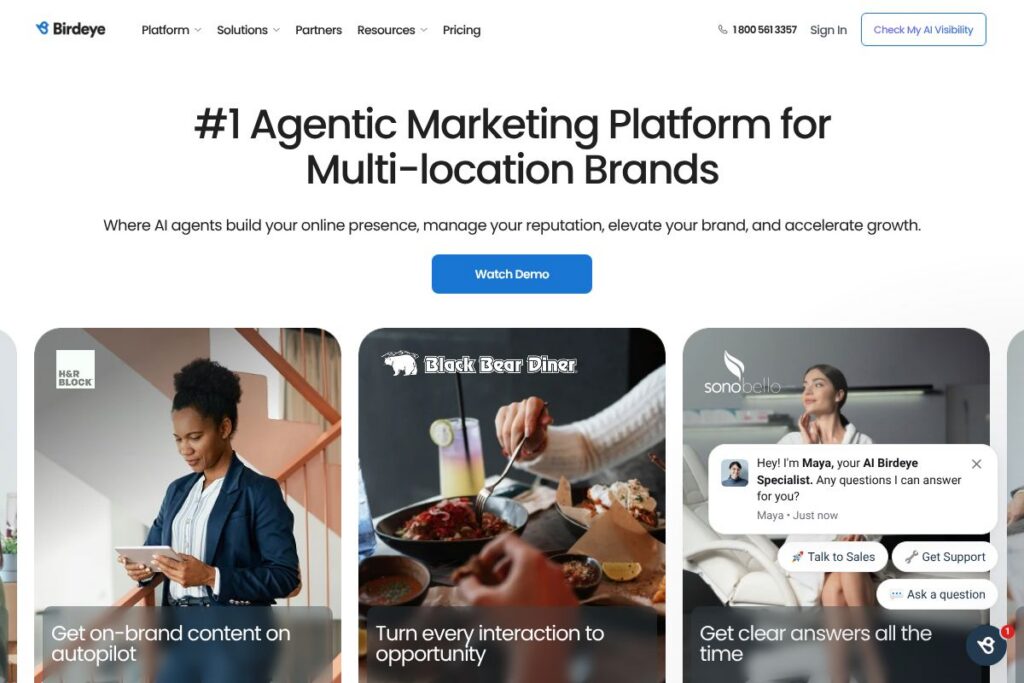
Birdeye is an enterprise platform that replaces a patchwork of local listings, review management, social publishing, and customer insights tools with a single system that deploys brand-trained AI agents. It focuses on multi-location businesses and enterprises that need centralized control over local SEO, reputation, and customer communications at scale.
Birdeye competes with tools that target local presence and reputation management. Compared with Yext, which centers on listings and knowledge graph syndication, Birdeye bundles listings with automated review workflows, social publishing, and AI-driven insights. Against Podium, which emphasizes messaging and payments for local businesses, Birdeye offers broader content publishing and performance measurement across many channels. Relative to Reputation.com, Birdeye presents a similar enterprise feature set with additional emphasis on custom AI agents and a location-level performance metric.
All of this makes Birdeye well suited for brands with many locations that need automated, consistent customer-facing communications. It does particularly well at local search optimization, continuous reputation management, and scaling brand-aligned content across channels, making it suitable for healthcare systems, retail chains, real estate portfolios, and other multi-site organizations.
How Birdeye Works
Birdeye connects to your customer data sources and channel endpoints, consolidating listings, reviews, social accounts, and messaging into a single dashboard. Once data is unified, you can configure BirdAI agents that are trained on your brand voice and industry context to run tasks like requesting reviews, responding to feedback, and publishing content.
Typical workflows include automated review solicitation after a transaction, continual listings monitoring and fixes to improve local search ranking, and scheduled social publishing across locations with brand guardrails. Teams set rules and templates, then Birdeye’s AI agents execute at scale while surfacing exceptions to human operators for review.
Birdeye features
Birdeye is organized around location-based reputation, local SEO, AI-driven automation, and unified customer communications. Core capabilities include BirdAI agents, dynamic listing management, review automation and response, social and messaging publishing, and location-level reporting with the Birdeye Score. The platform emphasizes enterprise integrations and industry-specific templates for sectors such as healthcare, finance, retail, and restaurants.
BirdAI agents
Custom AI agents act on behalf of the brand, using a model trained on your brand voice and industry context to request reviews, draft responses, and publish content. This reduces manual work while preserving consistent tone across thousands of locations.
Listings and local search management
Birdeye centralizes local business listings and synchronizes them across major directories to reduce inconsistent location data and improve visibility in search. Automated detection and correction of listing issues helps maintain accurate hours, addresses, and categories.
Review management and response automation
Automated review requests, sentiment analysis, and response drafting let teams maintain a continuous reputation program. Agents can prioritize negative feedback for immediate attention and publish approved replies, improving response time and SEO impact.
Social publishing and content automation
The platform supports bulk social publishing, scheduled posts, and content optimization across location accounts to maintain a consistent brand presence. Templates and AI-assisted drafting speed up repeatable campaigns while allowing regional customization.
Messaging and conversational workflows
Birdeye aggregates customer messages from SMS, webchat, and social inboxes and applies automated routing, canned responses, and AI-assisted replies to reduce response time and increase engagement. Centralized message history keeps customer context attached to interactions.
Insights and Birdeye Score
Location-level analytics and the Birdeye Score provide a composite metric for reputation, engagement, and operational signals so teams can prioritize underperforming locations. Automated insights surface churn risks, trending issues, and opportunities to improve retention.
Integrations and API access
Prebuilt integrations connect Birdeye to key platforms like Google Business Profile, Facebook, Salesforce, and major review sources so data flows into the platform without heavy engineering. For custom workflows, Birdeye exposes APIs and webhooks to push and pull data programmatically.
With these capabilities, the biggest benefit is centralized, automated management of local presence and reputation at scale. Organizations get continuous local optimization, consistent customer interactions, and location-level measurement that support both marketing and operations objectives.
Birdeye pricing
Birdeye uses an enterprise SaaS pricing approach with plans tailored to multi-location organizations rather than fixed public tiers. Pricing typically reflects the number of locations, feature set, integration needs, and service level, so costs vary by deployment and support requirements.
For specific commercial terms and customizable packages, see the Birdeye homepage or contact their sales team through the enterprise pricing and contact options to request a quote and get details aligned to your organization.
What is Birdeye Used For?
Birdeye is commonly used to improve local search rankings, manage reputation, and automate customer feedback programs across many locations. Marketing and operations teams use the platform to keep listings consistent, solicit and respond to reviews, and publish social content in a controlled, repeatable way.
Service teams and contact centers use Birdeye to consolidate incoming messages and automate responses while preserving customer context. Senior leaders use the Birdeye Score and location reports to prioritize investments and measure performance across regions or brands.
Pros and Cons of Birdeye
Pros
- Comprehensive local presence management: Centralizes listings, reviews, social, and messaging so teams manage location data and reputation from one platform.
- Brand-trained AI agents: BirdAI can automate repetitive tasks like review requests and response drafting while maintaining brand voice across locations.
- Location-level measurement: Birdeye Score and location analytics make it straightforward to compare performance and surface underperforming sites.
- Industry-specific templates: Prebuilt workflows and templates for sectors such as healthcare, real estate, and restaurants reduce setup time and improve relevance.
Cons
- Enterprise focus and onboarding: The platform is designed for multi-location and enterprise customers, which can require a longer implementation and change management effort.
- Custom pricing model: With pricing tailored to each customer, small businesses may find it harder to compare costs without engaging sales.
- Feature breadth requires configuration: The wide set of capabilities can demand initial configuration and governance to keep automation aligned with brand policies.
Does Birdeye Offer a Free Trial?
Birdeye provides demos and custom trial options for qualified businesses. Prospective customers can request a product demonstration and arrange trial access or pilot programs through Birdeye’s sales team to validate platform fit before committing to an enterprise contract.
Birdeye API and Integrations
Birdeye offers API access and a catalog of prebuilt integrations to connect listings, review sources, CRMs, and social platforms. The Birdeye integrations page lists common connectors and integration patterns for enterprise workflows.
For developer-focused automation, Birdeye documents endpoints and webhook patterns so teams can automate data exchange and embed Birdeye actions into internal systems. Refer to Birdeye’s developer resources and API documentation for technical details and implementation guides.
10 Birdeye alternatives
Paid alternatives to Birdeye
- Yext — Focuses on listings and knowledge graph management with syndicated distribution to search engines and directories, useful for organizations prioritizing structured data accuracy.
- Podium — Centers on messaging, reviews, and payments for local businesses, with strong conversational tools for lead capture and customer communication.
- Reputation — Provides enterprise reputation and customer experience management with emphasis on review aggregation, response, and CX analytics.
- Sprinklr — Enterprise social management and customer experience platform that combines social publishing, engagement, and analytics for large brands.
- Trustpilot — Review platform that focuses on collecting and showcasing customer reviews for reputation and SEO benefits, often used by consumer-facing brands.
- Whitespark — Local SEO tools and citation services that help improve local search rankings through citation building and local SEO audits.
- BirdEye (note: same as Birdeye in this context) — For teams comparing similarly named platforms, evaluate feature mappings carefully to ensure you compare listings, reviews, and AI automation consistently.
Open source alternatives to Birdeye
- Mautic — Open source marketing automation that handles campaign management and messaging workflows; requires configuration to support multi-location scenarios.
- Odoo — Open source ERP with CRM and website modules that can be extended to manage local listings and content, suitable for teams willing to customize.
- Matomo — Open source analytics that offers on-premises tracking and reporting for businesses that need data ownership and integration with other systems.
Frequently asked questions about Birdeye
What is Birdeye used for?
Birdeye is used to manage local presence, reputation, social publishing, and customer communications for multi-location brands. Organizations use it to centralize listings, automate review workflows, and measure location-level performance.
Does Birdeye integrate with Google Business Profile?
Yes, Birdeye integrates with Google Business Profile and other major listings and social platforms. Integration helps synchronize location data and improve local search visibility.
Can Birdeye automate review responses?
Yes, Birdeye can automatically request reviews and draft responses using BirdAI agents while surfacing negative feedback for human review. This reduces manual workload and maintains consistent response standards.
Is Birdeye suitable for healthcare organizations?
Yes, Birdeye provides industry-specific templates and compliance-aware workflows used by healthcare providers. The platform supports managing reviews, patient feedback, and location-level performance across health networks.
How does Birdeye measure performance across locations?
Birdeye uses the Birdeye Score and location analytics to compare reputation, engagement, and operational signals. These metrics allow teams to prioritize underperforming locations and track the impact of marketing efforts.
Final verdict: Birdeye
Birdeye stands out for bringing listings, reviews, messaging, social publishing, and AI-driven automation into a single platform designed for multi-location enterprises. Its BirdAI agents and location-level Birdeye Score make it straightforward to scale reputation programs, improve local search visibility, and maintain a consistent brand voice across many sites.
Compared with Yext, which focuses more narrowly on listings and structured data with subscription-based tiers often tied to the number of locations, Birdeye positions itself as an enterprise package that combines listings with review automation, social publishing, and AI. That difference means Birdeye can be a stronger fit for organizations seeking an all-in-one operational and marketing system, while Yext may suit teams primarily focused on listings and knowledge graph accuracy.
Overall, Birdeye is a practical choice for enterprises and brands with many locations that need automated, brand-consistent customer interactions and centralized measurement. Explore Birdeye’s platform and customer stories through the Birdeye homepage and the Birdeye case studies to evaluate fit for your organization.