BlueCart: An Overview
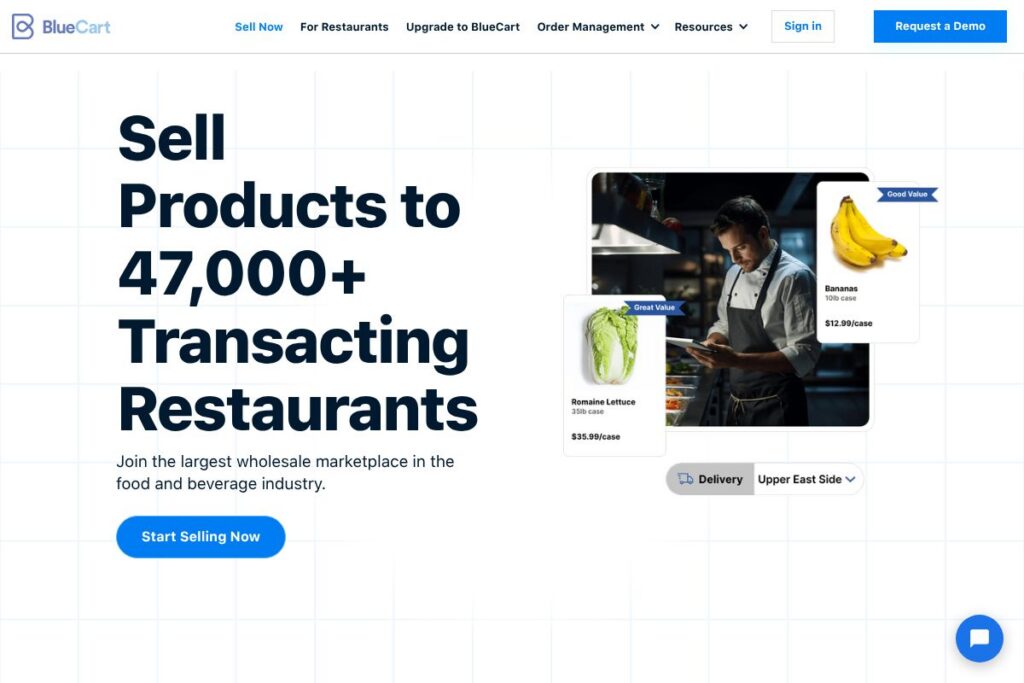
BlueCart is a wholesale marketplace built around foodservice purchasing, with a vendor-focused product called Endless Aisle that exposes suppliers to restaurants actively placing orders. The platform combines a marketplace listing with vendor tools for catalog uploads, order management, pricing feedback, and fulfillment controls so suppliers can sell directly into local and national restaurant markets.
Compare BlueCart with other wholesale and B2B selling platforms such as Faire, Handshake, and Shopify. Unlike Faire, which primarily targets independent retail shops and relies on a curated retail marketplace model, BlueCart centers on restaurants and foodservice operators and includes order and delivery controls tuned for perishable goods. Compared with Handshake, which is a wholesale channel for retailers, BlueCart adds restaurant-specific visibility and features like delivery zone filtering. Compared with Shopify, which is an all-purpose ecommerce platform with subscription plans, BlueCart combines marketplace exposure with vendor-side operations for suppliers focused on foodservice buyers.
All of this makes BlueCart a strong option for vendors who sell to restaurants and hospitality businesses and need an integrated way to list products, manage orders, and control delivery visibility. Its focus on market-specific discovery and vendor tooling makes it especially useful for suppliers that want to reach new buyers without rebuilding their own ecommerce infrastructure.
How BlueCart Helps Vendors
Vendors upload detailed product catalogs with images, descriptions, units, and pricing, then opt into the Endless Aisle to become discoverable by restaurants in their selected markets. The platform routes buyer searches and category browsing to vendor catalogs that match the buyer’s delivery area and product keywords, which increases exposure to active purchasers.
Order handling flows into a centralized vendor dashboard where vendors can accept, reject, or fulfill orders, print pick lists, and track fulfillment status. Vendors can set up separate catalogs for local delivery versus nationwide shipping, and choose whether to use in-house drivers, third-party logistics, or distributors for fulfillment.
BlueCart also supports promotional controls so vendors can offer incentives such as free delivery for first-time buyers, volume discounts, and targeted promotions to encourage repeat business and increase average order value.
What does BlueCart do?
BlueCart’s vendor platform centers on marketplace exposure and operational tools. Core capabilities include the Endless Aisle marketplace listing, a catalog management interface for product data and images, an order management system, pricing insights to help vendors evaluate competitive positioning, and delivery/fulfillment configuration so vendors control where products appear.
Let’s talk BlueCart’s Features
Endless Aisle marketplace
This feature lists vendor catalogs within BlueCart’s buyer-facing marketplace so restaurants can discover new suppliers. It increases product visibility in buyer searches and category browsing, and vendors can be highlighted to buyers in the same delivery region to drive initial awareness.
Product catalog management
Vendors upload product entries with high-quality images, units, and SKU details, enabling accurate listings and easier order entry for buyers. The catalog system supports multiple catalogs to separate local delivery items from nationally shippable goods.
Pricing Insights
Pricing Insights analyzes vendor pricing relative to the market and flags products as Great Value, Good Value, or Fair Value, helping vendors identify items to reprice or promote. This guidance supports competitive positioning and can inform discount and promotion strategy.
Customizable delivery zones
Vendors define delivery visibility by state, city, or custom zones so products only appear to buyers who can be served efficiently. This reduces unfulfillable orders and lets vendors target ideal markets while limiting exposure outside preferred service areas.
Order management system
The vendor dashboard consolidates incoming orders, status updates, and fulfillment workflows so teams can process orders faster and maintain order accuracy. Built-in tools include order filtering, pick list generation, and communication channels for buyer questions and confirmations.
Fulfillment flexibility
Vendors can choose their preferred fulfillment method, including local delivery via in-house drivers, third-party carriers, or established distributors, and can set up separate catalogs to reflect different shipping methods and lead times. This flexibility helps vendors map BlueCart into existing logistics and delivery workflows.
Promotions and buyer incentives
Tools are available to create first-time free delivery, discounts, and other promotions to encourage trials and build recurring customers. These promotional controls help vendors convert initial exposure into repeat business and higher customer lifetime value.
With these features, BlueCart blends marketplace reach with operational controls so vendors can both grow their customer base and maintain efficient order fulfillment. The biggest benefit is combining discovery to thousands of restaurant buyers with vendor-side tools for pricing, delivery control, and order processing.
BlueCart Pricing
BlueCart offers flexible vendor arrangements rather than a single public subscription model. For detailed costs, vendor onboarding options, or marketplace fee structures, check BlueCart’s vendor information and contact options on the BlueCart vendor pages to request current pricing and terms.
What is BlueCart Used For?
BlueCart is used by food and beverage manufacturers, distributors, and wholesalers that want to sell directly to restaurants, caterers, and other foodservice buyers. It is designed for suppliers that need a marketplace to reach active buyers without building a separate sales and fulfillment stack.
The platform is also used to simplify recurring order management, centralize incoming orders from multiple buyer accounts, and manage localized delivery rules. Vendors who need to control visibility by delivery zone or want to run introductory promotions to convert local restaurants will find the platform especially relevant.
Pros and Cons of BlueCart
Pros
- Large buyer network: Access to a marketplace used by tens of thousands of restaurants increases opportunities for discovery and new accounts, helping vendors scale their customer base.
- Vendor operational tools: Catalog management, order processing, and fulfillment configuration reduce manual order handling and fit into existing logistics workflows.
- Market-aware pricing guidance: Pricing Insights provides a quick, categorical view of pricing competitiveness so vendors can make informed repricing or promotional decisions.
- Delivery control: Customizable delivery zones help vendors limit visibility to areas they can efficiently serve, reducing wasted leads and returns.
Cons
- Marketplace dependence: Vendors gain exposure through BlueCart at the cost of relying on a platform for discovery rather than building direct buyer relationships outside the marketplace.
- Details on fees not public: Vendor pricing and marketplace fee structures are handled through sales or onboarding rather than a published plan, which requires direct contact to understand costs and terms.
- Foodservice focus limits cross-industry reach: The platform is optimized for restaurants and foodservice buyers, which is ideal for that vertical but less suitable for vendors targeting non-food retail channels.
Does BlueCart Offer a Free Trial?
BlueCart provides demo and onboarding options rather than a publicly advertised free tier. Prospective vendors can request a demo or vendor onboarding to see platform capabilities and how Endless Aisle will present their catalog, and BlueCart sales or support can discuss trial arrangements during the demo process.
BlueCart API and Integrations
BlueCart supports integrations and connects vendor workflows to order, accounting, and fulfillment systems so data flows between sales channels and backend operations. Vendors can integrate with common accounting and logistics partners to sync orders and inventory, and BlueCart’s team can provide integration guidance during onboarding.
For technical integration details or developer resources, consult BlueCart’s integration and support materials on the BlueCart integration pages or request developer documentation when you contact vendor support.
10 BlueCart alternatives
Paid alternatives to BlueCart
- Faire – A wholesale marketplace focused on independent retail buyers; useful for suppliers targeting retail shops rather than restaurant channels, with marketplace discovery and net payment terms.
- Handshake – A B2B ordering platform used by merchants to manage wholesale catalogs and orders; integrates with ecommerce backends and focuses on retailer-supplier relationships.
- Shopify – A general ecommerce platform that supports B2B and wholesale through apps and custom storefronts; better for vendors who want full control via subscription plans and storefront customization.
- MarketMan – Inventory and purchasing software built for restaurants that also supports supplier ordering workflows and can help vendors connect with hospitality buyers.
- Ordermark – Aggregates orders from multiple channels for restaurants and provides vendor-facing routing and fulfillment features; useful for suppliers working with multi-channel restaurants.
- FoodServiceDirect – A marketplace and distributor for restaurant supplies that connects vendors and buyers in the foodservice space with order fulfillment support.
Open source alternatives to BlueCart
- Odoo – An open source ERP with ecommerce and B2B modules that can be configured for wholesale marketplaces and vendor catalogs, useful for self-hosted vendors who want full control.
- Broadleaf Commerce – An open source B2B ecommerce framework that supports wholesale features and custom catalog logic for vendors building a marketplace or direct ordering portal.
- Spree Commerce – A modular open source ecommerce platform that can be extended for B2B and wholesale use cases, including vendor catalogs and custom checkout flows.
Frequently asked questions about BlueCart
How does BlueCart help vendors reach restaurant buyers?
BlueCart connects vendor catalogs to restaurants through the Endless Aisle marketplace. Products listed in a vendor’s catalog become discoverable to restaurants searching categories and keywords within the buyer’s delivery area.
Can vendors control where their products appear on BlueCart?
Yes, BlueCart allows vendors to set customizable delivery zones and market visibility. Vendors restrict product visibility to specific states, cities, or delivery areas so buyers only see items that can be delivered efficiently.
Does BlueCart provide tools to manage incoming orders?
Yes, BlueCart includes an order management system for vendors. The dashboard consolidates orders, allows status updates, generates pick lists, and supports communication with buyers to streamline fulfillment.
Can I fulfill orders through my own drivers or distributors on BlueCart?
Yes, BlueCart supports multiple fulfillment methods including in-house drivers, third-party carriers, and distributor fulfillment. Vendors can set separate catalogs or rules to reflect different shipping and delivery workflows.
How can I learn about BlueCart vendor pricing and onboarding?
BlueCart handles vendor pricing and onboarding through direct contact and demos. Visit the BlueCart vendor information and contact pages to request a demo and obtain current pricing and terms.
Final verdict: BlueCart
BlueCart brings targeted marketplace exposure and vendor operations into a single platform for foodservice suppliers, combining Endless Aisle discovery with catalog management, pricing insights, and delivery controls. It does particularly well for vendors whose primary buyers are restaurants and who need granular delivery visibility and order workflows that match perishable product logistics.
Compared with broad ecommerce platforms such as Shopify, which uses subscription plans and a modular app ecosystem, BlueCart focuses on marketplace-driven discovery and vendor-side operations tailored to hospitality. For suppliers that need restaurant reach and built-in order management rather than building their own storefront, BlueCart is a focused option; vendors seeking a general-purpose ecommerce subscription model may prefer Shopify or B2B platforms depending on pricing and feature requirements.