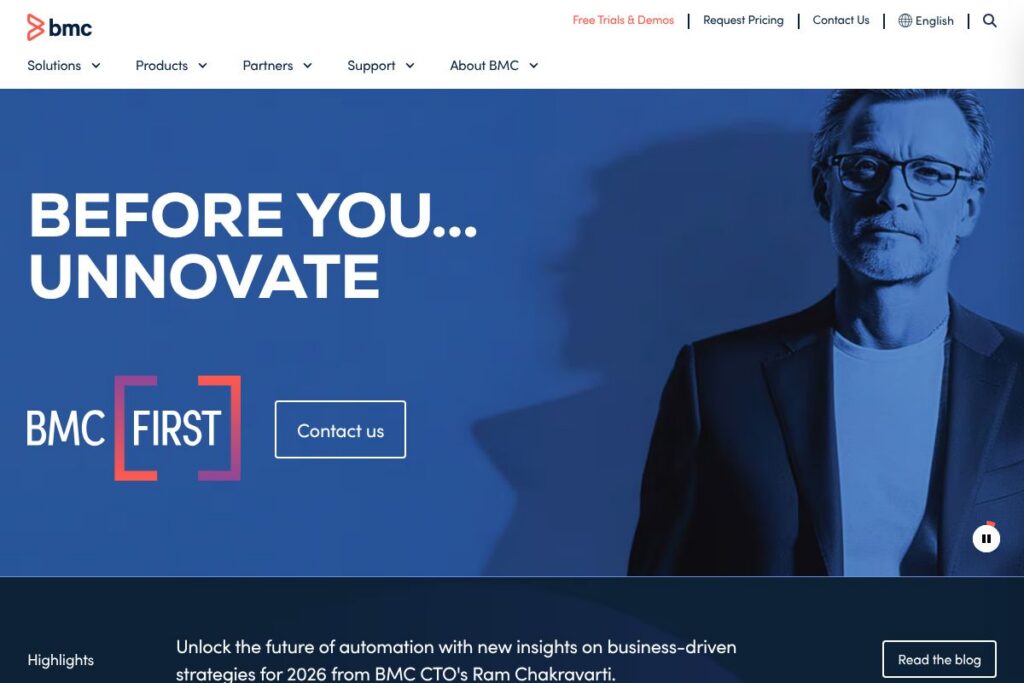
BMC: An Overview
BMC is an enterprise software vendor focused on IT operations, delivering solutions for automation, observability, and mainframe management. Its portfolio includes workload orchestration, monitoring and analytics, and mainframe modernization tools that target large, complex IT estates across on-premises and cloud environments.
BMC competes with several established vendors in adjacent spaces. Compared with ServiceNow, BMC emphasizes operational automation and mainframe support rather than primarily ITSM workflows. Compared with IBM in the mainframe and enterprise automation space, BMC positions itself with modular automation and AI-assisted tooling tuned for legacy systems. Against observability specialists such as Dynatrace or Splunk, BMC focuses on end-to-end integration with its automation and service orchestration layers.
All of this makes BMC particularly well suited for large enterprises that need unified automation across distributed systems and mainframes, and for operations teams that want the same vendor to cover monitoring, orchestration, and mainframe support. BMC does especially well where deep integrations with legacy systems and enterprise-grade scalability are required.
How BMC Works
BMC assembles a set of interoperable products that connect monitoring, orchestration, and mainframe management into operational workflows. Workload automation products schedule and coordinate jobs and tasks across cloud, virtual, and mainframe platforms while integrating with monitoring to trigger automated remediation or escalation.
In practice teams integrate BMC automation with observability feeds so alerts become actionable runbooks. For mainframe teams, BMC provides AI-assisted tools that inspect code, suggest diagnostics, and accelerate incident resolution without requiring operators to leave the mainframe environment. Typical workflows include alert ingestion, automated remediation or human-in-the-loop approvals, and post-incident analytics to reduce recurrence.
What does BMC do?
BMC’s platform centers on three capabilities: enterprise automation, observability and analytics, and mainframe operations. Core capabilities include workload orchestration, event and metric ingestion, dependency mapping, root cause analysis, and generative AI assistance for mainframe code and incidents. Recent product updates emphasize enterprise-scale AI for faster troubleshooting and conversational assistance for mainframe teams.
Let’s talk BMC’s Features
Workload automation (Control-M)
Control-M schedules and orchestrates batch and event-driven jobs across hybrid IT environments, including cloud and mainframe systems. It centralizes job definitions, handles dependencies and SLAs, and supports connectors to databases, cloud services, and business applications to reduce manual job management.
Observability and AIOps (TrueSight and observability suite)
The observability stack ingests logs, metrics, traces, and events to provide topology mapping and anomaly detection across services. It correlates telemetry with change and incident data to speed up root cause analysis and can feed automation rules that trigger runbooks or mitigation steps.
Mainframe management and BMC AMI Assistant
BMC’s AMI family provides performance, capacity, and storage management for z/OS environments while the AMI Assistant adds conversational AI to help troubleshoot, explain code, and accelerate common mainframe tasks. These tools aim to reduce the mean time to resolution for mainframe incidents and lower reliance on manual expertise.
Service orchestration and integration
Service orchestration capabilities connect monitoring, incident management, and automation so alerts can invoke automated playbooks or invoke approvals for human tasks. Prebuilt integrations and connectors allow teams to link BMC to ticketing systems, CI/CD pipelines, and cloud providers.
Security, compliance, and governance
BMC includes features that support role-based access control, audit trails, and policy-driven automation to help meet enterprise compliance requirements. Integration with enterprise identity providers and secure credential handling enables safe automation across critical systems.
The platform’s biggest benefit is combining automation, telemetry, and mainframe knowledge in one vendor stack so operations teams can move from noisy alerts to automated, auditable remediation pipelines faster. For organizations with large legacy footprints and stringent reliability needs, BMC brings a consolidated toolset.
BMC pricing
BMC uses enterprise licensing and subscription models tailored to large organizations rather than a single public price list; pricing is usually provided through custom quotes that consider product mix, deployment model, and support levels. For up-to-date licensing options and to discuss deployment needs, contact BMC sales or review their enterprise offerings on the BMC corporate site.
What is BMC Used For?
BMC is commonly used for enterprise workload automation, where teams need to coordinate batch jobs and event-driven processes across cloud, on-prem, and mainframe systems. Large IT operations groups use it to centralize job scheduling, manage dependencies, and enforce SLAs across complex application landscapes.
It is also used for observability-driven operations and incident response, where telemetry is combined with automation to route incidents, trigger mitigations, and capture post-incident analysis. Mainframe operations teams use BMC to monitor performance, manage capacity, and use AI-assisted tooling to speed troubleshooting and code explanations.
Pros and cons of BMC
Pros
- Comprehensive enterprise scope: BMC covers automation, observability, and mainframe operations in one vendor stack, reducing integration overhead and providing consistent operational workflows.
- Mainframe expertise: The AMI product set and AI-assisted AMI Assistant are built specifically for z/OS environments, helping teams modernize and operationalize mainframe tasks with generative guidance.
- Scalable orchestration: Workload automation tools handle large-scale, heterogeneous job estates and provide connectors to cloud platforms and enterprise applications.
Cons
- Complex deployment and licensing: Enterprise-grade capabilities come with complex licensing and implementation patterns that may require professional services and lead times.
- Steep learning curve for smaller teams: The breadth of functionality and depth of configuration can be heavy for small IT organizations without dedicated operations staff.
- Cost for smaller deployments: BMC is optimized for large-scale environments; smaller teams may find the total cost and scope misaligned with their needs.
Does BMC Offer a Free Trial?
BMC offers product trials and demonstrations rather than a single public free tier. Prospective customers can request demos or trial licenses for specific BMC products through their demo and contact channels to evaluate functionality in a controlled environment.
BMC API and Integrations
BMC provides APIs and integration points for automation and observability products, including RESTful endpoints and SDKs for extending automation workflows. See the BMC API documentation for developer guides, endpoints, and examples on integrating with Control-M, TrueSight, and other products.
BMC also supports a wide set of integrations with cloud providers, ITSM systems, CI/CD tools, and monitoring ecosystems so it can fit into existing toolchains and trigger or receive events from third-party systems.
10 BMC alternatives
Paid alternatives to BMC
- ServiceNow — Enterprise IT service management with strong workflow automation and ITOM capabilities that overlap with BMC in orchestration and incident workflows.
- IBM — Broad enterprise software portfolio including mainframe, automation, and monitoring tools that directly compete in mainframe and hybrid automation scenarios.
- Splunk — Observability and security analytics platform focused on logs and machine data with strong search and dashboarding capabilities.
- Dynatrace — Full-stack observability and AIOps with automated topology mapping and root-cause analysis for cloud-native environments.
- Broadcom — Offers mainframe and enterprise software (including legacy CA Technologies products) that compete for large mainframe customers.
- PagerDuty — Incident response and orchestration focused on alerting and on-call workflows with integrations into automation tools.
Open source alternatives to BMC
- Prometheus — Open source metrics monitoring and alerting for cloud-native systems, often paired with other tools for full observability.
- Grafana — Visualization and dashboarding platform that integrates with a wide array of telemetry sources for observability use cases.
- ELK Stack (Elasticsearch, Logstash, Kibana) — Open source logging and analytics stack used for log aggregation, search, and visualization.
- Apache Airflow — Workflow orchestration platform for scheduling and monitoring batch and data workflows, useful for automation of data pipelines.
- Ansible — Open source automation for configuration management and application deployment that can be used alongside orchestration tools.
Frequently asked questions about BMC
What is BMC used for?
BMC is used to automate IT operations, provide observability, and manage mainframe environments. Organizations deploy BMC to centralize workload orchestration, correlate telemetry for faster troubleshooting, and support z/OS operations.
Does BMC have integrations with cloud providers?
Yes, BMC integrates with major cloud providers and cloud services. Their products include connectors and plugins to link automation and observability workflows with cloud platforms and native cloud services.
Can BMC support mainframe modernization?
Yes, BMC provides mainframe management and modernization tools. Products in the AMI family and AI-assisted capabilities help teams modernize processes, improve observability, and speed troubleshooting on z/OS.
Does BMC offer APIs for automation?
Yes, BMC exposes APIs and developer documentation for automation and observability products. The BMC API documentation describes available endpoints and integration patterns for developers.
How can I get pricing for BMC?
BMC uses enterprise licensing and custom pricing approaches. To get a tailored quote or discuss licensing, contact BMC sales through their enterprise contact channels or request a demo on the corporate site.
Final verdict: BMC
BMC excels at providing a unified set of tools for enterprise automation, observability, and mainframe operations, making it a strong fit for organizations with large, heterogeneous IT estates and significant mainframe footprints. Its strength lies in deep mainframe capabilities, scale of orchestration, and the integration between monitoring and automation to reduce incident resolution time.
Compared with ServiceNow, BMC focuses more on operational automation and mainframe support while ServiceNow centers on ITSM and enterprise service workflows. Pricing models differ as well: BMC typically uses custom enterprise licensing aligned to deployment size and product mix, whereas ServiceNow commonly uses subscription pricing per user or per module; organizations should evaluate both on feature fit and total cost of ownership relative to their operational scope.
For teams that need robust mainframe tooling combined with enterprise-grade orchestration and observability, BMC is a comprehensive option worth evaluating via demos and trial licenses. Explore BMC’s product pages such as the Control-M automation platform, TrueSight Observability, and mainframe solutions to match capabilities to your needs.