Botsonic: An Overview
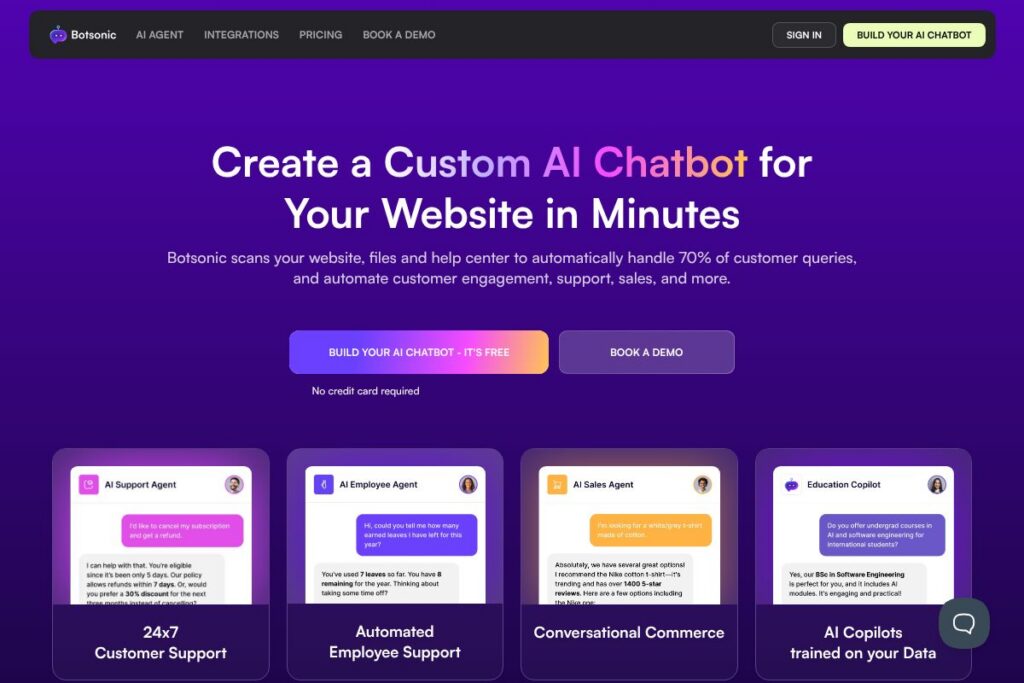
Botsonic is a no-code platform for building custom AI chatbots that train on your website, documents, and help center to answer user queries and automate customer engagement. It emphasizes quick setup, multilingual responses, and model flexibility by routing requests across multiple large language models for availability and quality.
Compared with established messaging platforms, Botsonic focuses on rapid data ingestion and retrieval-augmented responses rather than purely scripted flows. For example, Intercom provides a broad customer messaging suite with built-in CRM and workflows; Botsonic concentrates on building knowledge-driven agents quickly. Drift prioritizes sales conversation tooling and routing, while Botsonic targets both support and conversational commerce use cases with simpler no-code training. Compared to lightweight alternatives like Tidio, Botsonic leans more heavily on LLM-based answers and model-agnostic routing.
Botsonic performs best when organizations want a fast, document-trained assistant that can be embedded on the web and extended to messaging channels. It suits product and support teams that need verifiable answers from their own content, teams that must support multiple languages, and businesses that want to adjust models without replatforming their chatbot.
How Botsonic Works
Botsonic ingests content from your website, knowledge base, and uploaded files, then creates an index used to ground responses in company documentation. Training is oriented around retrieval augmentation so replies reference specific source content and reduce hallucinations.
Implementation follows a short workflow. 1. Import your data & train your agent: Upload documents or point the bot at your site to create searchable knowledge. 2. Customize behavior & appearance: Adjust tone, response length, and UI elements without code. 3. Integrate channels and tools: Embed the widget on the web and connect to messaging platforms like WhatsApp or SMS. 4. Integrate with your tools: Connect CRMs, ticketing systems, and analytics to sync context and hand off complex issues. 5. Monitor conversations & gain insights: Track resolution metrics, CSAT, and chat logs to iterate on content.
A typical deployment goes live in minutes: point the builder at documentation, test the agent in a staging environment, then embed the chat widget or enable a messaging channel. Live agent handoff and analytics are available to handle escalation and measure impact.
What does Botsonic do?
Botsonic centers its feature set on automated, document-grounded conversational experiences that can be deployed across websites and messaging channels. Core capabilities include a no-code builder, website scanning for rapid training, multilingual support, integrations for web and messaging, analytics for resolution tracking, and enterprise security controls.
What Makes Botsonic Stand Out
Website and Document Ingestion
The builder automatically scans websites and ingests uploaded files to create a searchable knowledge base, which the chatbot uses to answer queries with references to source content. This reduces the need to hand-author FAQ flows and speeds up coverage of existing documentation.
No-code Bot Builder
The interface lets non-technical users configure intents, alter response tone, set fallback rules, and change the widget appearance without programming. Teams can iterate on conversational flows and styling quickly to match brand voice and UX needs.
Multichannel Deployment
Botsonic supports embedding on web pages and connects to channels such as WhatsApp and SMS so the same agent can serve customers across platforms. Channel connectivity helps unify conversations and maintain context when users switch platforms.
Multilingual Support
Built-in language handling enables agents to respond in over 50 languages, which is useful for global support operations and multilingual marketing. Language detection and translation options reduce the need to maintain separate bots per locale.
Live Agent Handoff
When queries require human attention, the platform provides configurable handoff rules and ticket creation to route conversations to support staff. Handoffs preserve context so agents see the conversation history and referenced sources.
Analytics and Resolution Tracking
Conversation analytics track metrics such as resolved rate, response times, and customer satisfaction, and include tools to measure the bot’s impact on CSAT and ticket deflection. These insights guide content updates and training priorities.
Security and Compliance
Botsonic offers encryption at rest and in transit, workspace-level data segregation, audit logs, and configurable data retention controls that align with enterprise security requirements. The platform states SOC 2 Type 2 compliance and supports GDPR and HIPAA-related practices.
Model Agnostic Routing (GPT Router)
A model gateway routes requests between multiple LLM providers to optimize response quality and uptime, enabling teams to change or mix models without reworking the agent. This helps maintain availability and tune cost versus performance.
With these capabilities, the biggest benefit is a fast path from existing documentation to a production chatbot that reduces manual scripting, supports multiple channels, and meets enterprise security expectations.
Botsonic Pricing
Botsonic uses a SaaS pricing approach with a free entry level and paid tiers for higher usage and enterprise features. The platform typically offers a free builder tier to create and test agents, while advanced capabilities and high-volume usage are covered by paid and custom enterprise plans.
For current plan names, limits, and billing options, check Botsonic’s current pricing options. Enterprise customers can expect custom quotes that account for deployment scale, SLA needs, and integration requirements; contact sales for detailed pricing and contractual terms.
What is Botsonic Used For?
Botsonic is commonly used to automate first-line customer support by answering common queries from documentation, which reduces ticket volume and shortens response times. Teams use it for 24×7 coverage, triage, and to surface verifiable answers linked to source material.
Other frequent uses include conversational commerce and lead qualification, where the agent recommends products, captures customer intent, and hands qualified leads to sales. Internal use cases include employee self-service for HR and IT, accelerating onboarding, and providing multilingual workplace support.
Vertical examples include education for virtual campus assistants, healthcare for informational triage under compliance controls, real estate for property assistants, and hospitality for concierge-style guest support. The flexibility of data training and channel deployment makes the tool applicable across sectors.
Pros and Cons of Botsonic
Pros
- Fast setup and training: The platform can index a website and documents to produce a working agent quickly, reducing time-to-value for support and sales automation.
- Model flexibility: Being model agnostic allows organizations to route requests to different LLMs and avoid vendor lock-in, which helps balance quality and cost.
- Enterprise security focus: Features like AES-256 encryption, audit logs, data segregation, and SOC 2 Type 2 compliance provide a governance framework for regulated industries.
- Multichannel and multilingual support: Deploying the same agent across web, WhatsApp, and SMS and supporting 50+ languages helps scale global support operations.
Cons
- Custom pricing for large deployments: Enterprise-level pricing and feature sets are negotiated, which can delay procurement timelines for some buyers. This requires direct engagement with sales to get exact costs.
- Dependence on source content quality: The accuracy of responses depends on the underlying documentation and how well it is indexed; poor source content can lead to suboptimal answers.
- Advanced customization may need support: While the builder is no-code, complex integrations or bespoke behaviors may require technical resources or professional services.
Does Botsonic Offer a Free Trial?
Botsonic offers a free plan for building and testing AI agents, with paid upgrades and enterprise options available. The free tier allows teams to create a bot and validate workflow before moving to higher usage tiers; visit the current pricing options to see which features are included in the free plan.
Botsonic API and Integrations
Botsonic provides API and webhook support to integrate conversational data with CRMs, ticketing systems, and analytics platforms, enabling automated ticket creation and context sharing. The platform also offers built-in connectors for common channels such as web widgets, WhatsApp, and SMS to streamline deployment.
Developers can review the platform’s API documentation for endpoints, authentication methods, and examples for sending and receiving messages, managing knowledge sources, and exporting conversation logs.
10 Botsonic alternatives
Paid alternatives to Botsonic
- Intercom: A comprehensive customer messaging platform with routing, automation, and CRM features aimed at sales and support teams. It focuses on integrated customer workflows and team collaboration.
- Drift: Conversational marketing and sales automation that emphasizes lead qualification and real-time sales routing with robust CRM integrations. Drift is optimized for B2B sales scenarios.
- Zendesk: A broader customer service suite with AI-assisted answer bots, ticketing, and an omnichannel approach; suitable for organizations that need an integrated support platform.
- Tidio: A user-friendly chat platform with chatbots and live chat, aimed at small to medium businesses for quick deployments and commerce use cases.
- Ada: A no-code AI automation platform focused on customer service automation at scale, often used by enterprises to reduce ticket volumes.
- LivePerson: Enterprise-grade conversational AI with strong focus on messaging channels and contact center integrations for large-scale deployments.
- Freshdesk (Freshchat): Customer support and messaging tools with bot capabilities and strong ticketing features integrated into the Freshworks suite.
Open source alternatives to Botsonic
- Rasa: An open source machine learning framework for building contextual chatbots with full control over data and deployment, suited for teams with developer resources.
- Botpress: A developer-friendly open source conversational platform for building and running chatbots with a visual flow editor and modular architecture.
- Chatwoot: An open source customer engagement platform that includes messaging inboxes and basic chatbot integrations, focused on team collaboration and omnichannel support.
- Rocket.Chat: A communication platform with chatbot integration capabilities, often used for internal collaboration and customer-facing chat when self-hosting is required.
Frequently asked questions about Botsonic
What can Botsonic do for customer support?
Botsonic automates first-line support by answering queries from ingested documentation and routing complex issues to human agents. Teams use it to reduce ticket volume, improve response times, and surface documented answers linked to source content.
Does Botsonic support integrations with messaging apps like WhatsApp?
Yes, Botsonic can deploy agents to web widgets and messaging channels including WhatsApp and SMS. It provides connectors and API/webhook options to forward context to other systems and maintain conversation continuity.
Can Botsonic handle multiple languages?
Botsonic supports responses in over 50 languages. Language detection and multilingual response capabilities help organizations serve global customers from a single agent configuration.
Is Botsonic compliant with enterprise security requirements?
Botsonic includes enterprise-grade security features such as AES-256 encryption, audit logs, and SOC 2 Type 2 compliance. The platform also offers configurable data retention and workspace-level segregation for governance.
Does Botsonic offer an API for developers?
Yes, Botsonic provides an API and webhooks for integrating chat data, knowledge sources, and analytics with backend systems. Developers can consult the platform’s API documentation for endpoint details and examples.
Final Verdict: Botsonic
Botsonic is a practical choice for teams that need to turn company documentation into a working conversational agent quickly, with no-code tools and multilingual, multichannel deployment. Its model-agnostic routing, enterprise security controls, and analytics make it suitable for both support and conversational commerce use cases.
Compared to Intercom, which bundles broader customer messaging and CRM capabilities often at a higher entry cost, Botsonic provides a lower-friction path to a knowledge-grounded chatbot with a free entry tier and flexible enterprise options. For organizations prioritizing fast training on proprietary content and adaptable model routing, Botsonic is a compelling option with enterprise-grade controls.
For detailed feature comparisons and live pricing, visit the Botsonic homepage and the platform’s trust center.