ChatGPT: An Overview
ChatGPT is a conversational AI developed to handle natural-language tasks such as answering questions, drafting and editing text, explaining concepts, and writing or reviewing code. It is available through a web interface and mobile apps, and integrates with other OpenAI offerings via APIs and plugins to extend its capabilities.
Compared with Google Bard and Anthropic Claude, ChatGPT focuses on a broad ecosystem that includes a consumer-facing chat product, a plugin system for live web access, and deep integration with developer APIs. Google Bard emphasizes integration with Google Search and Google Workspace, while Anthropic Claude targets safety-focused enterprise use cases; ChatGPT sits between these by offering both an easy consumer experience and developer-focused tools.
Where ChatGPT performs best is in flexible, conversational tasks that require context retention and follow-up. It is well suited for writers, knowledge workers, educators, and developers who need quick drafts, explanations, or prototype interactions, and for companies that want to add conversational features via the OpenAI platform.
How ChatGPT Works
ChatGPT accepts text input and generates natural-language responses using large language model techniques. It maintains conversational context across turns so that follow-up questions and clarifications feel coherent and connected.
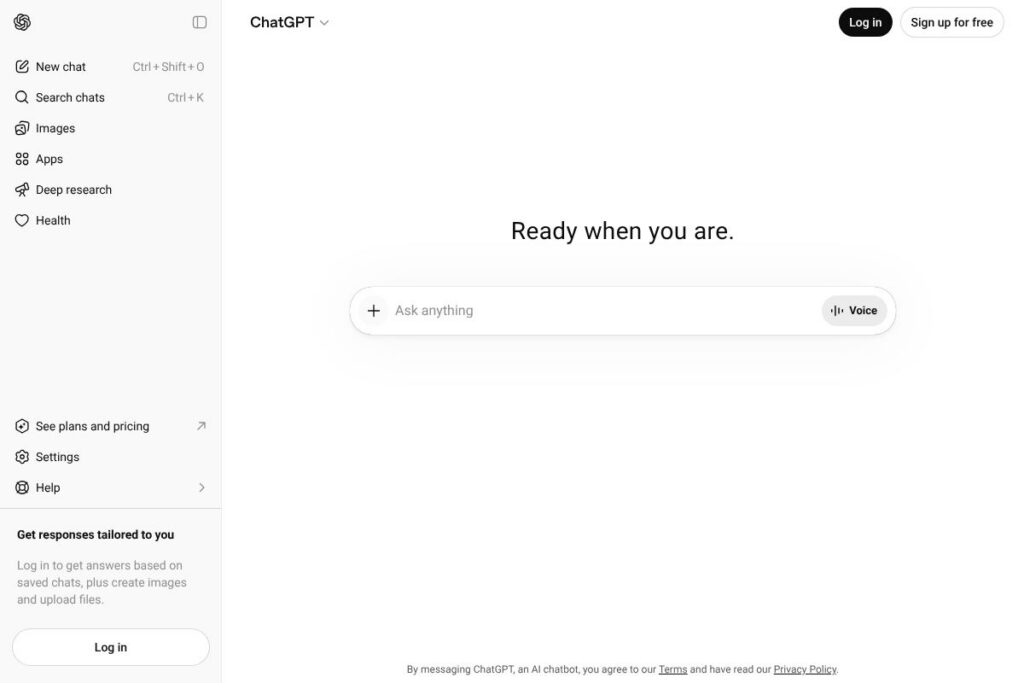
Users interact with ChatGPT through the web app or mobile apps where the interface supports conversation history, saved chats, and features like system-level instructions. Developers can access the same underlying models via the OpenAI API to build custom applications and workflows that programmatically send prompts and receive completions.
Common workflows include drafting emails or documents, iterating on code with AI-assisted debugging, turning notes into structured summaries, and using plugins to pull live information or run third-party services directly from the chat.
ChatGPT features
ChatGPT centers on conversational AI augmented by tools that broaden its practical use. Core capabilities include multi-turn conversation, assistant customization, document and code handling, and extensibility through plugins and APIs. Recent updates expanded multimodal inputs and developer-facing plugin capabilities.
Conversational context
The model preserves context across turns which lets users carry complex threads of discussion without repeating background. This benefits tasks like iterative drafting, multi-step problem solving, and long-form tutoring where prior messages inform future responses.
Assistant custom instructions
Users can set preferences and background details that the assistant will follow across sessions, improving personalization for tone, role, or domain focus. Teams can standardize instructions for consistent behavior in shared accounts.
Code generation and review
ChatGPT can generate example code, explain snippets, and suggest fixes across popular programming languages, which speeds prototyping and debugging. For developers this reduces initial implementation time and helps onboard new libraries or APIs.
Multimodal inputs
The platform supports image inputs and can analyze or describe visual content alongside text queries, enabling tasks such as document interpretation, simple image-based QA, and content extraction from photos.
Plugins and web access
Plugins let ChatGPT call external services and fetch up-to-date information, enabling capabilities like booking, real-time data lookup, or interacting with productivity tools. The plugin ecosystem connects the chat interface with external systems for practical workflows.
API access and automation
OpenAI exposes model endpoints so organizations can embed ChatGPT-style functionality into their products, automate workflows, and scale usage according to needs. The API supports programmatic prompts, streaming responses, and fine-grained control over model parameters.
Data controls and enterprise features
Enterprise offerings include additional controls for data retention, single sign-on, and administrative management to meet corporate security and compliance needs. These features support deployment inside larger organizations with governance requirements.
With these capabilities, ChatGPT is useful for a wide range of tasks from creative writing and research to coding assistance and business automation, making conversational AI accessible both to end users and to developers building integrated solutions.
ChatGPT pricing
ChatGPT uses a mixed pricing approach: a free tier for casual use, a paid consumer subscription for heavier use and priority access, and enterprise options with custom terms. API access is billed separately on a usage basis through OpenAI’s developer pricing.
Monthly Billing:
Free Plan – $0/month (Basic access to ChatGPT, limited priority and model availability)
ChatGPT Plus – $20/month (Access to faster response times and priority access to newer model capabilities)
Enterprise and API
Enterprise – Custom pricing (Includes SSO, advanced data controls, and administrative features for organizations)
API access uses a usage-based fee model charged per token or per API call, depending on the endpoint and model selected. For full details and the latest numbers, see the current pricing options and the OpenAI API documentation which explain usage-based billing.
What is ChatGPT Used For?
ChatGPT is commonly used for content creation tasks such as drafting emails, blog posts, or reports, and for editing and rewriting text to adjust tone or clarity. It also serves as a study aid for explaining complex topics, generating examples, and producing concise summaries of long documents.
Beyond writing, teams use ChatGPT for code assistance, automated customer support prototypes, brainstorming, and research. Developers embed the models via the API to provide conversational interfaces inside apps, and businesses adopt the enterprise tier to centralize AI-assisted workflows under corporate controls.
Pros and Cons of ChatGPT
Pros
- Advanced conversational ability: ChatGPT maintains multi-turn context and produces coherent, humanlike responses that help with follow-up questions and iterative tasks.
- Wide feature set: The combination of multimodal inputs, plugins, and API access offers flexible ways to apply the model across consumer and developer scenarios.
- Accessible tiers: A free tier plus a straightforward paid subscription makes it easy to start and scale usage while testing features.
Cons
- Occasional factual errors: The model can confidently produce incorrect or outdated information, so verification is required for critical tasks.
- Data and privacy considerations: Organizations must evaluate data handling and retention policies, and may need enterprise controls for sensitive use cases.
- Dependency on connectivity: The web-based chat and plugin features require online access, which can limit usage in offline scenarios.
Is ChatGPT Free to Try?
ChatGPT offers a free plan and a paid Plus subscription. The free tier provides basic conversational access with model availability that may change based on demand, while the paid ChatGPT Plus subscription at $20/month gives priority access and faster responses. Enterprise contracts and API usage are billed separately under custom or usage-based terms.
ChatGPT API and Integrations
OpenAI provides programmatic access to the same underlying models through the OpenAI API documentation, which describes endpoints for chat completions, embeddings, and multimodal features. Developers use these endpoints to build conversational experiences, integrate AI into applications, and automate prompt-based workflows.
ChatGPT connects to third-party services via plugins and integrations that enable live data lookups and direct interactions with external tools. Common integrations include productivity platforms and developer tooling, and companies can build private plugins to connect ChatGPT to internal systems; see the ChatGPT plugins documentation for details.
10 ChatGPT alternatives
Paid alternatives to ChatGPT
- Google Bard — A conversational assistant integrated with Google Search and Workspace for up-to-date web information and document collaboration.
- Anthropic Claude — Focuses on safety and controllability with conversational models for enterprise and developer use.
- Microsoft Copilot — Embedded into Microsoft 365 apps to assist with productivity workflows across Word, Excel, and Outlook.
- Perplexity — A search-oriented conversational assistant that emphasizes direct sourcing and concise answers.
- Jasper AI — Tailored to marketing teams with templates and workflow tools for content generation.
Open source alternatives to ChatGPT
- Llama 2 — A family of models from Meta available for research and commercial use under certain licenses, suitable for self-hosting.
- Mistral — High-performance open models and tooling designed for customization and deployment by organizations.
- Hugging Face Transformers — A large ecosystem of community models and tools for fine-tuning and hosting open models.
- GPT4All — Community-driven projects that package open weights and local inference tools for offline use.
- Alpaca (community variants) — Lightweight instruction-tuned models adapted from open foundations for task-specific deployments.
Frequently asked questions about ChatGPT
What can ChatGPT do for writing and content creation?
ChatGPT can draft, edit, and summarize text across many formats. It helps generate blog posts, emails, marketing copy, and can adapt tone or length based on user prompts.
Does ChatGPT offer an API for developers?
Yes, OpenAI provides an API for programmatic access to ChatGPT-style models. The OpenAI API documentation explains endpoints, authentication, and usage patterns for building applications.
How much does ChatGPT cost per month?
ChatGPT Plus is priced at $20/month. A free tier is available for casual use, and enterprise or API usage is billed separately under custom or usage-based terms.
Can ChatGPT access live web information?
ChatGPT can access live information through plugins and web-enabled modes. Plugins allow the assistant to retrieve up-to-date data and interact with external services when enabled by the user or organization.
Is ChatGPT suitable for enterprise deployment?
Yes, ChatGPT offers enterprise features like SSO, administrative controls, and tailored data policies. Organizations can contract for custom terms and deployment options that meet corporate governance needs.
Final Verdict: ChatGPT
ChatGPT is a broadly capable conversational AI that mixes an easy-to-use chat interface with developer-grade APIs and an extensible plugin ecosystem. It does well at multi-turn conversation, creative drafting, and rapid prototyping, and its combination of free access and a simple $20/month Plus tier makes it accessible to individuals and teams.
Compared with Google Bard, which emphasizes free integration with Google Search and Workspace, ChatGPT provides a more mature plugin and API ecosystem for third-party integrations and developer use. For users deciding on cost and features, ChatGPT’s $20/month Plus plan buys performance and priority access, while enterprise customers can negotiate additional controls and support through custom contracts.
Overall, ChatGPT is a practical choice for anyone who needs conversational AI for daily tasks, content work, or to embed language understanding into products, with clear upgrade paths for heavier or enterprise use.