What is Chatlayer.ai
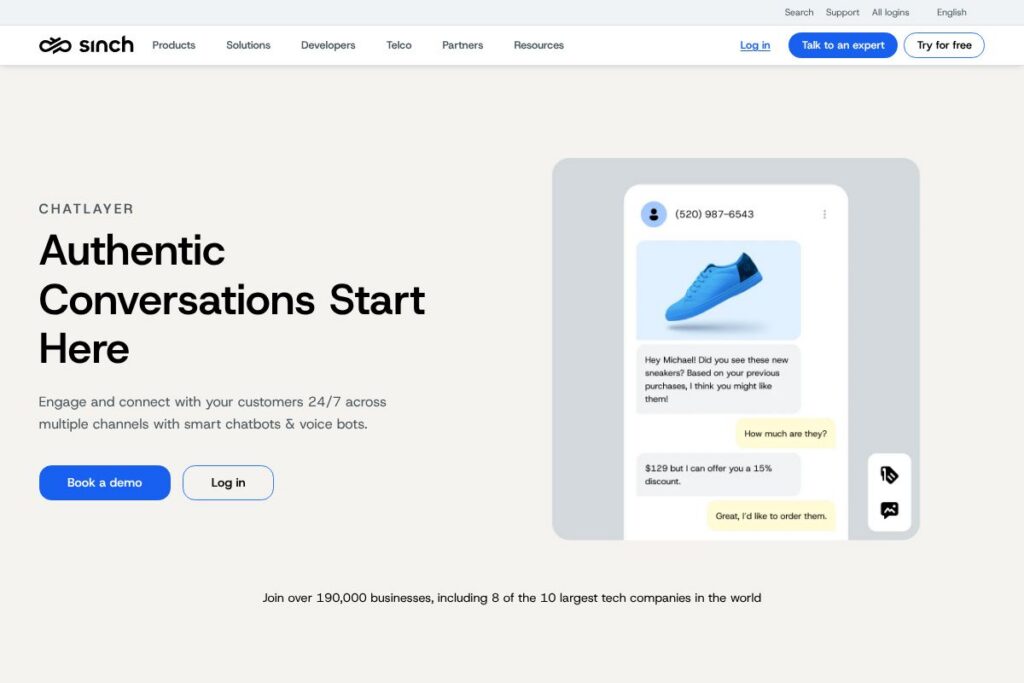
Chatlayer.ai is a no-code conversational AI platform for building chat and voice bots that handle customer interactions across messaging apps, web chat, and telephony. The platform emphasizes multilingual natural language processing, prebuilt templates for common workflows, and integration with CRM, ticketing, and contact center systems to operate at enterprise scale. The product is positioned to let business teams own bot content and conversational design while maintaining links to backend systems for transactions and agent handover.
Compared with Dialogflow from Google, Chatlayer.ai focuses more on packaged, business-ready templates and omnichannel deployment out of the box, rather than requiring developer-driven design and cloud platform configuration. Against IBM Watson Assistant, Chatlayer.ai provides a simpler no-code workflow and integrated analytics tailored for customer support and marketing teams, while Watson Assistant often appeals to organizations that need deep customization and enterprise governance. Compared with open-source alternatives such as Rasa, Chatlayer.ai offers faster time to value for non-developers and managed hosting, where Rasa emphasizes developer control and on-premise deployment.
All of this makes Chatlayer.ai a practical choice for customer experience and support teams that need fast deployment of multilingual bots across channels, and for organizations that prefer a managed SaaS approach with built-in templates and analytics rather than a fully custom developer project.
How Chatlayer.ai Works
The platform provides a visual, no-code bot builder where users assemble conversation flows using templates or blank canvases, then train intents and responses with examples. A best-practice template library speeds common use cases such as FAQs, booking, claims intake, or lead qualification, and those templates are editable by business users without developer intervention.
Under the hood, Chatlayer.ai applies a multilingual NLP engine to classify user intents and extract entities, routing conversations to automated flows or to human agents when needed. Bots can connect to CRMs, knowledge bases, and contact center platforms via built-in integrations or API calls, and platform analytics track message performance, intent coverage, and escalation rates to guide continuous improvement.
Chatlayer.ai features
Chatlayer.ai groups capabilities around no-code bot creation, multilingual NLP, omnichannel delivery, backend integrations, analytics, and recent additions to support GPT-style responses. The platform has extended generative model support to augment intent-based responses, and it emphasizes enterprise features such as role-based access and operational dashboards.
The platform includes several powerful capabilities worth highlighting:
Easy-to-start, no-code setup
Non-technical users can assemble bots from industry-tailored templates and a visual flow editor, which reduces the need for developer involvement during initial setup. Templates cover common customer journeys so teams can launch pilots quickly and iterate on content based on analytics.
Multilingual NLP (100+ languages)
A core NLP engine enables intent recognition and entity extraction across more than 100 languages, which helps global businesses maintain a consistent experience without building separate bots per locale. Language coverage supports locale-specific fallback strategies and allows content authors to supply localized responses.
Multichannel delivery
Bots can be deployed to messaging channels such as WhatsApp, Facebook Messenger, web chat, and to voice channels for IVR-style interactions, providing a single workspace for omnichannel conversations. This reduces duplication of bot logic and ensures consistent behavior across text and voice touchpoints.
End-to-end integrations
The platform offers API connectors and prebuilt integrations for major CRMs, ticketing systems, knowledge bases, and contact center platforms so bots can read and write records, fetch customer context, and create tickets when escalation is required. Integrations simplify handovers and let bots complete transactional tasks instead of only answering questions.
Smart analytics and monitoring
Built-in dashboards surface message-level analytics, intent performance, conversation health, and escalation metrics so administrators can monitor bot effectiveness and prioritize training data updates. Administrators can drill into problematic flows and export logs for further analysis.
GPT and generative model support
Chatlayer.ai supports integration with GPT-style models to enrich responses and produce more personalized, context-aware replies while combining that capability with intent controls to maintain consistency. Generative responses can be used to draft replies, expand knowledge-base answers, or create tailored marketing copy inside conversations.
With these capabilities combined, the biggest benefit of Chatlayer.ai is rapid deployment of multilingual, omnichannel bots that non-developers can maintain while still connecting to enterprise systems for transactional workflows.
Chatlayer.ai pricing
Chatlayer.ai uses a SaaS enterprise pricing model with plans tailored to different business sizes and usage patterns, and public, fixed-price tiers are not published on a dedicated pricing page. For current plan options and to discuss seat counts, channel volumes, or enterprise features such as SSO and SLAs, contact the vendor through the Chatlayer.ai homepage.
What is Chatlayer.ai Used For?
Chatlayer.ai is commonly used to automate customer care scenarios such as FAQs, order tracking, appointment booking, and first notification of loss workflows in insurance, which reduces agent load and speeds response times. Organizations use it to support multilingual audiences and to route complex issues to human agents with context preserved.
Marketing and sales teams also use the platform to run conversational campaigns on messaging channels led by WhatsApp, to qualify leads, and to schedule demos or appointments directly from chat. Contact centers deploy Chatlayer.ai to handle high-volume, repetitive tasks and to integrate conversational channels into existing CRM and ticketing pipelines.
Pros and Cons of Chatlayer.ai
Pros
- No-code bot building: Business users can create and edit bots using templates and a visual editor, reducing dependency on engineering teams. This accelerates pilots and iterative improvements without long development cycles.
- Multilingual NLP: The platform supports over 100 languages which makes it suitable for global deployments and reduces the need to maintain separate bots per language. Language support improves scalability for multinational customer bases.
- Omnichannel support: Deploy the same bot logic across text and voice channels, including popular instant messaging apps, which simplifies operations and provides consistent experiences. This reduces duplicated maintenance across channels.
- Enterprise integrations: Prebuilt connectors and an API ecosystem let bots access CRM and ticketing data for transactional flows and smooth agent handovers. That capability keeps conversational workflows tied into backend processes.
Cons
- Enterprise pricing model: Pricing is oriented toward business and enterprise customers with custom plans, which may be less predictable for small teams seeking transparent, per-seat pricing. Budgeting often requires direct engagement with sales.
- Less developer-level control than open-source: Compared with open-source frameworks, there is less flexibility for teams that need low-level customization or to self-host every component. Organizations requiring full code-level control may prefer a developer-first approach.
- Dependency on third-party channels: Availability and feature parity can vary across messaging platforms, meaning some advanced features may behave differently depending on channel constraints. Teams need to validate channel-specific behavior during testing.
Does Chatlayer.ai Offer a Free Trial?
Chatlayer.ai offers free demos and trial options for evaluation. Prospective customers can request a demo to see templates, a guided setup, and platform analytics; trial access typically includes the core bot builder and sample templates so teams can test workflows before committing to a paid plan.
Chatlayer.ai API and Integrations
Chatlayer.ai provides a developer-facing API and prebuilt connectors to common enterprise systems, enabling data exchange with CRM, ticketing, and contact center software. The platform documentation explains endpoints for message routing, session management, and custom integrations; consult the Chatlayer.ai developer resources for technical details.
Channels and integrations include major instant messaging apps led by WhatsApp for business messaging, web chat widgets, and voice services so bots can operate across text and telephony channels. For an overview of channel support and contact center connectors, see the Sinch Engage product information.
10 Chatlayer.ai alternatives
Paid alternatives to Chatlayer.ai
- Dialogflow – A Google Cloud conversational platform that supports intent-based bots with strong developer tools and pay-as-you-go pricing for scalable deployments. See the Dialogflow platform for details.
- IBM Watson Assistant – Enterprise-grade conversational AI with robust tooling for complex dialog design and integrations into IBM Cloud services. Review the Watson Assistant offering for enterprise capabilities.
- Microsoft Bot Framework – A developer-focused framework and Azure services for building, testing, and deploying conversational agents across channels. Explore the Microsoft Bot Framework documentation.
- Zendesk Answer Bot – Designed for support teams using Zendesk, this bot automates ticket deflection and integrates tightly with Zendesk Support. Learn about the Zendesk Answer Bot.
- Ada – A customer service automation platform focused on no-code bot building for support and commerce teams, with analytics and personalization features. See Ada’s platform.
- LivePerson – A conversational commerce and customer care platform that combines messaging, AI, and agent experiences for enterprise customers. Check the LivePerson solutions.
Open source alternatives to Chatlayer.ai
- Rasa – An open-source conversational AI framework that offers full developer control for intent and entity modeling, and on-premise deployment options. Visit the Rasa project.
- Botpress – A developer-friendly, modular open-source platform for building conversational experiences with a visual flow editor and extensible plugins. Explore Botpress.
- OpenDialog – A conversation design and runtime framework focused on building complex, stateful dialogs with developer tooling. Learn about OpenDialog.
- ChatterBot – A lightweight Python library for building rule-based and machine-learning driven chatbots suitable for prototyping. Review the ChatterBot project.
Frequently asked questions about Chatlayer.ai
What languages does Chatlayer.ai support?
Chatlayer.ai supports more than 100 languages. The multilingual NLP engine handles intent recognition and entity extraction across global languages so bots can serve international customer bases.
Does Chatlayer.ai integrate with WhatsApp and other messaging apps?
Yes, Chatlayer.ai can deploy bots to WhatsApp and major instant messaging channels. The platform centralizes channel management so you can run campaigns and support across several messaging apps in one workspace.
How much does Chatlayer.ai cost?
Chatlayer.ai uses custom SaaS pricing tailored to business needs. For exact rates, configurations, and channel or volume considerations, contact the vendor through the Chatlayer.ai homepage to request pricing and a demo.
Does Chatlayer.ai provide an API for developers?
Yes, Chatlayer.ai exposes APIs and developer resources for integrations. API endpoints cover message routing, session handling, and backend connections, with documentation available from the vendor.
Can Chatlayer.ai handle voice interactions as well as chat?
Yes, Chatlayer.ai supports voice channels in addition to text messaging. Voice capabilities allow conversational flows to run over telephony or voice-enabled platforms, and voice deployments can be combined with the same intent models used for chat.
Final verdict: Chatlayer.ai
Chatlayer.ai excels at delivering no-code, multilingual conversational AI that business teams can deploy quickly across messaging and voice channels. Its template-driven approach, analytics, and built-in integrations make it particularly well suited for customer service and marketing teams that need fast time to value and consistent omnichannel experiences.
Compared with Dialogflow, which offers flexible pay-as-you-go pricing and deep developer tooling as part of Google Cloud, Chatlayer.ai trades some low-level customization for faster business adoption and packaged integrations. Organizations that prefer managed SaaS, template-driven workflows, and enterprise integration should evaluate Chatlayer.ai, while teams that need developer-first control or wish to minimize vendor-managed services may prefer a platform such as Dialogflow or an open-source alternative like Rasa.