Clari: An Overview
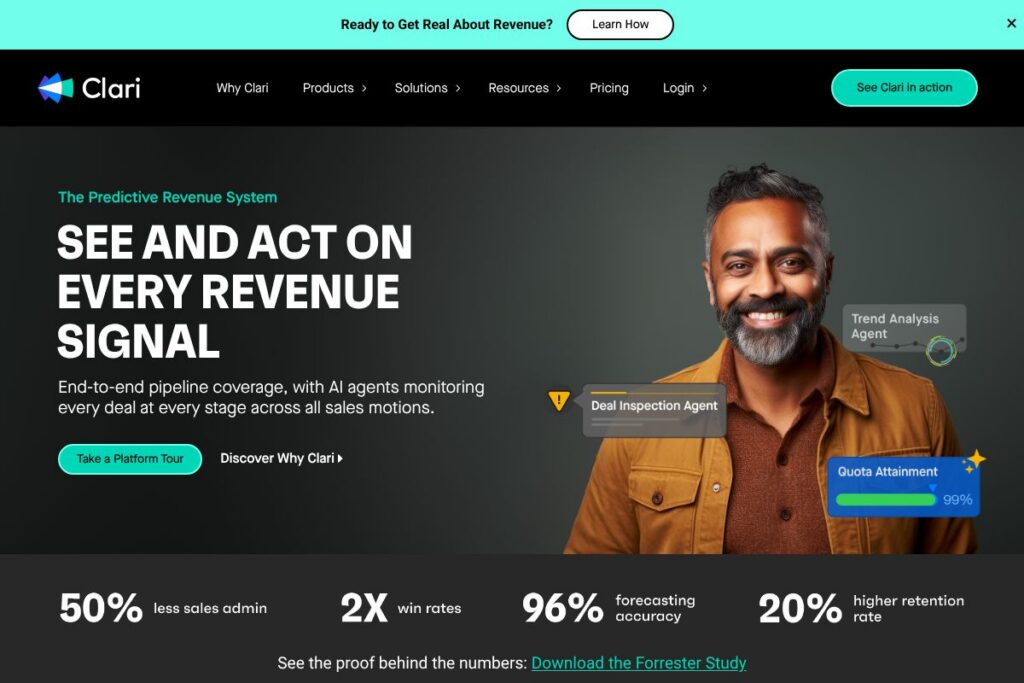
Clari is built to collect and normalize revenue signals across CRM, email, calendar, ERP, and other systems, then apply AI to surface actionable insights for forecasting, pipeline hygiene, and customer growth. The platform is positioned for enterprise sales, revenue operations, customer success, and finance teams that need a single source of truth for revenue performance.
Compared with Salesforce, which is primarily a customer relationship management platform with broad customization and CRM-first workflows, Clari focuses specifically on revenue orchestration and AI-driven forecasting that ties signals to outcomes. Against conversation intelligence tools like Gong, Clari places more emphasis on cross-system revenue context and company-wide forecasting rather than on-call transcription and coaching alone. Compared with business intelligence tools such as Tableau, Clari surfaces realtime operational signals and prescriptive next steps rather than only dashboards and historical reporting.
Clari does particularly well at aligning front-line sellers and revenue ops around a single forecast and a shared set of deal signals, making it suited to large organizations with distributed sales teams, complex deal motions, and multiple revenue systems. Its strengths are AI-based forecasting, pipeline hygiene, and cross-functional visibility for enterprise-scale revenue organizations.
How Clari Works
Clari ingests and normalizes data from CRMs, email and calendar systems, contract and ERP systems, and other revenue-related sources to create a unified view of accounts, opportunities, and forecast categories. Machine learning analyzes activity patterns, engagement signals, and historical outcomes to rate deal health, surface risks, and recommend next steps for reps and managers.
Teams use Clari by connecting their data sources, defining revenue workflows and stages, and applying AI signals to automate routine tasks such as risk tagging, next-step recommendations, and forecast rollups. Managers get live dashboards and coaching queues, while ops teams can export audit-ready forecast reports for finance and the boardroom.
What does Clari do?
Clari centralizes revenue operations around a platform that combines pipeline management, forecasting, sales engagement signals, and customer retention insights. Core capabilities include AI-driven deal scoring, integrated activity capture, and cross-system forecasting that pulls from CRM, email, and ERP data.
Let’s talk Clari’s Features
Pipeline Management & Prospecting
Clari shows where pipeline is real, where deals are at risk, and which accounts need outreach by correlating activity, engagement, and historical conversion patterns. This helps sellers prioritize outreach and helps managers spot gaps in pipeline coverage.
Sales Engagement & Productivity
AI-assisted deal signals highlight the highest impact actions for reps, and automated follow-through reduces manual administrative work. Managers gain real-time visibility to coach on live deals and replicate sales motions that close.
Forecasting & Revenue Insights
The platform aggregates signals from CRM to ERP and email to deliver forecasts that are explainable and auditable for finance teams. Forecast models can be adjusted for segment, product, or sales motion to reflect how the business actually operates.
Customer Retention & Growth
Clari identifies churn risk and upsell opportunity by tracking account health signals and usage patterns, allowing Sales, Customer Success, and Marketing to coordinate targeted plays. That alignment reduces churn and increases expansion velocity.
Revenue Context and AI
Clari’s AI adds context to raw signals so recommendations reflect the cadence of actual workflows and historical outcomes. The contextual layer makes predictive outputs actionable, helping teams move from insight to execution.
Integrations and Data Connectors
The platform connects with major CRMs, email systems, ERP sources, and modern data warehouses to consolidate revenue signals into a single operational view. Those integrations reduce manual reconciliation and improve the accuracy of pipeline and forecast data.
With these features combined, Clari helps organizations reduce forecast variance, increase forecast explainability, and turn dispersed revenue data into coordinated execution across sales and customer-facing teams.
Clari pricing
Clari uses an enterprise-style pricing model with custom plans tailored to company size, deployment scope, and required modules. Pricing is typically negotiated with sales and can vary based on the number of users, included modules, and integration or implementation services.
For detailed and current pricing options or to request a quote, contact Clari through their contact sales page or review the available offerings on Clari’s platform overview.
What is Clari Used For?
Large sales organizations use Clari to run end-to-end revenue workflows including pipeline management, forecasting, and cross-functional revenue plays. The platform is commonly applied to weekly forecasting cadence, deal hygiene reviews, and activity-driven coaching for distributed sales teams.
Customer success and account management teams use Clari to spot churn risk and prioritize expansion opportunities, while revenue operations and finance teams use it for audit-ready forecasts and to reduce forecast variance in board reporting.
Pros and Cons of Clari
Pros
- Revenue-wide visibility: Unifies signals from CRM, email, and ERP into a single operational view, improving forecast accuracy and cross-team alignment.
- AI-driven forecasting: Uses historical patterns and activity signals to produce forecasts that are explainable and actionable for finance and sales leaders.
- Operational automation: Automates deal health tagging, next-step recommendations, and routine follow-up, reducing manual data work for reps and ops.
Cons
- Enterprise focus and onboarding: Implementation requires configuration and data integrations, which can be resource intensive for smaller teams. This typically means longer setup and initial data mapping effort.
- Custom pricing: Pricing is custom and negotiated, making it harder for small buyers to estimate total cost without engaging sales.
Does Clari Offer a Free Trial?
Clari offers demo evaluations and proof-of-concept engagements rather than a public self-serve free tier. Prospective customers typically arrange an on-demand product demo or evaluation through Clari’s sales team to assess fit, with trial or pilot programs available by request via their contact sales page.
Clari API and Integrations
Clari provides APIs and prebuilt connectors to ingest CRM, email, calendar, ERP, and data warehouse signals; the integrations directory lists supported systems and connectors. The platform supports data export and programmatic access so revenue operations teams can automate workflows and synchronize derived signals with other systems.
Developers can reference Clari’s API documentation for endpoints related to opportunity data, activity capture, and forecast exports, and integration partners can use connector templates to accelerate deployment.
10 Clari alternatives
Paid alternatives to Clari
- Salesforce — A full-featured CRM platform that handles pipeline, opportunity management, and extensive customization for enterprise sales organizations.
- Gong — Conversation intelligence platform focused on sales call analysis, coaching, and deal insights derived from call and meeting transcripts.
- HubSpot Sales Hub — CRM and sales toolkit that combines pipeline management, automation, and reporting for mid-market buyers.
- Outreach — Sales engagement platform that focuses on sequence automation, outreach analytics, and rep productivity.
- Anaplan — Connected planning platform used for complex revenue planning and financial forecasting across large organizations.
- InsightSquared — Revenue intelligence and forecasting tool with a focus on analytics and pipeline performance reporting.
- People.ai — Revenue operations platform that captures activity and automates sales performance analytics to improve productivity.
Open source alternatives to Clari
- ERPNext — Open-source ERP with sales and CRM modules that can be extended to handle revenue workflows for smaller or self-hosted deployments.
- Odoo (Community) — Community edition provides open-source CRM, sales, and invoicing modules that can be combined to manage revenue processes.
- Metabase — Open-source business intelligence tool for creating dashboards and queries across revenue data sources when teams need custom reporting.
- Apache Superset — Open-source data visualization platform that can be used to build revenue dashboards and exploratory analytics on integrated data.
Frequently asked questions about Clari
What is Clari used for?
Clari is used for revenue orchestration including pipeline management, forecasting, and customer growth. Organizations use it to align sales, success, and finance around a single forecast and a shared set of deal signals.
Does Clari integrate with Salesforce?
Yes, Clari integrates with Salesforce and other major CRMs. The integration synchronizes opportunities, activities, and forecast categories so teams can combine CRM records with additional signals.
How does Clari improve forecast accuracy?
Clari improves forecast accuracy by combining activity signals, historical outcomes, and AI models to surface risk and adjust probabilities. That produces forecasts that are more explainable and easier to defend in executive reviews.
Can Clari be extended via API?
Yes, Clari provides APIs and data connectors for programmatic access to opportunities, activity signals, and forecast exports. Developers can use the API documentation to automate exports and integrate Clari signals into other systems.
Is Clari suitable for small businesses?
Clari is primarily targeted at mid-market and enterprise organizations with complex revenue motions. Small businesses with simple pipelines may find lighter-weight CRM and analytics tools more cost-effective.
Final Verdict: Clari
Clari stands out as a revenue orchestration platform that ties together disparate revenue signals and applies AI to produce explainable forecasts and prescriptive next steps. Its value is strongest for enterprise organizations that need coordinated forecasting, pipeline hygiene, and cross-functional account plays rather than only CRM or BI capabilities.
Compared to Salesforce, which provides extensive CRM functionality starting at $25/user/month, Clari focuses on delivering revenue intelligence and orchestration on top of CRM data and uses a custom enterprise pricing model. For teams that need enterprise-grade forecasting accuracy and cross-system signal correlation, Clari offers purpose-built capabilities that complement a CRM like Salesforce rather than replace it.