What is Cogsdale
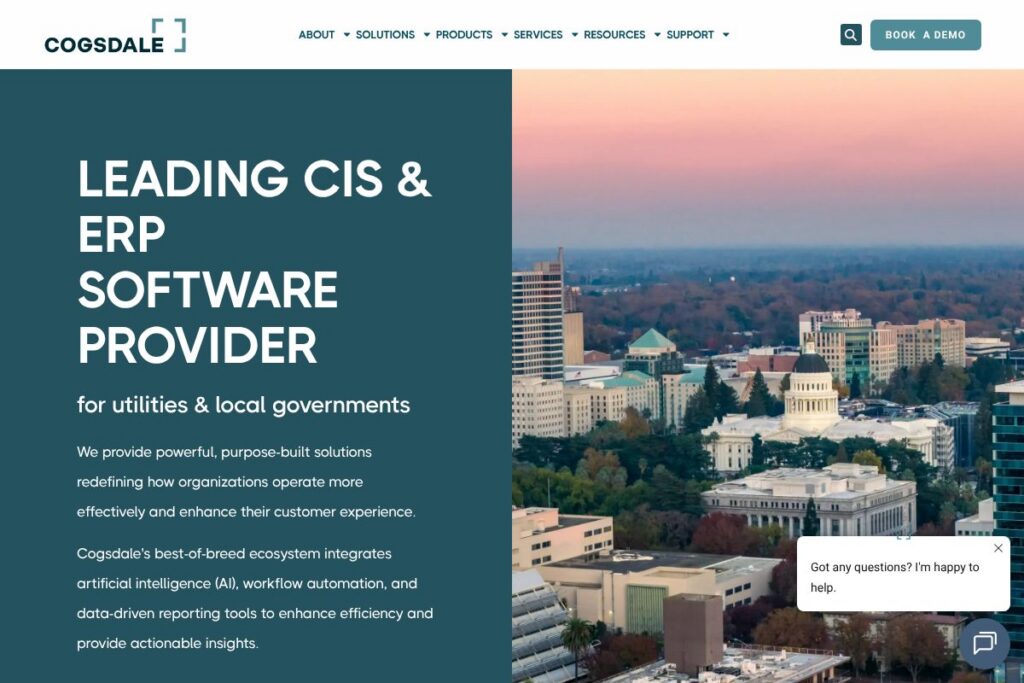
Cogsdale is a software provider that offers integrated ERP and customer information systems for utilities and local governments. Its platform combines utility billing, financial management, meter data support, asset management, and customer service tools in a cloud-hosted architecture designed for regulatory and operational requirements.
Compared with competitors, Cogsdale focuses on mid-size municipal and utility customers with a product set that blends CIS and financial ERP functionality. Tyler Technologies tends to provide broader municipal suites including permitting and public safety modules, while Oracle Utilities targets large utilities with enterprise-grade grid and network operations. Cogsdale sits between these options by offering specialized utility billing and municipal finance modules with more compact implementation footprints.
Cogsdale excels at providing purpose-built modules for utility billing and municipal finance that reduce integration complexity for organisations with both utility and general ledger needs. This makes it well suited to local governments and utility districts that require a single vendor for billing, payments, and financial reporting.
How Cogsdale Works
Cogsdale is delivered as a cloud-hosted platform where core modules share a common data model so billing, payments, and financial entries stay synchronized. Users access role-based web applications for customer service, billing administration, finance, and field operations; this reduces data handoffs and duplicate entry across departments.
Operational workflows are defined inside the platform so processes like meter-to-cash, delinquency management, and journal entry approvals follow configurable steps. Integrations to meter data systems, payment gateways, and GIS are handled through connectors or APIs that move data between Cogsdale and external systems for near real-time updates.
Implementation typically involves data migration from legacy CIS or ERP systems, configuration of billing rules and rate structures, and setup of user roles. Training and phased rollouts are common, with the vendor providing implementation support and optional managed services for hosting and operations.
Cogsdale features
Cogsdale’s product suite centers on utility billing and municipal financials, augmented by workflow automation, AI-assisted reporting, and cloud deployment. The platform integrates customer service, meter and asset data, payment processing, and general ledger functions, while recent investments emphasize automation and analytics to provide actionable operational insights.
Customer Information System (CIS)
The CIS handles account management, service orders, rate structures, and billing cycles in a utility-centric data model. It supports segmented billing for water, sewer, storm, and other services, helping customer service teams produce accurate bills and manage service exceptions.
Utility Billing and Payments
Billing supports complex rate structures, seasonal adjustments, and tiered consumption pricing, with integrated payment processing and remittance handling. The system reduces manual reconciliation by posting payments directly into the financial ledger and supports multiple tender types and online payments.
Financial Management / ERP
General ledger, accounts payable, and accounts receivable modules are built to work with utility transactions and fiscal reporting requirements. This alignment ensures revenue from billing posts correctly to financial statements and simplifies audit trails for municipal accounting teams.
Meter and Asset Management
Meter tracking, exception handling, and integration with AMI/MDMS platforms enable near real-time meter reads and validation workflows. Asset registers and lifecycle tracking help utilities plan maintenance, capital replacement, and depreciation reporting within the same system as billing and finance.
Workflow Automation and Case Management
Configurable workflows guide processes such as delinquency follow-up, service disconnects, and customer dispute resolution. Case management features centralize notes, attachments, and task assignments so teams can track outstanding issues from initial contact through resolution.
Reporting, Analytics, and AI-driven Insights
Built-in reporting and dashboards surface operational KPIs such as aging receivables, consumption patterns, and revenue trends. The platform pairs those capabilities with rule-based analytics and emerging AI features to detect anomalies, forecast revenue, and automate routine reporting tasks.
Field Mobility and Work Order Support
Mobile-enabled apps for field crews support meter reading, work order dispatch, and service confirmations with offline capabilities. Field updates sync back to the central system to keep billing and asset records current and reduce paperwork.
Security and Compliance
Role-based access, encryption in transit and at rest, and audit logging are standard to meet municipal and utility compliance needs. The platform is designed to support regulatory reporting and secure personally identifiable information handled by billing and customer service teams.
With these capabilities, Cogsdale brings utility billing and municipal financials into a single operational environment, reducing integration overhead and giving stakeholders a consistent dataset for reporting and decision making.
Cogsdale pricing
Cogsdale offers enterprise-class pricing that is typically provided through custom quotes tailored to an organisation’s deployment size, module selection, and support needs. Pricing is not listed on a public pricing page and is generally structured as subscription or licensed agreements with implementation and hosting options.
For specific plan details, deployment options, and licensing models, review Cogsdale’s product and solutions information on the vendor site or contact their sales team via Cogsdale’s website for a tailored proposal. View Cogsdale’s product and solutions details on their official site for the latest purchasing options and contract models.
What is Cogsdale Used For?
Municipal finance teams use Cogsdale to centralize general ledger activity, accounts payable, and receivable processing while maintaining audit-ready records that align with public sector accounting standards. This reduces reconciliation work and streamlines month-end and year-end financial processes.
Utility departments use the platform for meter-to-cash operations including billing, payment processing, delinquency management, and integrations to meter data systems. Customer service teams leverage the CIS module to manage service requests, account changes, and outage or billing inquiries in a unified interface.
Pros and Cons of Cogsdale
Pros
- Integrated CIS and ERP: Reduces duplicate data entry between billing and finance while maintaining a single source of truth for utility and municipal transactions.
- Utility-focused functionality: Native support for complex rate structures, multi-service billing, and meter workflows tailored to utility operations.
- Workflow automation and analytics: Configurable workflows and built-in reporting help teams automate routine tasks and monitor key performance indicators.
Cons
- Enterprise implementation complexity: Large deployments can require substantial configuration and phased rollouts, which increases the time to value for some organisations.
- Custom pricing and procurement: Absence of public pricing requires direct vendor engagement for budgeting and procurement, which may extend selection timelines.
- Niche focus: Organisations seeking a broad municipal platform covering permitting, public safety, and broader civic services may need additional systems or vendors.
Does Cogsdale Offer a Free Trial?
Cogsdale provides demonstrations and trial environments by request rather than a public free plan. Prospective customers can request product demos or temporary trial access through Cogsdale’s contact channels, which typically include sandbox environments for evaluation and a guided walkthrough of relevant modules.
Cogsdale API and Integrations
Cogsdale exposes integration points and connectors to link meter data systems, payment gateways, GIS platforms, and external financial systems so data flows between core operational systems and Cogsdale modules. The vendor supports API-driven integrations and pre-built connectors to common utility and municipal technologies.
For technical details and developer resources, consult Cogsdale’s solutions and integration information on Cogsdale’s website to review supported connectors and integration options.
10 Cogsdale alternatives
Paid alternatives to Cogsdale
- Tyler Technologies — Provides broad municipal software suites including ERP, permitting, and utility billing modules geared to larger cities and counties. Visit Tyler’s utilities and municipal solutions for details.
- Oracle Utilities — Enterprise-grade utility solutions for large electric, gas, and water utilities, with advanced network and grid management capabilities. Explore Oracle’s utilities portfolio for more information.
- Hansen Technologies — Offers customer care and billing systems for utilities with a focus on regulated energy and water sectors. Hansen supports global utility billing requirements.
- Accela — Focuses on government permitting, licensing, and service request management with extensions for civic workflows and citizen engagement. See Accela’s public-sector platform for features.
- SAP for Utilities — Enterprise resource planning and industry-specific utilities modules for large-scale utilities requiring deep enterprise integration. Review SAP’s industry solutions for utilities.
- Civica — Provides public sector and utility software tailored to local government operations, billing, and revenue management in several international markets.
- Enoro — Specialized CIS for utilities with strong support for retail and commercial customer billing scenarios and market integrations.
Open source alternatives to Cogsdale
- ERPNext — Open source ERP with modules for accounting, asset management, and invoicing that can be configured for municipal finance and utility billing basics. Explore ERPNext’s documentation for customization options.
- Odoo — Modular open source ERP that includes accounting, invoicing, and CRM; suitable for organisations willing to extend modules for utility-specific needs. See Odoo’s app catalog for relevant modules.
- Open311 — An open standard and set of tools for municipal service requests and case management, useful for governments implementing citizen-facing reporting workflows.
- CKAN — Open data platform used by governments to publish and manage datasets, which can complement analytics and transparency requirements alongside financial and operational systems.
Frequently asked questions about Cogsdale
What is Cogsdale used for?
Cogsdale is used for utility billing, customer information, and municipal financial management. Organisations use it to centralize meter-to-cash workflows, payment processing, and general ledger posting.
Does Cogsdale integrate with GIS and meter data systems?
Yes, Cogsdale supports integrations with GIS platforms and meter data systems. The platform provides connectors and API endpoints to synchronise spatial and metering information with billing and asset records.
How does Cogsdale pricing work?
Cogsdale uses custom enterprise pricing based on modules, deployment, and support levels. Procurement typically involves a tailored quote and options for cloud hosting, implementation services, and ongoing support.
Can Cogsdale handle multi-utility billing scenarios?
Yes, Cogsdale supports multi-utility billing for water, sewer, storm, and other utility services. The billing engine handles complex rate structures, seasonal adjustments, and consumption-based charges.
Does Cogsdale provide APIs for developers?
Cogsdale provides API and connector options for integrations. Developer and integration details are available through Cogsdale’s solutions and integration documentation on the vendor site.
Final verdict: Cogsdale
Cogsdale is a focused platform that pairs utility CIS and municipal financial management in a single cloud-hosted suite, which reduces integration work for organisations that manage both types of operations. Its strength lies in utility-specific billing capabilities, workflow automation, and a unified ledger that helps municipalities and utilities reconcile operational and financial data more efficiently.
Compared with a competitor like Tyler Technologies, Cogsdale offers a more concentrated utility and finance pairing while Tyler provides a wider municipal product portfolio. Both vendors use enterprise pricing models with custom quotes and multi-year contracts, so the right choice depends on whether an organisation prioritises specialised utility billing and integrated finance (Cogsdale) or a broader municipal stack with additional civic modules (Tyler Technologies).