CometChat: An Overview
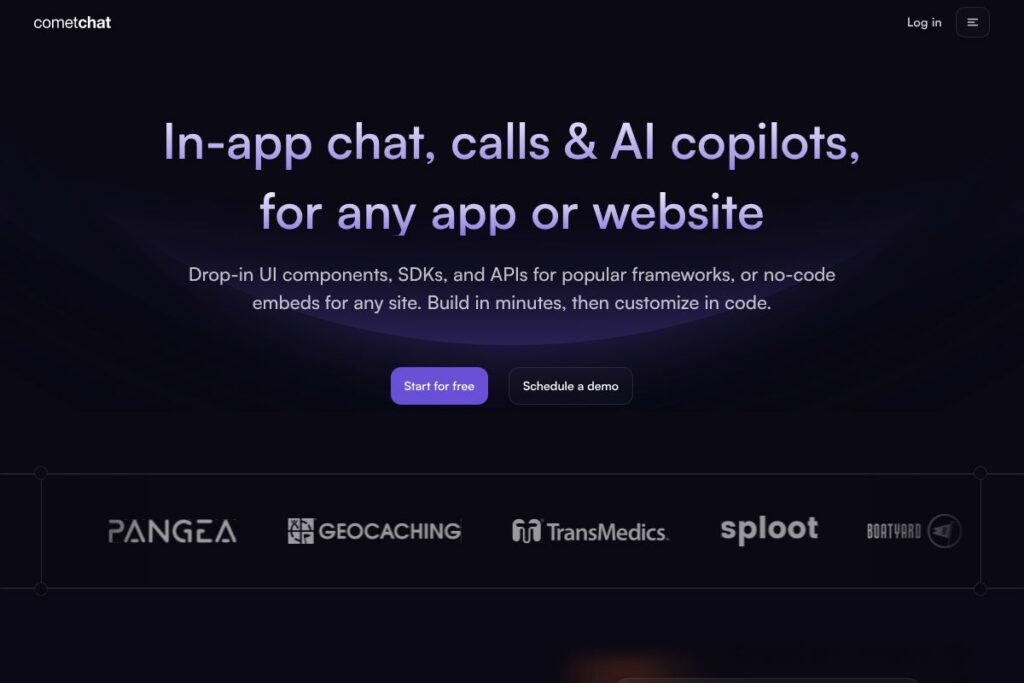
CometChat is a communications platform that combines real-time messaging, voice and video calling, and an agent-ready AI layer into a single developer-focused stack. It supplies SDKs for popular frameworks, prebuilt UI kits, web components, and no-code embeds so teams can add a production-ready chat experience quickly and then customize behavior in code.
Compared with lower-level building blocks like Twilio‘s programmable APIs, CometChat provides more opinionated UI components and built-in services such as moderation, analytics, and tenant isolation that reduce integration work. Against competitors such as Sendbird and Agora, CometChat leans toward a full-stack packaged experience that includes conversational AI tooling plus notification and safety systems out of the box.
All of this makes CometChat a practical choice for product teams that want a complete communication platform with integrated safety and observability. It is especially suited to apps that need multi-tenant support, in-product AI agents, or rapid delivery of branded chat and call experiences without building every subsystem from scratch.
How CometChat Works
CometChat installs into an application through platform-specific SDKs for web, iOS, Android, React Native, Flutter, and JavaScript. Developers authenticate users against their existing identity systems, then initialize the SDK to connect users to the CometChat cloud; from there messages, presence, and call signaling flow over CometChat’s real-time infrastructure.
Teams can use CometChat’s drop-in UI kits to ship immediately, or build custom interfaces using the low-level APIs. For agent and AI workflows, CometChat routes messages to configured LLMs or tool-calling services, applies guardrails and moderation rules, and surfaces analytics for tuning conversational logic.
A typical workflow looks like this: integrate the SDK, wire authentication, add UI components or custom UI, configure moderation and notification prefs, then iterate using dashboards and webhooks for events. Multi-tenant projects isolate data, moderation rules, and branding at the tenant level so one backend can serve multiple customers or communities.
CometChat features
CometChat organizes core communication features, AI tooling, and shared services into a layered platform so teams can pick the capabilities they need. Core additions in recent releases emphasize agent tooling, guardrails for AI responses, multi-region delivery, and enhanced analytics.
Real-time chat
Supports 1:1, group, and broadcast messaging with rich media, file attachments, reactions, threads, typing indicators, and read receipts. This feature set helps product teams deliver conversation types from simple direct messages to community forums and classroom discussions with consistent UX.
Voice and video calling
Offers 1:1 and group voice and video calls with optional screen sharing and recording. Call features integrate with the messaging layer so sessions, transcriptions, and media can be surfaced inside chat histories for consultations, support, or collaboration workflows.
Full-stack AI agent platform
Enables teams to plug in external LLMs or run agents inside the platform, include retrieval-augmented generation and tool-calling, and use an agent-ready UI with citations, memory, and retry controls. Built-in guardrails and fallback logic make it easier to deploy user-facing agents safely.
Moderation and guardrails
Provides AI-native, context-aware safety that covers user-generated content and agent responses with multilingual support. The visual rule engine, fallback handling, and policy enforcement reduce the need to build bespoke moderation pipelines.
Analytics and insights
Includes dashboards and metrics for conversation health, agent performance, and usage trends so teams can measure feature adoption and tune UX without wiring additional analytics tools. Event-level tracking and prebuilt reports speed iterations.
Notification engine
Delivers push, email, and SMS notifications with frequency controls, quiet hours, retries, and templating support. Notifications respect user preferences and can be used to re-engage users or surface critical events from the chat system.
Developer tooling and extensibility
Ships with UI kits, SDKs, REST APIs, webhooks, and visual builders that support rapid prototyping and large-scale product development. The combination of no-code embeds and programmatic APIs means both non-developers and engineers can iterate efficiently.
Multi-tenant infrastructure
Supports running multiple brands or customers on one backend while isolating logic, moderation policies, and branding per tenant. This reduces code duplication for SaaS products, marketplaces, and platforms serving multiple communities.
Security and compliance
Includes encryption in transit and at rest, role-based access control, access logs, and message auditing for policy enforcement. Global multi-region delivery and an edge network help minimize latency while maintaining compliance controls.
With these features CometChat aims to remove infrastructure friction so teams can focus on the product experience rather than the plumbing underlying real-time conversation.
CometChat pricing
CometChat uses a subscription-based SaaS pricing approach with options that range from free tiers for development and small projects to paid plans and custom enterprise arrangements for larger deployments. Pricing typically reflects usage, feature set, and enterprise requirements rather than a single flat fee.
For the most accurate and up-to-date information on plans, enterprise options, and billing terms, consult CometChat’s website at the CometChat homepage or contact their sales team through the site for tailored quotes and volume-based arrangements.
What is CometChat Used For?
CometChat is commonly used to add in-app messaging and calling to consumer apps, SaaS products, marketplaces, telehealth platforms, education tools, gaming lobbies, and social networks. Its prebuilt UI kits and moderation systems make it suitable for both customer-facing chat and internal collaboration features.
Product teams also use CometChat to deploy conversational AI assistants that sit inside the chat interface, enabling use cases such as customer support bots, interactive help agents, and guided workflows where an agent performs lookups or triggers backend actions.
Pros and Cons of CometChat
Pros
- Comprehensive feature set: CometChat bundles messaging, voice and video, notifications, analytics, and AI agent tooling which reduces the need to integrate multiple vendors to get a full communication stack.
- Developer-friendly SDKs and UI kits: Prebuilt components speed time to market while low-level APIs and webhooks allow deeper customization for production-grade apps.
- Built-in safety and tenant controls: Moderation, guardrails, and multi-tenant isolation lower operational overhead for regulated or multi-brand deployments.
Cons
- Managed service dependency: Using a hosted communications platform means relying on a third-party backend for critical chat and call capabilities rather than a fully self-hosted solution.
- Integration surface can be broad: The number of configurable options and services can require upfront investment to tune moderation, notifications, and agent behaviors for a specific product experience.
Does CometChat Offer a Free Trial?
CometChat offers a free tier plus paid subscription plans. The free tier is intended for development and small-scale evaluation, and paid plans provide higher usage limits, advanced features, and enterprise-grade controls; sign up and plan details are available on the CometChat homepage.
CometChat API and Integrations
CometChat provides platform SDKs and a REST API alongside extensive developer documentation for message, presence, and call management; explore the CometChat developer documentation for endpoint details, SDK guides, and quickstarts. Webhooks and event APIs enable integration with backend systems and analytics pipelines.
Common integrations include CRM and support systems, workflow automation tools, and identity providers; teams frequently connect CometChat with systems like Zendesk, Salesforce, or automation platforms via webhooks and intermediary services to route events and synchronize users.
10 CometChat alternatives
Paid alternatives to CometChat
- Twilio — Low-level programmable messaging and voice APIs that give fine-grained control over usage and billing, often chosen by teams that want custom implementations rather than prebuilt UIs; see Twilio Programmable Chat for details.
- Sendbird — A messaging platform with scalable chat and voice/video SDKs, focused on in-app social and commerce experiences with moderation and analytics.
- Agora — Emphasizes real-time voice and video infrastructure for calls and live interactions, often selected for low-latency media-first applications.
- Stream — Real-time feeds and chat focused on performance and client-side SDKs to build high-throughput messaging and activity streams.
- PubNub — Real-time data streaming and messaging infrastructure designed for global delivery and pub/sub messaging patterns.
- Pusher — Realtime APIs for presence, channels, and event-driven updates, useful for lightweight chat and collaboration features.
Open source alternatives to CometChat
- Matrix — A decentralized open protocol for real-time communication; used via clients like Element and suitable for teams that want full control and federation.
- Rocket.Chat — An open source team chat platform with support for messaging, audio/video, and on-premises deployment.
- Mattermost — Focused on secure, self-hosted team communication and collaboration with extensive customization and compliance options.
- Jitsi — Open source video conferencing suitable for embedding group calling and screen sharing capabilities into products.
- Chatwoot — Open source customer messaging platform oriented at support and engagement use cases with self-hosting options.
Frequently asked questions about CometChat
What platforms does CometChat support?
CometChat supports web, iOS, Android, React Native, and Flutter. SDKs and UI kits are available for major platforms and there are JavaScript libraries for web integration.
Does CometChat provide moderation features?
Yes, CometChat includes moderation and guardrail tools. The platform offers a visual rule engine, automated filters, fallback logic, and multilingual media support for content and agent responses.
Can CometChat handle multi-tenant applications?
Yes, CometChat has built-in multi-tenant support. You can isolate branding, moderation rules, and logic per tenant without duplicating backend infrastructure.
Does CometChat offer APIs for building custom workflows?
Yes, CometChat exposes REST APIs, SDKs, and webhooks. Developer documentation provides endpoints, event hooks, and guides for integrating with backend systems and automation tools.
Is CometChat suitable for building conversational AI agents?
Yes, CometChat provides an AI agent platform. It supports plugging in LLMs, RAG, tool-calling, agent memory, and citation-ready UIs with guardrails and analytics.
Final Verdict: CometChat
CometChat excels at delivering a packaged communications stack that combines messaging, voice and video, and agent capabilities with built-in moderation, analytics, and multi-tenant controls. That combination reduces integration work for teams that want a production-ready chat and calling experience without assembling each subsystem independently.
Compared with Twilio‘s lower-level programmable APIs, CometChat trades some raw flexibility for faster time to market through UI kits and managed services; Twilio tends to be usage-based while CometChat is positioned around subscription tiers and enterprise agreements with bundled features. For teams that need rapid delivery of branded chat, safe agent workflows, and tenant isolation, CometChat is a strong fit; teams that require per-message billing or full control over every protocol detail may prefer a lower-level provider such as Twilio.