CorTec and ChefTec: An Overview
CorTec and ChefTec are purpose-built software suites for foodservice management, covering recipe and menu costing, inventory control, purchasing and ordering, production planning, nutritional analysis, and requisitioning. ChefTec targets independent operations, small chains, and on-premise kitchens with a focus on ease of use and rapid deployment. CorTec is designed for larger, corporate or multi-site foodservice operations where centralized control, multi-location inventory, and advanced reporting are priorities.
Compared with competitors such as Apicbase, MarketMan, and CBORD, CorTec and ChefTec place stronger emphasis on on-premise production workflows and requisitioning between storerooms and production kitchens. Apicbase focuses on cloud-native recipe management and ingredient traceability with modern API-first integrations, while MarketMan emphasizes purchasing and supplier connectivity with mobile receiving. CBORD often serves large institutions with integrated campus solutions and meal plan functionality. CorTec and ChefTec bridge those needs by offering traditional foodservice controls plus options for centralized enterprise management.
All of this makes CorTec and ChefTec particularly well suited to foodservice directors, multi-site operators, university and healthcare kitchens, hospitality groups, and independent restaurateurs who need accurate cost control across recipes, production batches, and transfers. The platforms are practical choices where tight inventory control, food cost visibility, and production planning drive measurable ROI for kitchens.
How CorTec and ChefTec Work
Both products organize food operations around core data entities: ingredients, recipes, menus, inventory locations, vendors, and purchase orders. Users build recipes with ingredient yields and unit conversions, link those recipes to menus and production batches, and then track consumption against inventory to produce accurate food cost and usage reports.
Typical workflows start with recipe setup, move to purchasing and receiving, then continue through production and transfers with final reconciliation against on-hand counts. CorTec adds multi-site centralization so users can consolidate purchasing and roll up reporting across locations, while ChefTec keeps workflows streamlined for single-site and small-chain operators.
Implementation normally involves importing vendor price files and vendor catalogs, setting up inventory par levels for storerooms and freezers, and training kitchen staff on simple receiving and production screens. Reporting outputs integrate into purchasing cycles to suggest order quantities and identify high-cost recipes that need attention.
CorTec and ChefTec features
CorTec and ChefTec cover the practical needs of foodservice operations with modules for costing, inventory, purchasing, nutrition, production, and multi-location control. Recent updates have focused on tighter inventory reconciliation and simplified recipe yield handling to reduce cycle counts and improve food cost accuracy.
The platform includes several powerful capabilities worth highlighting:
Recipe and Menu Costing
Ingredient-level costing supports multiple purchase units, yield adjustments, and vendor prices so recipe cost per portion is calculated precisely. Cost roll-ups allow menu-level profitability views and automatic updates when vendor costs change, helping managers set menu prices based on accurate food cost targets.
Inventory Control
Inventory features include manual and cycle counting, par-based replenishment, unit conversion across purchase and usage units, and variance reporting. Those controls reduce waste by surfacing overstocked items and shrinkage, and they support both storeroom-level and production-level stock tracking.
Purchasing and Ordering
Purchasing workflows let users generate purchase orders from par levels or direct requisitions, track receiving, and maintain vendor price histories. The system supports multi-vendor ordering and produces receiving reports that feed directly into inventory adjustments and cost calculations.
Production Planning and Requisitioning
Production modules support batch cooking, yield allocation, and requisition slips to move product between locations or production lines. This streamlines large-scale prep, ensures consistent portioning, and provides traceability from raw ingredient to finished portion.
Nutritional Analysis
Nutritional analysis breaks recipes down by calories and macro nutrients based on ingredient profiles so kitchens serving regulated environments or meeting labeling requirements can produce consistent nutrition facts. Outputs can be used for menu labeling or compliance reporting.
Reporting and Analytics
Standard reports cover usage, ordering, inventory valuation, recipe profitability, and vendor spend. Customizable reporting lets managers create focused dashboards for weekly food cost trends, high-spend categories, and variance analysis across locations.
Multi-location and Centralized Control
CorTec adds centralized purchasing, recipe sharing, and consolidated reporting to support corporate kitchens and chains. Central control simplifies price negotiation, enforces standardized recipes, and provides enterprise-level visibility while maintaining local execution.
With these capabilities CorTec and ChefTec help kitchens reduce food cost, simplify purchasing, and standardize production practices across single sites and multi-site organizations.
CorTec and ChefTec pricing
CorTec and ChefTec use a licensed pricing model tailored to organizational needs, with options that scale from single-site ChefTec licenses to multi-site CorTec enterprise agreements. For current licensing options, deployment types, and any subscription or maintenance fees, contact the vendor directly through their site for a tailored quote.
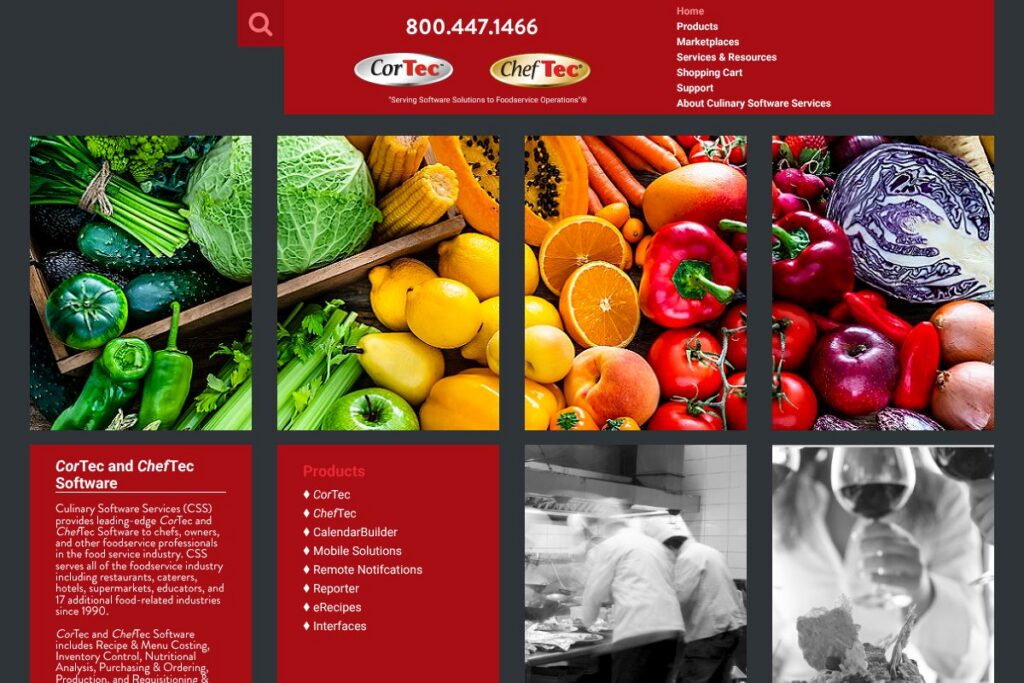
For a direct look at licensing and service levels, see the Culinary Software Services homepage for contact and purchasing details.
What is CorTec and ChefTec Used For?
CorTec and ChefTec are used to control food costs, streamline purchasing, and manage inventory for kitchens ranging from independent restaurants to large institutional programs. Operators use recipe costing to set menu prices, inventory tools to reduce waste, and purchasing modules to automate reordering and track vendor performance.
They are also used for production planning and batch management in high-volume kitchens such as catering operations, university dining, and hospital foodservice. Multi-location organizations rely on CorTec for centralized purchasing and consolidated reporting, while small operators use ChefTec for day-to-day food cost control and inventory accuracy.
Pros and Cons of CorTec and ChefTec
Pros
- Comprehensive foodservice functionality: The suite covers costing, inventory, purchasing, production, and nutrition which reduces the need for multiple separate systems. This helps operators keep data consistent across workflows.
- Scales from small sites to enterprise: ChefTec suits single-site kitchens while CorTec adds centralized controls for multi-site organizations, providing options for growing operations. The common data model eases transitions from single-site to multi-site deployments.
- Strong production and requisition workflows: Batch production, yield handling, and requisition slips make the software practical for high-volume kitchens that need consistent portioning and traceability.
Cons
- Enterprise deployment and customization: Large CorTec deployments may require professional services and integration work, which can increase time to value for organizations with complex legacy systems. Budgeting for implementation is important.
- Modern cloud-native integrations: Compared to newer, API-first platforms, integration with some modern procurement or analytics tools may require custom connectors or middleware for full automation. This is often resolved via professional services.
Does CorTec and ChefTec Offer a Free Trial?
CorTec and ChefTec are offered under paid licenses with demos and trial options available through the vendor. Organizations typically arrange a product demonstration and can request trial access or a sandbox to evaluate workflows before committing to a licensed deployment. Contact the vendor via the Culinary Software Services homepage to arrange a demo or trial environment.
CorTec and ChefTec API and Integrations
Both platforms support integrations with point-of-sale systems, accounting and purchasing systems, and supplier data imports to streamline ordering and receiving. Enterprise customers can request API access and integration support to connect CorTec or ChefTec with procurement platforms and ERP systems.
For details about supported connectors and developer access, review the vendor’s integration information at the integration and API information page.
10 CorTec and ChefTec alternatives
Paid alternatives to CorTec and ChefTec
- Apicbase — Cloud-first recipe management, food cost control, and inventory with strong API integrations and supplier connectivity. Good for operators seeking modern SaaS workflows.
- MarketMan — Purchasing and inventory platform with mobile receiving and supplier management, focused on streamlining purchasing and invoice reconciliation.
- Oracle MICROS — Enterprise point-of-sale and back-office capabilities often bundled with broader hospitality solutions and integrations for large hospitality groups.
- BlueCart — Ordering and inventory automation that simplifies supplier communication and reduces manual ordering work for restaurants and distributors.
- Kitchen CUT — Recipe and supplier management with menu engineering tools aimed at chefs and food teams focused on menu profitability.
- ChefMod — Procurement and inventory system targeted at multi-site operators, providing purchasing controls and vendor management.
- Squirrel Systems — Restaurant management suite with POS and back-office tools for dining operations and hospitality venues.
Open source alternatives to CorTec and ChefTec
- ERPNext — Open source ERP with inventory, purchasing, and manufacturing modules that can be adapted for recipe and kitchen workflows. Good for teams that can customize and self-host.
- Odoo (Community edition) — Modular open source business apps including inventory and purchasing that can be extended to support foodservice processes with custom modules.
- Open Food Network — A platform focused on food supply chains and food business operations, useful for small-scale producers and co-ops adapting workflows for markets.
Frequently asked questions about CorTec and ChefTec
What does CorTec and ChefTec do for food cost management?
CorTec and ChefTec provide ingredient-level costing and recipe roll-up tools to calculate menu and portion costs. They automatically apply yields and unit conversions so menu prices and food cost percentages reflect current vendor pricing.
Does CorTec and ChefTec integrate with point-of-sale systems?
Yes, both products support integrations with POS systems through connectors or API access for enterprise customers. Integration options streamline sales-to-inventory reconciliation and help maintain accurate usage records.
How much does CorTec and ChefTec cost to license?
CorTec and ChefTec use licensed pricing tailored to the size and needs of the operation. Pricing varies by site count, deployment type, and optional services; contact the vendor via their homepage for a customized quote.
Can CorTec and ChefTec handle multi-site inventory and purchasing?
Yes, CorTec is designed for multi-site and corporate foodservice management with centralized purchasing and consolidated reporting. ChefTec serves single sites and small chains with the same core modules in a simpler configuration.
Is nutritional analysis available in CorTec and ChefTec?
Yes, both platforms include nutritional breakdowns for recipes to support menu labeling and dietary planning. Outputs include calorie and macro nutrient calculations based on ingredient nutritional profiles.
Final Verdict: CorTec and ChefTec
CorTec and ChefTec are practical, function-rich solutions for foodservice operators who require precise recipe costing, robust inventory control, and structured production workflows. ChefTec provides approachable functionality for single-site kitchens and small chains, while CorTec adds centralized controls and enterprise reporting needed by larger organizations.
Compared with Apicbase, which emphasizes a cloud-native, API-first approach and transparent subscription tiers, CorTec and ChefTec favor licensed deployments with deeper on-premise production controls and centralized purchasing features. Organizations that prioritize on-site production workflows and multi-location centralization will find CorTec and ChefTec well aligned with those needs, while operators seeking a purely cloud-native integration stack may prefer Apicbase or similar SaaS-first alternatives.
Overall, these platforms deliver the operational controls that kitchens need to manage food cost, purchasing, and production at scale, making them solid choices for hospitality groups, institutions, and independent operators focused on measurable cost savings and standardized kitchen practices.