What is CustomGPT.ai
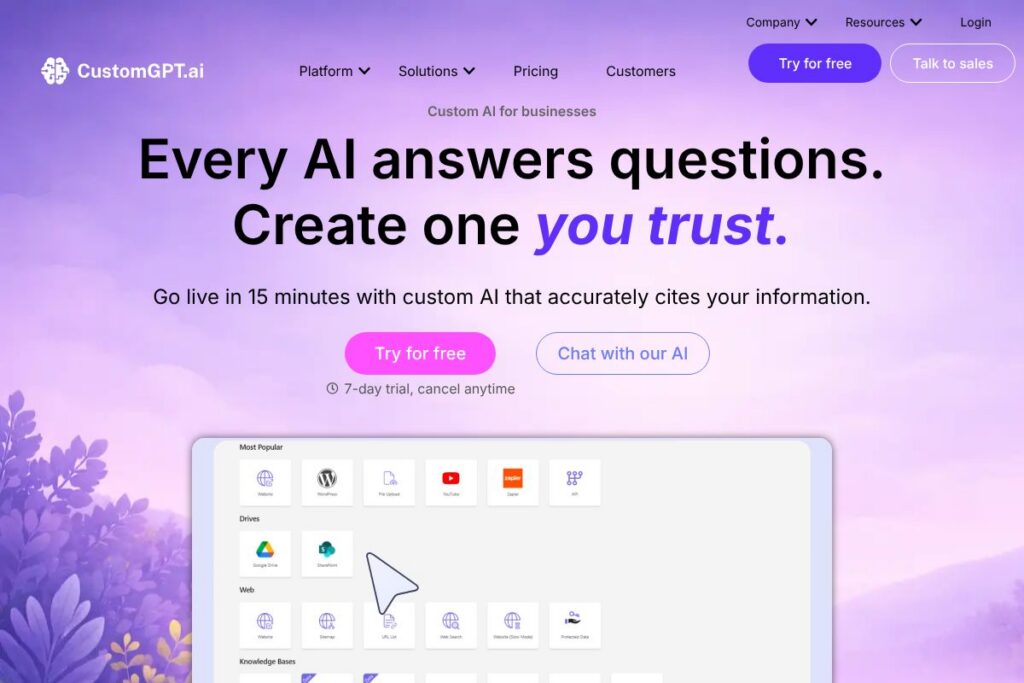
CustomGPT.ai is a platform that helps businesses build custom GPTs from their own documents, knowledge bases, and product content. It focuses on turning proprietary content into conversational agents that answer questions, automate routine tasks, and surface company knowledge inside chat interfaces and APIs.
Compared with OpenAI‘s native Custom GPTs, CustomGPT.ai emphasizes scalable data ingestion pipelines and enterprise connectors for multiple knowledge stores rather than a single self-serve builder. Against Anthropic and Google Vertex AI, CustomGPT.ai positions itself as a turnkey option for applying retrieval-augmented generation workflows to business content with a focus on answer quality and deployment flexibility. For teams that already use frameworks such as LlamaIndex or LangChain for RAG, CustomGPT.ai offers a more productized path from ingestion to hosted assistant.
All of this makes CustomGPT.ai well suited for companies that need accurate, context-aware conversational agents built from distributed content. It does particularly well at bringing multiple knowledge bases together, and is aimed at enterprises and product teams that need API access and scalable ingestion rather than a single-user chatbot builder.
How CustomGPT.ai Works
CustomGPT.ai ingests content from documents, knowledge bases, and APIs, then processes that content into searchable embeddings and retrieval indexes that power a conversational layer. Queries are answered using retrieval-augmented generation so responses draw on source documents and can include citations, context, and follow-up logic.
Teams deploy assistants through hosted chat interfaces or via API integration into existing apps, CRMs, and support tools. Typical workflows include configuring data sources, setting up indexing and refresh schedules, defining response guardrails, and connecting the assistant to channels like web chat or internal help desks.
What does CustomGPT.ai do?
CustomGPT.ai organizes capabilities around creating production-ready conversational agents from enterprise content. Core features center on data ingestion, retrieval, conversational orchestration, API access, and enterprise controls. Recent focus areas include scaling ingestion across many knowledge systems and improving answer relevance through tuning and context management.
Custom GPT creation from your content
The platform converts documents, FAQs, and structured knowledge into conversational agents that reflect your company voice and facts. This capability reduces manual prompt engineering by using indexed content plus templates and role settings to shape responses for customer support, sales, and internal assistants.
Scalable data ingestion and connectors
CustomGPT.ai supports ingesting content from multiple sources at scale, including cloud storage, databases, and knowledge bases, allowing teams to centralize fragmented information. Automated pipelines and scheduled updates keep indexes fresh so answers reflect the latest documentation and product changes.
Retrieval-augmented generation (RAG)
RAG combines a nearest-neighbor retrieval layer with model generation so answers cite and reference source documents rather than hallucinate. This approach improves factual accuracy for customer-facing answers and internal knowledge searches while enabling traceability back to the source.
API access and developer tools
The platform exposes APIs and developer tooling to embed assistants into apps, workflows, and backend systems. API capabilities support programmatic query handling, session context, and integration with business logic for actions or data lookups.
Security, access controls, and compliance
Enterprise controls include role-based access, data isolation, and options for secure hosting to meet organizational security and compliance needs. These controls let teams restrict which content feeds specific assistants and audit conversational logs for governance.
Deployment options and channel support
Assistants can be delivered via hosted web chat, embeddable widgets, or integrated into third-party tools through the API. This allows consistent experiences across customer support portals, internal help centers, and product interfaces.
CustomGPT.ai’s strongest benefit is turning fragmented corporate content into reliable, context-aware conversational agents that can be deployed at scale. That single capability reduces time to value for knowledge automation projects and improves answer consistency across customer and internal interactions.
CustomGPT.ai pricing
CustomGPT.ai uses a custom enterprise pricing model tailored to deployment scale, data volume, and API usage. For up-to-date plan options, enterprise tiers, and procurement details, view the CustomGPT.ai homepage and contact channels to request pricing and a tailored quote.
What is CustomGPT.ai Used For?
Customer support automation is a primary use case, where CustomGPT.ai provides contextual answers drawn from product documentation, knowledge bases, and support histories. Teams use it to reduce average handling time by surfacing accurate steps, policy details, and guided resolutions inside chat and ticketing systems.
Internal knowledge and employee-facing assistants are another common use. HR, IT, and operations teams deploy private assistants to let staff query policies, onboarding materials, and internal procedures without searching multiple systems.
Sales enablement, product documentation augmentation, and developer support are additional use cases where conversational agents accelerate access to relevant content. Product teams often use the system for in-app help and to power smart documentation search that returns actionable, sourced answers.
Pros and Cons of CustomGPT.ai
Pros
- Strong data ingestion: The platform centralizes multiple knowledge bases into one retrieval index, which reduces fragmentation and improves answer coverage. This capability is useful for organizations with decentralized documentation.
- Enterprise controls and security: Role-based access, data isolation, and governance features help meet compliance needs and limit exposure of sensitive content. These controls are important for regulated industries.
- API-first approach: Robust API access enables embedding assistants in custom workflows, adding business logic, and scaling conversational capabilities across products and services. Developers can automate queries and session handling.
- Focused on answer quality: Emphasis on retrieval-augmented generation and tuning tools leads to more accurate, source-backed responses for customer-facing and internal scenarios.
Cons
- Enterprise pricing model: Custom enterprise pricing can be less predictable for small teams that need transparent self-serve plans and may require sales engagement to evaluate costs. This structure fits larger deployments better than single-user trials.
- Platform dependency for ingestion: Organizations that require full control over indexing and hosting may need additional integration work to meet specific architecture or on-premises requirements. Some teams may prefer open-source stacks for full self-hosting.
- Implementation overhead: Configuring connectors, tuning retrieval, and establishing governance requires technical resources and time, which may slow early-stage pilots without dedicated engineering support.
Does CustomGPT.ai Offer a Free Trial?
CustomGPT.ai offers a free AI community and typically manages product trials through sales and onboarding channels. Join the CustomGPT.ai community to engage with engineers and partners, and contact the team through the homepage to discuss trial access or pilot programs tailored to your content and use case.
CustomGPT.ai API and Integrations
CustomGPT.ai provides API access to query assistants, manage sessions, and integrate responses into applications and workflows. For developer onboarding, consult the CustomGPT.ai homepage and contact pages to request API documentation and keys suitable for your environment.
Common integrations include embedding assistants into web chat, connecting with ticketing systems, and linking to CRMs or knowledge stores so that answers reflect customer and product data. Integration patterns typically mirror standard RAG deployments, with connectors to content repositories and webhook-based action flows.
10 CustomGPT.ai alternatives
Paid alternatives to CustomGPT.ai
- OpenAI — A broad AI platform offering model APIs and Custom GPT features that let teams build assistants with pay-as-you-go API pricing and self-serve tooling. OpenAI is useful for teams that want direct access to model capabilities and transparent billing.
- Anthropic — Focuses on safety and controllable models, with enterprise options for building conversational agents and retrieval workflows. Anthropic suits organizations prioritizing model behavior controls.
- Google Cloud Vertex AI — Provides managed model training, hosting, and retrieval tools integrated with Google Cloud services for large-scale deployments and data pipeline integration. Ideal for teams already on Google Cloud.
- Cohere — Offers API access to large language models and embeddings, with developer tooling for retrieval-augmented solutions and enterprise support. Cohere is used for custom conversational and search experiences.
- Jasper — A content-first AI platform that includes assistant features and integrations geared toward marketing and sales teams; suited for content generation combined with conversational workflows.
- Perplexity — A consumer and enterprise-oriented answer engine that combines web retrieval with generative responses, useful for research and customer assistance projects.
Open source alternatives to CustomGPT.ai
- LlamaIndex — A toolkit for building RAG applications that connects documents to LLMs via flexible indexing and retrieval strategies; preferred by developer teams building custom pipelines.
- Haystack — An open source framework for RAG and conversational AI that includes connectors, retrievers, and pipelines for production deployments. It is suitable for teams that require full control and self-hosting.
- Rasa — An open source conversational AI framework focused on dialog management and custom actions, typically used for bot-driven workflows where stateful conversations and integrations matter.
- GPT4All — Community-driven projects offering local model options for smaller-scale or offline assistant deployments where on-premises control is required.
Frequently asked questions about CustomGPT.ai
What is CustomGPT.ai used for?
CustomGPT.ai is used to build conversational agents from company content for support, internal knowledge, and product help. Teams deploy assistants to answer questions, automate workflows, and surface documented procedures across customer and employee channels.
Does CustomGPT.ai provide an API for developers?
Yes, CustomGPT.ai offers API access for embedding assistants and automating queries. Developers can connect the API to apps, chat widgets, and backend services; contact the team via the homepage for documentation and keys.
Can CustomGPT.ai integrate with existing knowledge bases?
CustomGPT.ai integrates with multiple content sources to centralize knowledge into searchable indexes. Connectors and ingestion pipelines allow you to bring together documents, FAQs, and databases so assistants draw from authoritative sources.
Is CustomGPT.ai suitable for regulated industries?
CustomGPT.ai includes enterprise controls for data access and governance that support regulated deployments. Role-based permissions, data isolation, and hosting options help align implementations with compliance requirements.
How does CustomGPT.ai handle updates to company content?
CustomGPT.ai supports scheduled ingestion and index refreshes so assistants reflect updated documentation and product changes. Teams can configure update cadence and data pipelines to keep responses current.
Final verdict: CustomGPT.ai
CustomGPT.ai is a focused platform for turning internal and external company content into production-ready conversational agents that scale across customer and employee use cases. Its strengths are scalable data ingestion, enterprise controls, and API-first deployment patterns that suit organizations with multiple knowledge sources and high accuracy requirements.
Compared with OpenAI, which provides transparent pay-as-you-go API pricing and self-serve custom GPT capabilities, CustomGPT.ai tilts toward enterprise engagements with tailored pricing and dedicated ingestion tooling. If your priority is a managed, enterprise-oriented path from fragmented content to deployed assistants, CustomGPT.ai offers a practical, API-capable solution; if you prefer full control of model selection and billing transparency, consider evaluating OpenAI‘s offerings and pricing at OpenAI’s API pricing.