What is DeadSimpleChat
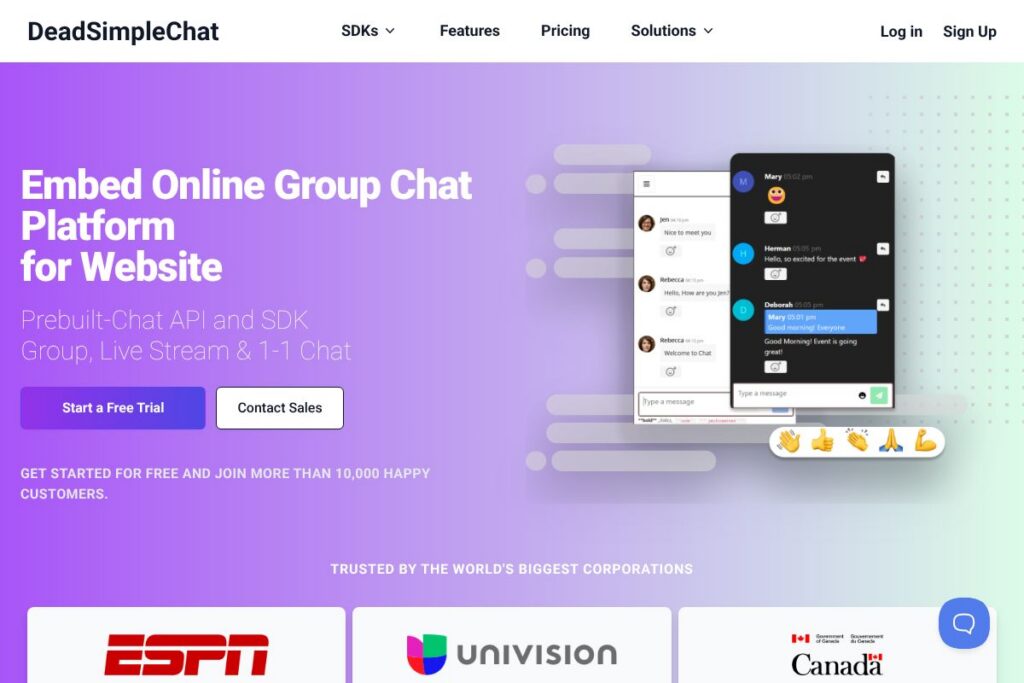
DeadSimpleChat is an embeddable online group chat platform you can add to any website or application with a single line of code. It focuses on high concurrency, low latency, and a ready-made UI that developers or non-technical teams can customize through a dashboard or by adding custom CSS.
Compared with providers focused solely on developer APIs such as Sendbird and GetStream, DeadSimpleChat emphasizes a pre-built, drop-in chat experience plus enterprise-grade scaling up to millions of concurrent participants. Against general-purpose collaboration platforms like Slack, DeadSimpleChat is optimized for public-facing chat rooms, live events, and streaming where extremely high concurrency and simple web embedding matter more than persistent team workspaces.
All of this makes DeadSimpleChat a strong choice for event organizers, streaming platforms, marketplaces, and education platforms that need a fast, reliable chat experience with built-in moderation and translation. It suits teams that want a quick integration path without building a chat UI from scratch, and organizations that require enterprise SLAs for mission-critical live events.
How DeadSimpleChat Works
The platform runs a managed real-time chat service with a pre-built front end you embed using an iframe or a single script snippet. The front end handles message rendering, reactions, replies, file uploads, and UI localization while the backend manages presence, message distribution, persistence, and moderation rules.
Integration workflows typically involve pasting the provided embed code into your page, configuring authentication via Single Sign On if desired, and tuning moderation, translation, and feature flags through the DeadSimpleChat dashboard. Developers can extend or automate chat behavior using the available APIs, SDKs, and webhooks to synchronize user identity, export analytics, or trigger external moderation and logging systems.
DeadSimpleChat features
DeadSimpleChat is organized around a fast, scalable chat engine plus a configurable UI and moderation toolkit. Core capabilities include group and 1-to-1 chat, image and file sharing, Q&A and polls, built-in AI-based image moderation, language translation, webhooks, and a developer API. The platform also advertises enterprise SLAs, E.U. data residency options, and 24×7 support for mission-critical events.
Let’s dive into the standout features:
Group Chat
Support for large-scale public and private rooms that the vendor advertises can handle up to 10 million concurrent participants in a single chat room, with low-latency message delivery suitable for high-traffic events and streams.
Channels and Sub-Rooms
Create topic channels and sub-rooms to separate conversations by booth, session, or subject, making it easier to moderate and surface relevant discussions during events or on high-traffic pages.
Customization
UI-based customization plus the ability to inject custom CSS lets product teams match the chat appearance to their site or app branding without rebuilding the interface from scratch.
Moderation
Moderation tools include multiple moderator roles, message deletion, ban/ un-ban users, blocklists for bad words, and A.I.-driven image moderation to reduce manual moderation load while keeping rooms safe.
Single Sign On (SSO)
SSO integrates your site identity with the chat so users are automatically signed in to chat using existing platform credentials, which simplifies moderation and user management.
Image and File Sharing
Image and file uploads are supported and can be toggled on or off from the dashboard, allowing configurable tradeoffs between engagement and content control or storage costs.
Reply, Reactions, and Q&A Mode
Users can reply to specific messages, add reactions, and run structured Q&A sessions with exportable transcripts, which is useful for moderated event engagement and post-event analysis.
Polls and Interactive Features
Conduct polls and collect audience feedback directly in chat, useful for live webinars, virtual events, and classroom interactions where quick audience input is needed.
Analytics and Downloadable History
Dashboards show metrics like peak connections, message volume, and active users; analytics can be exported and chat history is downloadable for compliance or archival needs.
APIs, SDKs, and Webhooks
Comprehensive APIs and webhooks let developers control chat lifecycle events, user provisioning, message export, and custom moderation flows; SDKs speed integration into web and mobile apps. See the API documentation to explore available endpoints and examples.
Security, Compliance, and SLAs
Connections are protected with TLS, the platform supports GDPR compliance and E.U. data residency on request, and enterprise customers can arrange SLAs and guaranteed uptime during events. For enterprise details consult the enterprise SLA information.
The biggest advantage is the combination of a ready-made embed plus enterprise features; teams get a production-ready chat with scale and the hooks needed to integrate with existing systems.
DeadSimpleChat pricing
DeadSimpleChat uses a flexible, enterprise-oriented pricing approach rather than a single public plan, with free trial or account options for initial testing and custom pricing for high-concurrency or SLA-backed deployments. Pricing typically scales with peak concurrent connections, retention needs, and required SLAs.
For organizations evaluating the platform, the recommended next step is to create a free account to test the embed and to contact sales for tailored enterprise pricing and SLA options. View the current pricing options and account signup to get a quote specific to your traffic and feature needs.
What is DeadSimpleChat Used For?
DeadSimpleChat is commonly used to add live chat to conferences, virtual events, webinars, live streams, and high-traffic landing pages where rapid deployment and high concurrency are essential. Its moderation and Q&A features make it suited for moderated panels, fan engagement, and classroom settings.
Beyond events, marketplaces and fintech platforms use the service for in-product messaging and buyer-seller communications, while publishers embed chatrooms to increase real-time engagement during breaking news or live shows.
Pros and Cons of DeadSimpleChat
Pros
- Extreme scalability: The platform supports very large numbers of simultaneous participants, making it suitable for live streams and mass-audience events. This reduces the need to architect custom scaling strategies when traffic spikes.
- Fast integration and customization: The pre-built embed plus UI customization and custom CSS support lets teams add chat quickly while matching brand appearance.
- Robust moderation and safety controls: A.I. image moderation, bad-word filters, multi-moderator roles, and user bans provide several layers of content control for public chats.
- Enterprise support and compliance: Dedicated 24×7 support, SLA options, GDPR compliance, and E.U. data residency options address enterprise operational and legal requirements.
Cons
- Enterprise-focused pricing model: Pricing is tailored and typically based on scale and SLA requirements, which can be less predictable than fixed per-seat plans for small teams.
- Less control for fully bespoke UIs: Teams that want to build a completely custom front-end may still need to invest significant development time, even though the platform provides APIs and SDKs.
- Single vendor dependency for scale: Relying on a managed chat provider for critical live events means uptime and feature roadmaps are dependent on the vendor, which may not suit teams that require full on-premises control.
Does DeadSimpleChat Offer a Free Trial?
DeadSimpleChat offers a free account or trial option for testing the embed and core features. The free trial lets teams validate the pre-built chat, moderation controls, and basic API/webhook integrations; for event guarantees and enterprise SLAs you need to contact sales and request a tailored plan. Start a test account or request an enterprise quote via the DeadSimpleChat signup and contact page.
DeadSimpleChat API and Integrations
The platform provides a developer-facing API, SDKs for web and mobile, and outgoing webhooks to notify external systems of events like new messages, moderation actions, and user joins. The API documentation outlines endpoints for message management, user provisioning, room configuration, and analytics export.
Common integration points include Single Sign On providers for automatic user identity mapping, analytics pipelines via webhooks, and third-party moderation or logging services. Teams can integrate notifications into tools like Slack or their own monitoring systems using the webhook endpoints.
10 DeadSimpleChat alternatives
Paid alternatives to DeadSimpleChat
- Sendbird — A developer-first chat API with SDKs, moderation tooling, and scalable messaging for apps; more API-centric with customizable UI components.
- GetStream — Real-time feed and chat APIs with client SDKs and hosted infrastructure aimed at product teams building bespoke chat experiences.
- CometChat — A mix of pre-built UI kits and APIs for text, voice, and video chat, positioned for faster time-to-market with flexible pricing tiers.
- Twilio (conversational APIs) — Programmable messaging and chat building blocks that integrate with broader communication services and pay-as-you-go billing.
- Agora — Real-time engagement platform that covers voice, video, and messaging with global low-latency infrastructure and SDKs.
Open source alternatives to DeadSimpleChat
- Matrix / Element — An open protocol and client ecosystem enabling federated real-time communication that you can self-host for complete control.
- Rocket.Chat — A self-hosted team chat platform that supports real-time messaging, file sharing, and extensive customization when you need on-premises control.
- Mattermost — An open source messaging platform focused on developer and enterprise collaboration, available as self-hosted or hosted service.
- Zulip — Open source chat with threaded conversations that can be self-hosted, useful when structured conversation is important.
Frequently asked questions about DeadSimpleChat
What platforms does DeadSimpleChat support?
DeadSimpleChat supports web and mobile embeds via iframe or SDKs. The platform provides a pre-built web UI you can drop into pages and client SDKs for deeper native integrations.
Does DeadSimpleChat offer APIs and webhooks for automation?
Yes, DeadSimpleChat provides REST APIs, SDKs, and outgoing webhooks. Developers can use these to provision users, control rooms, export analytics, and receive real-time event notifications; see the API documentation for examples.
Is DeadSimpleChat compliant with GDPR?
DeadSimpleChat is GDPR compliant and offers E.U. data residency on request. Enterprise customers can request specific data residency and processing agreements as part of their deployment.
Can DeadSimpleChat be used for high-concurrency events?
Yes, DeadSimpleChat is designed for high-concurrency scenarios and advertises support for millions of concurrent participants. The platform pairs global infrastructure, low-latency delivery, and enterprise SLAs for mission-critical live events.
Does DeadSimpleChat support moderation and AI moderation?
Yes, DeadSimpleChat includes moderation controls and A.I.-based image moderation. Moderation features include multiple moderators, message deletion, user bans, bad-word filters, and automated image scanning for explicit content.
Final verdict: DeadSimpleChat
DeadSimpleChat stands out as a turnkey embeddable chat solution built for very large audiences, quick integration, and enterprise-grade moderation and compliance. Its combination of a pre-built UI, customization options, APIs, and SLAs makes it well suited for event platforms, publishers, and large-scale streaming where reliability and speed of deployment are critical.
Compared with developer-centric providers like GetStream, DeadSimpleChat focuses more on a ready-made embed and event-focused features rather than offering purely SDK-driven building blocks; pricing for DeadSimpleChat is typically tailored to traffic and SLA needs while GetStream and similar vendors use usage-based or tiered plans published on their sites. For teams that want a fast deployment with enterprise support during high-traffic events, DeadSimpleChat provides a practical, managed option with the hooks needed for deeper integrations.
For evaluation, create a free account to test the embed and consult sales for an enterprise quote that covers your expected concurrency, data residency, and SLA requirements by visiting the DeadSimpleChat homepage.