Denser.ai: An Overview
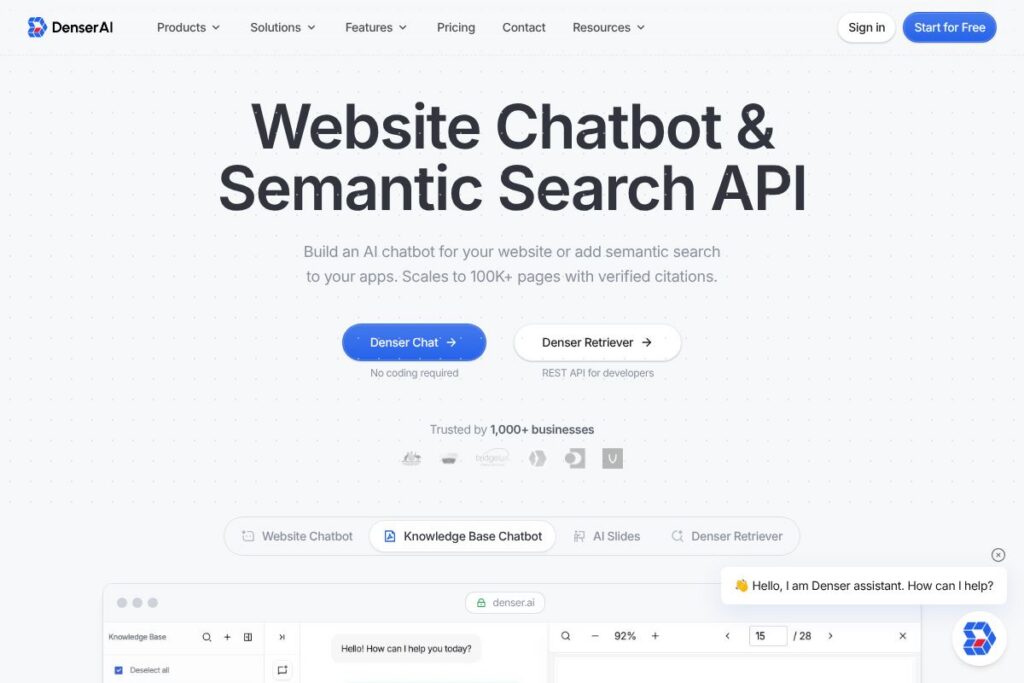
Denser.ai is a platform for building AI chatbots and adding semantic search to websites and applications. It combines a no-code chatbot builder with a REST API that indexes documents, PDFs, and web pages so chatbots can answer user questions with source citations and context-aware retrieval.
Denser.ai sits between conversational chatbot builders like Intercom and vector search services like Pinecone. Compared with Intercom, Denser.ai focuses on document-driven QA and source citation rather than full customer messaging suites. Compared with vector databases such as Pinecone or Weaviate, Denser.ai bundles indexing, retrieval, and a chat front end so teams do not need to assemble separate components. All of this makes Denser.ai well suited for businesses that need an out-of-the-box website chatbot that scales to large document collections and returns verifiable answers.
Denser.ai does particularly well at rapid deployment of knowledge-driven bots, delivering searchable knowledge bases, and letting non-developers launch chat experiences. It is aimed at product teams, support organizations, and knowledge-heavy workflows that require accurate retrieval with traceable sources.
How Denser.ai Works
The platform ingests content from PDFs, web pages, and document stores and creates embeddings to power semantic retrieval. Indexing is available via a simple drag and drop no-code flow or programmatically through the REST API so teams can choose between a graphical setup and developer-driven integration.
When a user asks a question the system runs a retrieval step against the indexed corpus, selects relevant passages, and assembles an answer with citations back to the original documents. Chat flows can include handoffs to human agents, SQL/database queries, and automated actions triggered by conversation intent, which makes it practical for support and self-serve scenarios.
What does Denser.ai do?
Denser.ai groups capabilities into chatbot building, semantic retrieval, and developer APIs. Core features include a website chatbot for 24/7 support, a knowledge base assistant that turns documents into Q&A, and the Denser Retriever API for scalable semantic search across large collections.
Let’s dive into the standout features:
No-code chatbot builder
Teams can build and publish a website chatbot without writing code using visual workflows, content connectors, and configurable response behavior. This reduces time to value for customer support and knowledge discovery projects by letting non-technical users manage content and conversation flows.
Denser Retriever (semantic search API)
The Retriever API indexes documents at scale and returns high-quality semantic matches for queries, suitable for powering search and retrieval-augmented generation. It is designed to scale to hundreds of thousands of pages and large document stores while keeping retrieval latencies low.
Source citations and provenance
Chat responses include citations that point back to specific documents or web pages, making answers auditable and improving trust for knowledge-sensitive use cases. Citations help agents verify responses and let users follow links to original material.
REST API and developer controls
Developers can integrate indexing and retrieval into apps using a REST API, enabling production-ready search and chatbot experiences. The API supports document upload, indexing status, query endpoints, and programmatic chat sessions for embedding in custom front ends.
Database and SQL chat
Denser.ai can connect to SQL databases to answer queries against structured data as part of chat flows, allowing bots to fetch user-specific info or pull records on demand. This extends the chatbot from static documents to dynamic, transactionally accurate responses.
AI Slides and content generation
The platform can generate AI slides from content, turning indexed documents into presentation-ready summaries for quick knowledge sharing. This feature suits teams that want to convert repository content into concise deliverables.
With these capabilities combined, the biggest benefit is fast delivery of verified, document-driven chat experiences that scale with your knowledge base and require minimal assembly of underlying components.
Denser.ai pricing
Denser.ai uses a tiered subscription model with a free tier for getting started and paid plans for individuals and teams. Plans are based on the number of DenserBots, query volume, document storage limits, and added features such as database chat and longer query log retention.
Monthly Billing:
Free – $0 (Good for getting started)
- 1 DenserBot, 20 queries, Maximum of 100 webpages or 50MB doc storage, 10 AI Slides per month, Continuous chatbot training
Starter – $29/mo (For individuals and side projects)
- 2 DenserBot, 1 team member, 1500 queries per month, Maximum of 100 webpages or 50MB doc storage per DenserBot, 50 AI Slides per month, REST API, 30 days query log retention, Continuous chatbot training
Standard – $119/mo (Good for small team)
- 4 DenserBot, 5 team members, 7500 queries per month, Maximum of 2000 webpages or 1G doc storage per DenserBot, 100 AI Slides per month, REST API, Chat with SQL/Database, 90 days query log retention, Continuous chatbot training
Business – $399/mo (Perfect for businesses)
- 8 DenserBot, 10 team members, 15000 queries per month for all DenserBots combined, Maximum of 10000 webpages or 5G doc storage per DenserBot, 200 AI Slides per month, REST API, Chat with SQL/Database, 360 days query log retention, Dedicated accuracy support, Continuous chatbot training
Enterprise
Enterprise Plan – Custom pricing (Tailored to organizational scale, security, and SLA needs). For enterprise requirements and custom deployments contact sales or review the enterprise options on Denser.ai.
For billing specifics and any annual discounts, review the current pricing options or contact the Denser.ai team for a tailored quote.
What is Denser.ai Used For?
Denser.ai is used to create website chatbots that surface answers from internal documentation, help centers, product manuals, and databases. Typical deployments include customer support bots that reduce ticket volume, internal knowledge assistants for employees, and embedded semantic search in product help pages.
Product teams use Denser.ai to power contextual help, support teams use it to accelerate first response and deflect routine questions, and data teams use the Retriever API to build retrieval-augmented workflows where accuracy and source traceability matter.
Pros and cons of Denser.ai
Pros
- Document-driven answers: Responses include source citations which make answers auditable and useful for compliance and knowledge validation. Citations help users verify information quickly.
- No-code plus API: Both non-technical teams and developers can use the platform; product teams can launch bots without engineering, while developers use the REST API for custom integrations. This dual approach shortens deployment cycles.
- Scales to large corpora: Designed for hundreds of thousands of pages and large document volumes, making it suitable for enterprises with extensive knowledge repositories.
Cons
- Query limits on lower tiers: Entry-level plans constrain monthly queries and document storage which may require upgrading for high-traffic sites. Organizations with heavy query volumes will need to budget for higher tiers.
- Enterprise customization may be required: Large organizations often need bespoke security controls and SLA agreements which require a custom enterprise plan and direct vendor engagement.
Does Denser.ai Offer a Free Trial?
Denser.ai offers a free plan. The Free tier provides 1 DenserBot, 20 queries, up to 100 webpages or 50MB of document storage, and 10 AI Slides per month so you can test basic chatbot and indexing functionality before upgrading to paid plans.
Denser.ai API and Integrations
Denser.ai provides a REST API for indexing documents, running semantic queries, and managing chat sessions; developers can integrate retrieval and chat into custom applications. See the API documentation for endpoints, payload formats, and example integration patterns.
The platform also supports database connectivity for SQL chat and common content sources such as PDFs and web pages, and it can be embedded into websites as a chat widget or connected into existing help centers. For platform-specific integrations and automation options review the product pages.
10 Denser.ai alternatives
Paid alternatives to Denser.ai
- Intercom — Customer messaging platform with bots and automation focused on support and sales workflows, stronger in unified customer inbox and product messaging.
- Drift — Conversational marketing and sales chat platform that focuses on lead capture, routing, and playbooks with built-in CRM integrations.
- Ada — No-code conversational AI for customer service that emphasizes automation, multilingual support, and enterprise-grade orchestration.
- Zendesk — Support platform with chat and Answer Bot capabilities, tighter integration into ticketing and agent workflows for customer support teams.
- LivePerson — Conversational AI and messaging platform for enterprise chat at scale, with omnichannel routing and analytics.
Open source alternatives to Denser.ai
- Rasa — Open source conversational AI framework for building custom chatbots with full control over NLU and dialogue management, suited for developer-led projects.
- Haystack — Open source framework for building retrieval-augmented generation and semantic search pipelines, focused on document indexing and QA.
- Botpress — Developer-focused open source chatbot platform with a visual authoring environment and extensible modules for custom flows.
- Chroma — Open source embedding database for vector search that teams can use as the retrieval layer when building custom chatbots.
Frequently asked questions about Denser.ai
What is Denser.ai used for?
Denser.ai is used to build website chatbots and semantic search that answer questions from documents, PDFs, and databases. Teams use it for customer support bots, internal knowledge assistants, and embedding retrieval in apps.
Does Denser.ai offer an API?
Yes, Denser.ai provides a REST API for indexing, semantic retrieval, and chat sessions. Developers can integrate the Retriever API and chat endpoints; see the API documentation for details.
Is Denser.ai free to try?
Denser.ai has a free plan. The Free tier includes 1 DenserBot, 20 queries, and limited document storage so you can evaluate core features without cost.
Can Denser.ai connect to my database?
Yes, Denser.ai supports chat with SQL/database connections on paid plans. Database chat allows bots to return dynamic, query-backed responses alongside document citations.
How does Denser.ai handle source citations?
Denser.ai includes source citations with chat responses. Citations point back to the original documents or web pages so users can verify provenance and follow up on the source material.
Final verdict: Denser.ai
Denser.ai is a practical choice for teams that need fast, document-focused chat experiences with verifiable answers and a low barrier to deployment. Its combination of a no-code builder, indexed semantic retrieval, and developer API covers both business and technical needs when building knowledge-driven bots.
Compared with Intercom, Denser.ai is more focused on retrieval accuracy and document citation rather than end-to-end customer messaging and CRM features. On pricing, Denser.ai provides a free tier and paid plans starting at $29/mo, which can be more cost effective than full-service messaging platforms if your primary requirement is document Q&A and semantic search.
For organizations that need an integrated indexing plus chat solution with source tracking, Denser.ai offers a strong balance of usability, developer controls, and scalability. Visit the Denser.ai products pages to explore use cases and the current pricing options for plan details.