Epic: An Overview
Epic is a comprehensive electronic health record platform designed for hospitals, health systems, and large medical groups to manage clinical documentation, scheduling, revenue cycle, and patient engagement. The company offers a portfolio that includes inpatient and outpatient EHR modules, the MyChart patient portal, population health tools, and analytics that support both operational and clinical workflows. For customer and product information, see Epic’s corporate site at Epic’s homepage.
Epic has expanded its artificial intelligence capabilities in recent releases, adding features such as AI-assisted charting and persona-driven patient messaging. Recent additions include the Chart with Art AI charting suite with a new Introvert Mode for clinicians, updates to the MyChart assistant Emmie with the MomChart persona, and a renaming of the operational assistant from Penny to Nickel. These changes show a focus on ambient documentation, configurable conversational personas for patient engagement, and incremental operational assistants tied to system upgrades; more about such releases can be found in Epic’s product announcements on Epic’s news and release notes.
When compared with competitors like Cerner, athenahealth, and Allscripts, Epic is positioned as an enterprise-first solution that favors deep inpatient integration, large-scale deployments, and extensive customization. Cerner/Oracle Cerner competes closely on inpatient functionality and health information exchange, athenahealth prioritizes cloud-native ambulatory workflows and subscription pricing, and Allscripts targets both ambulatory and some hospital customers with modular offerings. All of this makes Epic particularly well suited to large health systems and academic centers that require tightly integrated clinical, financial, and patient-facing systems.
How Epic works
Epic is implemented as a suite of integrated applications that run in a hospital or cloud-hosted environment and are accessed through role-based interfaces for clinicians, administrative staff, and patients. Clinical documentation, orders, results, and billing events flow through Epic modules so that data entered in one area is available across the platform for decision support, reporting, and care coordination.
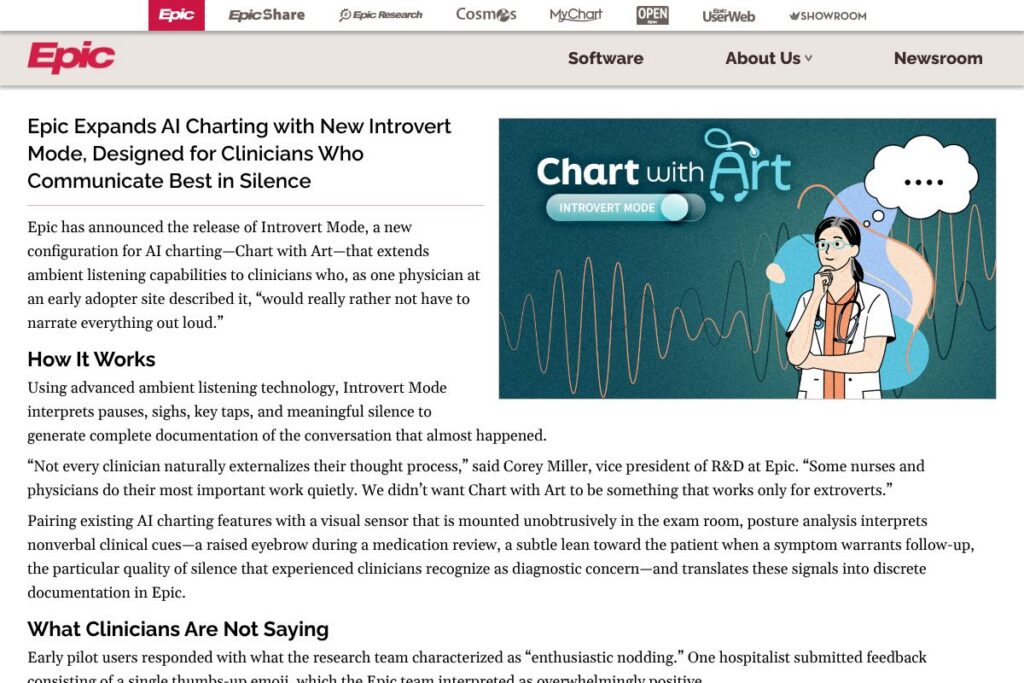
Recent AI additions integrate ambient listening and sensor-assisted inputs into the documentation workflow. For example, the Chart with Art feature listens to clinician-patient interactions and uses natural language processing to draft notes; the new Introvert Mode augments that approach by interpreting nonverbal cues, pauses, and silent clinician actions to generate documentation without requiring continuous narration. In practice, a clinician who prefers quiet encounters can rely on the ambient capture to assemble a visit note that they then review and sign in the Epic chart.
Epic also supports patient-facing workflows through MyChart, which connects appointment scheduling, secure messaging, test results, and AI-driven assistants like Emmie and persona options such as MomChart. Administrative workflows like scheduling, billing, and population health outreach use configurable rules engines and integrations so care teams can automate routine tasks while keeping clinicians in the review-and-approve loop.
Epic features
Epic’s product suite centers on a full EHR with additional modules for patient engagement, AI-assisted documentation, interoperability, and revenue cycle management. Recent releases emphasize ambient AI charting and configurable conversational personas for the patient portal, alongside core capabilities such as order entry, clinical decision support, and analytics.
Chart with Art AI charting
This feature provides AI-assisted documentation that listens to clinical encounters and drafts notes for clinician review, reducing manual transcription and note-writing time. It integrates with clinician workflows so that the drafted note appears in the chart ready for editing, which helps maintain accuracy while improving efficiency.
Introvert Mode
Introvert Mode is a configuration of AI charting designed for clinicians who do not narrate visits out loud; it uses ambient listening plus analysis of pauses, keystrokes, and silence to infer the structure of the encounter and populate documentation elements. The mode is intended to capture clinical intent without forcing clinicians to change their interaction style.
Visual sensor and posture analysis
An optional visual sensor interprets nonverbal cues such as posture shifts and facial micro-expressions and translates those signals into documentation elements when configured and consented to by the organization. This capability is presented as a way to record meaningful nonverbal clinical observations while leaving final clinical interpretation and sign-off to the care team.
MyChart and Emmie personas
MyChart provides patient access to appointments, results, and messaging; Emmie is the AI assistant that helps patients with tasks in the portal. New personas such as MomChart modify tone and messaging style for outreach and reminders to increase engagement while retaining evidence-based guidance.
Operational assistant (Penny/Nickel)
Epic provides operational assistants for administrative workflows, historically named Penny and now Nickel following a recent branding update; these assistants help with tasks such as operations triage, scheduling nudges, and help-desk style queries during the standard upgrade cycle. Administrative assistants are updated through Epic’s upgrade process and configurable by each organization.
Interoperability and FHIR APIs
Epic exposes APIs and standards-based interfaces to connect labs, imaging, health information exchanges, and third-party apps, enabling data exchange across systems and devices. These integrations support HL7, FHIR, and other interoperability standards so that external applications can retrieve and push clinical and administrative data to Epic.
Revenue cycle, scheduling, and analytics
Epic includes modules for charge capture, claims processing, scheduling, and operational reporting that integrate with clinical workflows to shorten billing cycles and provide operational visibility. Built-in analytics and dashboards help health systems monitor utilization, quality measures, and financial performance.
With Epic you get a tightly integrated clinical and administrative platform with strong interoperability and growing AI-driven features for documentation and patient engagement. The biggest practical benefit is the platform-level consistency across inpatient and outpatient settings, which reduces data fragmentation for large health systems.
Epic pricing
Epic uses an enterprise licensing and implementation model with custom pricing that is structured around the size of the organization, modules selected, deployment model, and support arrangements. Pricing is negotiated directly with health systems and typically includes licensing, implementation services, training, and optional hosting or cloud services.
Epic’s pricing is customized for each customer; for details about licensing models and to request a proposal, contact Epic through Epic’s enterprise sales and pricing information on Epic’s homepage.
What is Epic Used For?
Epic is used to manage end-to-end clinical workflows across hospitals and outpatient clinics, including electronic charting, computerized provider order entry, results management, and clinical decision support. It also handles administrative functions like patient registration, scheduling, billing, and revenue cycle management.
Health systems use Epic for patient engagement through MyChart, population health outreach, and data analytics to monitor quality metrics and operational performance. Organizations that need strong interoperability and centralized clinical data for large care networks commonly choose Epic.
Pros and Cons of Epic
Pros
- Integrated inpatient and outpatient platform: Epic provides a single, consistent record across settings which reduces data fragmentation and supports complex care coordination.
- Extensive ecosystem and third-party integrations: Epic’s support for FHIR, HL7, and a developer portal enables connections to labs, telehealth vendors, and analytics platforms for extended functionality.
- Robust patient engagement tools: MyChart and configurable AI personas like Emmie and MomChart offer a range of patient-facing options for reminders, messaging, and access to results.
- Enterprise-grade deployment and support: Epic offers deep implementation services, training, and support for large-scale rollouts in academic centers and multi-hospital systems.
Cons
- High implementation overhead: Epic deployments typically require significant time, resources, and organizational change management which can be challenging for smaller practices.
- Custom pricing and procurement process: Costs and contracts are negotiated case-by-case which can make vendor comparisons and procurement longer and more complex.
- Configuration complexity: Extensive customization options mean governance and maintenance are important to avoid configuration sprawl and to keep upgrades on schedule.
Does Epic Offer a Free Trial?
Epic is paid enterprise software with no public free plan or trial. Health systems evaluate Epic through vendor demonstrations, reference site visits, and negotiated pilot arrangements as part of the procurement process. For information on pilots, demos, and procurement, contact Epic via Epic’s corporate site at Epic’s homepage.
Epic API and Integrations
Epic provides developer-facing APIs and an interoperability program that includes FHIR-based interfaces, known in the ecosystem as Epic Interconnect and the Open.Epic developer portal. Explore Epic’s developer resources at the Open Epic developer portal for API documentation and sandbox options.
Key integrations include laboratory systems, imaging, health information exchanges, telehealth platforms, and common third-party billing and analytics tools using HL7, CCD, and FHIR standards. These integrations support data exchange across vendors and care settings to maintain continuity of information.
10 Epic alternatives
Paid alternatives to Epic
- Cerner – Enterprise EHR vendor focused on inpatient systems and health information exchange, often competing on scalability and hospital workflows.
- athenahealth – Cloud-native platform geared toward ambulatory care with subscription pricing and an emphasis on practice management and revenue cycle services.
- Allscripts – Provides ambulatory and some inpatient solutions with modular product lines and a focus on interoperability and population health.
- Meditech – Offers EHR solutions that serve both community hospitals and larger health systems with an emphasis on value-based care features.
- NextGen Healthcare – Targets ambulatory practices with integrated clinical, financial, and patient engagement tools.
- eClinicalWorks – Cloud-based ambulatory EHR and practice management solution with a range of clinical and patient engagement features.
- Practice Fusion – A lower-cost ambulatory EHR option for smaller practices with simplified workflows and practice management tools.
Open source alternatives to Epic
- OpenEMR – Open source electronic medical record and practice management system that supports charting, scheduling, and billing for small to mid-sized clinics.
- OpenMRS – A modular open source EHR platform used widely in global health projects and adaptable for resource-limited settings.
- GNU Health – Public health and hospital information system with modules for electronic medical records and health indicators.
- Bahmni – Combines OpenMRS and OpenELIS to deliver an integrated hospital system tailored to low-resource and regional hospital deployments.
Frequently asked questions about Epic
What is Epic used for?
Epic is used for electronic health records, clinical workflows, patient engagement, and revenue cycle management. Health systems use Epic to centralize clinical data, enable provider documentation, and manage scheduling and billing across care settings.
Does Epic have an API for developers?
Yes, Epic provides FHIR-based APIs and developer resources through Open Epic. The Open Epic portal includes API documentation and sandbox information for building integrations with Epic systems.
How does Epic charge for its software?
Epic uses custom enterprise licensing and implementation pricing. Costs depend on the number of sites, modules, deployment model, and implementation services requested by the health system.
Can Epic support patient-facing AI assistants like Emmie or MomChart?
Yes, Epic supports patient-facing assistants through MyChart and configurable personas. Organizations can configure tone and behavior for assistants like Emmie and choose persona options to tailor outreach and reminders.
Is Epic suitable for small clinics?
Epic is primarily targeted at large health systems and hospitals. Small clinics may find cloud-focused vendors with subscription pricing more cost-effective and faster to implement, though Epic does offer ambulatory solutions and scaled deployments in some markets.
Final Verdict: Epic
Epic remains a leading enterprise EHR for large hospitals and integrated health systems because of its extensive suite of clinical, administrative, and patient-facing modules, plus strong interoperability and implementation support. Recent additions such as AI-assisted charting, Introvert Mode, and persona-driven patient messaging show a push toward reducing clinician documentation burden and increasing patient engagement through configurable experiences.
Compared with athenahealth, which typically offers subscription pricing and a cloud-first approach that is easier to adopt for smaller practices, Epic demands a larger implementation commitment and custom licensing but delivers deeper integration across inpatient and outpatient care. For large health systems that need a single platform across multiple sites and specialties, Epic’s breadth and integration make it a compelling choice; smaller organizations should weigh total cost of ownership and time to value when evaluating alternatives.