IBM: An Overview
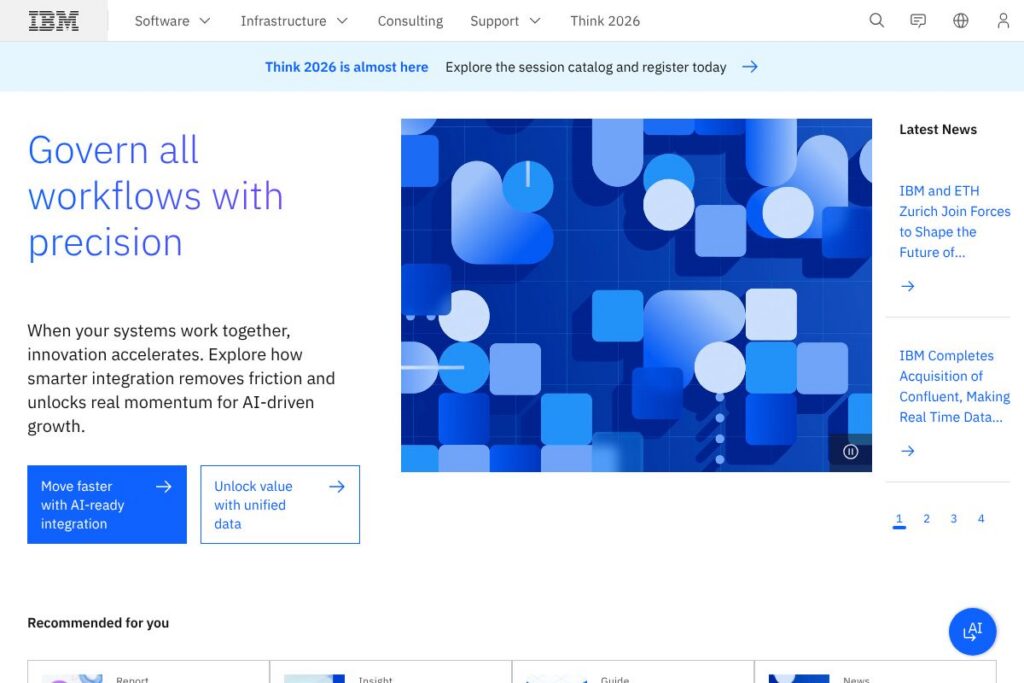
IBM is a global technology and consulting company that builds enterprise-grade software, cloud infrastructure, AI systems, and industry-focused services for large organizations. Its portfolio spans AI with Watson, hybrid cloud and infrastructure with Red Hat and IBM Cloud, data and analytics, security and governance, and consulting through IBM Consulting. IBM also provides training and certification programs aimed at building skills for cloud, AI, and data engineering roles.
Compared with Amazon Web Services, Microsoft Azure, and Google Cloud Platform, IBM is typically chosen where hybrid cloud integration, enterprise consulting, legacy-system modernization, and industry-specific regulatory compliance are priorities. AWS and Azure lead in raw cloud scale and developer ecosystem breadth, while Google Cloud emphasizes data analytics and machine learning research. IBM competes by combining software such as Red Hat OpenShift with professional services and regulated-industry expertise.
Where IBM stands out is in hybrid cloud operations, enterprise AI tailored to business workflows, and large-scale consulting engagements. These strengths make IBM a common choice for regulated industries, global enterprises with complex legacy systems, and organizations that require deep integration between on-premises systems and cloud-native services.
How IBM Works
IBM packages technology and services into combined offerings that are deployed either on-premises, in public cloud environments, or as managed services. Teams typically start with a discovery phase led by IBM Consulting to map business processes, data sources, and compliance needs, then select a combination of IBM Cloud, Red Hat OpenShift, and Watson AI services to implement the solution.
Operational workflows rely on integration layers and APIs that connect transactional systems, data lakes, and analytics tools so business applications can run in a hybrid environment. For many clients, IBM provides ongoing managed services and platform operations so internal teams can focus on domain problems while IBM handles infrastructure, security, and scaling.
IBM features
IBM’s product set covers several enterprise domains: hybrid cloud infrastructure, AI and automation, data management, security, and professional services. Recent emphasis has expanded on industry AI models, tighter integration between Red Hat OpenShift and IBM Cloud, and expanded consulting offerings to support large digital transformations. Below are the main capabilities to consider.
Watson AI and enterprise models
Watson provides tools for building, deploying, and managing AI models tailored to business data and workflows. Teams can use prebuilt industry models, fine-tune models on proprietary data, and deploy models with governance controls to meet regulatory requirements.
Hybrid cloud and Red Hat OpenShift
IBM’s hybrid cloud approach centers on Red Hat OpenShift for running containers consistently across on-premises and multiple cloud providers. This makes migrating legacy workloads and implementing cloud-native services more predictable for enterprise operations teams.
Automation and IBM Automation Suite
Automation capabilities include process mining, workflow orchestration, robotic process automation, and decision automation to reduce repetitive work and accelerate operational processes. These tools are packaged so business users and developers can collaborate on automations while preserving audit trails.
Data management and analytics
IBM offers data virtualization, data governance, and analytics platforms that centralize data access and provide business intelligence and reporting. The stack supports trusted data pipelines and operational analytics for teams that need real-time or near-real-time insights.
Security, compliance, and governance
IBM integrates identity and access management, encryption, threat detection, and compliance controls across cloud and on-premises deployments. These features help organizations meet industry regulations and maintain consistent security posture across hybrid environments.
Integration and application resilience
Integration tooling and API management enable connections between enterprise applications, external services, and legacy systems, with support for message routing, transformation, and transactional integrity. Built-in observability and resiliency patterns help maintain uptime for critical services.
Consulting, deployment, and managed services
IBM Consulting provides design, implementation, and operational services for enterprise transformations, including system integration, change management, and long-term platform operations. Managed services options allow teams to outsource platform maintenance and support.
Training and professional certifications
IBM provides instructor-led courses, self-paced learning, and certification paths for cloud, AI, security, and data engineering roles to upskill internal teams and validate expertise. Training can be integrated with adoption plans to shorten time-to-value for new platforms.
With these capabilities combined, IBM aims to help enterprises run regulated, large-scale systems across hybrid architectures while providing consulting and training to support organizational change.
IBM pricing
IBM uses an enterprise-focused pricing model with a mix of subscription, usage-based, and contract-based options depending on products and deployment choices. Pricing varies by service tier, resource consumption, add-on services such as support and consulting, and whether services are consumed on IBM Cloud, third-party clouds, or on-premises.
Because IBM tailors pricing to deployment patterns and enterprise requirements, organizations typically obtain quotes through sales engagement or by contacting IBM Consulting. View IBM’s enterprise contact options to request pricing details specific to your planned deployment and support needs.
What is IBM Used For?
IBM is commonly used to modernize legacy IT systems, run regulated workloads, and deploy enterprise AI that integrates with existing business processes. Organizations use IBM to create hybrid cloud platforms that keep sensitive data on-premises while leveraging cloud services for scalability and advanced analytics.
Typical use cases include core banking and financial services modernization, supply chain optimization with data-driven analytics, healthcare systems that require strict compliance, large-scale customer experience platforms, and industry-specific AI applications built by IBM Consulting with client teams.
Pros and Cons of IBM
Pros
- Hybrid cloud expertise: IBM offers integrated hybrid cloud platforms and support for Red Hat OpenShift, making it easier to run applications consistently across environments, which reduces migration risk and operational fragmentation.
- Enterprise AI with governance: Watson and IBM’s model management provide tools to train, deploy, and govern AI models in regulated settings, helping organizations apply AI while controlling data privacy and model lineage.
- Consulting and industry depth: IBM Consulting combines technical implementation with industry domain experience, which is useful for complex transformations that touch compliance, operations, and large user bases.
- Security and compliance tooling: IBM provides security controls and governance features designed for industries with strict regulatory requirements, enabling centralized policy enforcement across hybrid deployments.
Cons
- Enterprise-focused pricing and procurement: IBM’s pricing and contracting are often geared toward larger organizations, which can mean longer procurement cycles and less transparent list pricing for smaller teams.
- Complex product portfolio: The breadth of IBM’s offerings can require significant evaluation and integration work to choose the right components, which may increase time to deploy for organizations without experienced architects.
- Competitive cloud scale: For organizations prioritizing raw cloud scale, developer ecosystem size, or the broadest global infrastructure footprint, alternatives such as Amazon Web Services or Microsoft Azure may offer advantages in pricing flexibility and marketplace ecosystems.
Does IBM Offer a Free Trial?
IBM offers a mix of free tiers and limited-time trials for specific services. IBM Cloud often provides a Lite account and free tiers for selected services, and many Watson and developer tools include trial credits so teams can prototype solutions. For training, IBM offers free introductory courses alongside paid certification tracks. Check IBM’s Cloud and developer offerings for available free tiers and trial details.
IBM API and Integrations
IBM provides APIs and SDKs across its cloud and AI products; the IBM Cloud API documentation lists endpoints for services such as AI, data, and infrastructure. Developers can programmatically manage resources, deploy models, and integrate IBM services into existing applications.
In addition to APIs, IBM maintains connectors and integrations with enterprise software ecosystems including Salesforce, ServiceNow, SAP, Microsoft Azure, and third-party observability and CI/CD tools, which helps teams connect IBM services into broader IT landscapes.
10 IBM alternatives
Paid alternatives to IBM
- Amazon Web Services – Large public cloud with extensive compute, storage, analytics, and AI services plus a vast partner ecosystem for cloud-native and enterprise workloads.
- Microsoft Azure – Integrated cloud platform with strong hybrid cloud tooling, enterprise SaaS integrations, and a large portfolio for identity, analytics, and developer services.
- Google Cloud Platform – Cloud provider focused on data analytics, machine learning, and high-performance networking, with managed data platforms and ML tooling.
- Oracle Cloud Infrastructure – Cloud and database-focused provider with strengths in enterprise databases, ERP integrations, and industry applications.
- Accenture – Global consulting firm offering technology transformation services and managed services, often competing with IBM Consulting on large transformation programs.
- Salesforce – Customer relationship and CRM platform that competes on enterprise SaaS and industry-specific customer experience solutions.
Open source alternatives to IBM
- OpenStack – Open-source cloud infrastructure software for private and hybrid cloud deployments that organizations can adopt for full control over infrastructure.
- Kubernetes – Container orchestration platform used for running cloud-native workloads and building platform layers similar to Red Hat OpenShift without the commercial distro.
- TensorFlow – Open-source machine learning framework for building models; used by teams that prefer full control over ML pipelines instead of managed AI services.
- Apache Hadoop – Distributed data processing and storage framework for large-scale analytics workloads, useful where organizations want to manage big data clusters directly.
- Prometheus – Open-source monitoring and alerting toolkit for systems and services, often paired with Kubernetes for observability in cloud-native environments.
Frequently asked questions about IBM
What is IBM primarily used for?
IBM is primarily used for enterprise IT modernization, hybrid cloud deployments, and industry-focused AI and consulting services. Organizations leverage IBM to modernize legacy systems, implement governed AI, and run regulated workloads across hybrid environments.
Does IBM offer AI services through Watson?
Yes, IBM provides AI services via Watson and related platforms. Watson includes model hosting, natural language processing, and tools for building industry-specific AI applications with governance features.
How does IBM charge for cloud and consulting services?
IBM uses a mix of subscription, usage-based, and contract pricing for cloud and consulting services. Enterprise costs depend on chosen services, consumption levels, support tiers, and managed services agreements.
Can IBM integrate with Microsoft and third-party cloud services?
Yes, IBM supports integrations with Microsoft, AWS, Google Cloud, and many enterprise systems. Integration options include API connectors, OpenShift-based deployments, and partner-developed adapters for ERPs and ITSM platforms.
Does IBM provide training and certifications?
Yes, IBM offers training, courses, and certification programs for cloud, AI, data, and security roles. Training is available as self-paced learning, instructor-led classes, and role-based certification tracks to support workforce upskilling.
Final verdict: IBM
IBM is best suited for large organizations that need a combination of hybrid cloud infrastructure, enterprise AI with governance, and consulting-led transformations. Its strengths lie in integrating legacy systems with modern cloud platforms, providing industry-specific solutions, and supplying managed operations that meet strict compliance requirements.
Compared with Microsoft Azure, IBM usually emphasizes consulting, hybrid application portability through Red Hat OpenShift, and industry-tailored AI solutions rather than purely competing on cloud price-per-hour metrics. Azure often provides more transparent, per-resource pricing and a broader SaaS integration ecosystem, while IBM is tailored for enterprises that require deep systems integration and specialist industry services.
For enterprises planning a regulated or hybrid migration and who value vendor-led implementation support and governance controls, IBM remains a practical choice. For organizations prioritizing the lowest-cost commodity cloud resources or the broadest developer marketplace, evaluating Microsoft Azure or Amazon Web Services in parallel is recommended.