IBM Watson Explained
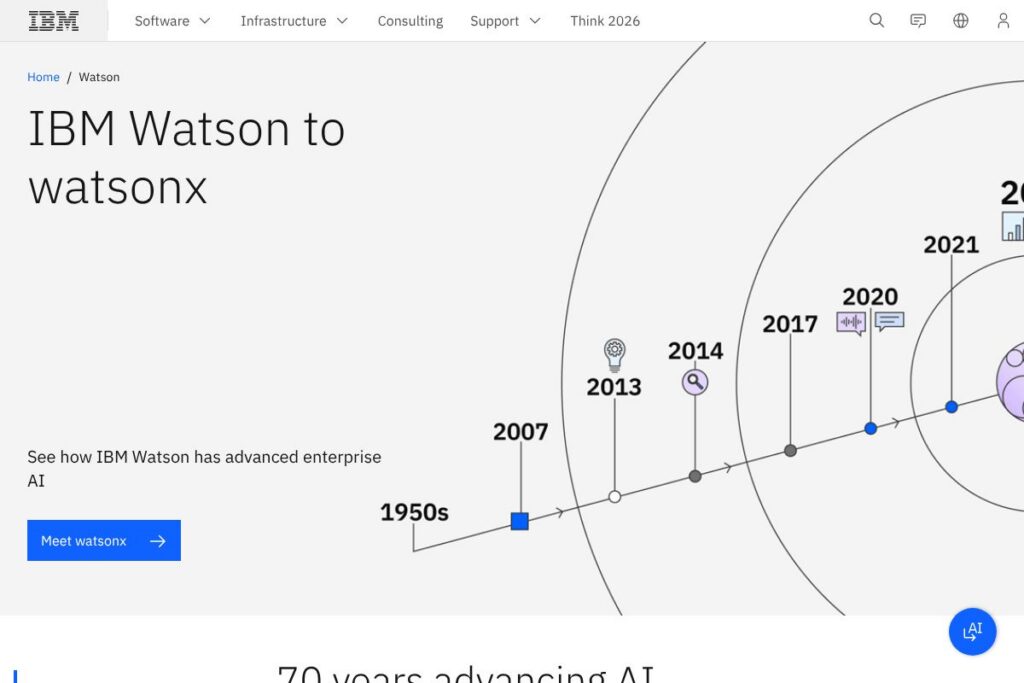
IBM Watson is a suite of AI services and tools aimed at helping organizations build applications that understand language, analyze data, and automate workflows. The platform includes conversational AI, natural language understanding, machine learning lifecycle tools, and components for model governance, and it has evolved into the watsonx family for modern model and data management.
Compared with Google Cloud AI, Microsoft Azure AI, and Amazon SageMaker, IBM Watson emphasizes enterprise features such as data governance, industry-specific accelerators, and integration with existing IBM infrastructure and professional services. Google Cloud AI and Azure tend to focus on broad cloud-native ML and model hosting with extensive developer tooling, while SageMaker emphasizes end-to-end model training and deployment on AWS. IBM Watson’s differentiator is its combination of prebuilt vertical solutions, governance controls, and enterprise support for regulated industries.
All of this makes IBM Watson a strong fit for enterprises that need production-grade NLP, conversational systems, and a governance framework that ties models back to data policies and compliance requirements. It is especially useful for financial services, healthcare, retail, and large organizations that require on-premises or hybrid deployments and vendor support for complex integrations.
How IBM Watson Works
IBM Watson exposes services as APIs and cloud-hosted services, and it also supports on-premises and hybrid deployments through IBM Cloud and watsonx. Typical components include natural language processing APIs for entity extraction and sentiment analysis, dialog engines for conversational interfaces, model lifecycle tooling for training and deployment, and governance modules to track model lineage and usage.
Teams commonly integrate Watson by connecting data sources to watsonx.data for unified access, training or fine-tuning models in watsonx.ai, and deploying models through managed endpoints or containers. A practical workflow looks like this: ingest enterprise data, use prebuilt language models for initial extraction, iterate with custom model training, and deploy the final model with monitoring and governance policies in place.
IBM Watson features
IBM Watson is organized around language, models, deployment, and governance. Core capabilities include conversational AI with Watson Assistant, language understanding APIs, tools for model development and fine-tuning in watsonx.ai, and governance and data management with watsonx.data and watsonx.governance. Recent evolution centers on the watsonx family to provide clearer model governance and hybrid deployment options.
The platform includes several powerful capabilities worth highlighting:
Natural Language Understanding
The language services extract entities, sentiment, categories, and relationships from text, supporting multi-language processing and domain customization. These capabilities help teams automate document classification, extract structured data from unstructured text, and power downstream analytics pipelines.
Watson Assistant (Conversational AI)
Watson Assistant builds chatbots and virtual agents with dialog management, context handling, and integration hooks for backend systems. It supports both web and voice channels and lets teams route conversations to human agents when needed, reducing repetitive support tasks and improving response consistency.
watsonx.ai (Model Training and Fine-tuning)
watsonx.ai provides tools for training, fine-tuning, and evaluating models, including support for foundation models and fine-tuning on private data. This capability accelerates custom model creation while preserving control over training data and performance metrics.
watsonx.data (Data Access and Query)
watsonx.data is designed to provide a unified platform for querying, preparing, and serving data to models across hybrid environments. It supports federated queries and integration with enterprise data lakes so models can be trained on governed, auditable datasets.
watsonx.governance (Model Governance and Compliance)
Governance tools track model lineage, metadata, and usage, and provide workflows for approval and risk assessment. These features help organizations meet internal and regulatory requirements for explainability and auditability of AI systems.
Model Deployment and MLOps
The platform supports containerized deployment, managed endpoints, and monitoring for latency, accuracy drift, and usage patterns. Teams can automate CI/CD for models and roll back or version models as part of standard release processes.
Prebuilt Industry Solutions
IBM offers domain-specific templates and accelerators for healthcare, financial services, and retail that include preconfigured models, data mappings, and integration patterns. These reduce time to value for common enterprise scenarios such as claims processing, customer service, and risk analysis.
With these capabilities, IBM Watson helps organizations move from experimentation to production while maintaining governance, monitoring, and integration with enterprise systems. The biggest benefit is its focus on enterprise controls and hybrid deployment options that fit regulated or complex IT environments.
IBM Watson pricing
IBM Watson uses a flexible enterprise pricing model that varies by service, deployment type, and usage, with options for cloud-hosted services, on-premises licensing, and custom enterprise agreements. Pricing is typically consumption-based for APIs and may include additional charges for managed deployment, dedicated support, or professional services.
For current pricing options and the best path for your organization, see the IBM Watson product overview or contact IBM sales to request a tailored quote that reflects your deployment and compliance needs.
What is IBM Watson Used For?
IBM Watson is commonly used for building conversational agents, automating document processing, and extracting insights from large volumes of unstructured text. Use cases include virtual customer assistants, automated claims triage in insurance, clinical document analysis in healthcare, and compliance monitoring in financial services.
Beyond NLP, organizations use Watson’s model lifecycle and governance tools to operationalize machine learning at scale, ensuring models are versioned, monitored, and auditable in production. Teams that need hybrid deployment or strong governance often choose Watson to align AI practices with existing IT and regulatory frameworks.
Pros and Cons of IBM Watson
Pros
- Enterprise-grade governance: Watson includes tools to track model lineage, approvals, and metadata, making it easier to meet compliance and audit requirements. These controls are valuable for regulated industries that must demonstrate explainability and oversight.
- Hybrid deployment flexibility: IBM supports cloud-hosted, on-premises, and hybrid deployments, which helps organizations with data residency or legacy system constraints. This flexibility allows teams to run workloads where they are required to by policy or cost considerations.
- Prebuilt vertical solutions: Industry templates and accelerators reduce implementation time for common scenarios in healthcare, finance, and retail. They include domain-specific models, data mappings, and integration patterns to jumpstart projects.
Cons
- Complexity for small teams: The platform’s depth and enterprise features can be more than smaller teams need, and setup may require support from IBM or experienced engineers. Smaller projects may find simpler cloud-native AI services faster to adopt.
- Vendor and integration overhead: Integrating Watson into existing enterprise stacks can require configuration and professional services, which adds time and cost to initial deployments. Custom connectors or legacy adapters can increase project scope.
- Perceived cost for full enterprise deployments: While consumption options exist, full-featured enterprise deployments with governance, SLAs, and support can involve negotiated contracts and higher total cost of ownership compared with simple pay-as-you-go alternatives.
Does IBM Watson Offer a Free Trial?
IBM Watson offers free tiers and trial access for select services. Many Watson services are available in a lite or trial form via IBM Cloud with limited monthly usage, and IBM Cloud also provides a free tier and trial credits for new accounts to test services. See the IBM Cloud free tier and the watsonx product page for details on available trials and service limits.
IBM Watson API and Integrations
IBM Watson provides REST APIs and SDKs for multiple languages, enabling programmatic access to language models, speech, vision, and assistant capabilities. The Watson API documentation includes endpoints, request formats, and SDK guides for popular languages such as Python and Java.
Integrations include connectors and reference integrations for CRM and collaboration platforms such as Salesforce, ServiceNow, and Slack, plus the ability to connect to enterprise data sources and identity providers for SSO and access control. This makes Watson suitable for embedding AI across existing business applications.
10 IBM Watson alternatives
Paid alternatives to IBM Watson
- Google Cloud AI – Broad set of AI and ML services with strong managed model training, large-scale data processing, and pretrained language models.
- Microsoft Azure AI – Comprehensive cognitive services and machine learning platform with strong integration into Microsoft 365 and Azure data services.
- Amazon SageMaker – End-to-end ML platform on AWS focused on scalable training, model tuning, and managed endpoints.
- OpenAI – Foundation models and APIs optimized for natural language tasks, with a focus on large language models and developer-facing APIs.
- Anthropic – Safety-focused foundation models and API offerings targeted at enterprise use cases requiring model alignment.
- Salesforce Einstein – AI features embedded into Salesforce CRM for predictive analytics, automation, and customer insights.
Open source alternatives to IBM Watson
- Hugging Face – Model hub and libraries for NLP and foundation models, with tools for training, deployment, and model sharing.
- Rasa – Open source conversational AI framework focused on custom chatbots and dialogue management for enterprise deployments.
- MLflow – Open source platform for managing the ML lifecycle including experiments, reproducibility, and model registry.
- TensorFlow – Widely used open source machine learning framework for building and training models at scale.
- KServe – Open source model serving project for Kubernetes, used to deploy and manage inference workloads in production.
Frequently asked questions about IBM Watson
What is IBM Watson used for?
IBM Watson is used for natural language processing, conversational agents, and production AI workflows. Organizations use it to build chatbots, extract insights from text, and operationalize models with governance and monitoring.
Does IBM Watson offer APIs for developers?
Yes, IBM Watson exposes REST APIs and SDKs for developers. The platform provides documentation and SDKs for languages like Python and Java that cover language, speech, and assistant services.
Can IBM Watson be deployed on-premises?
Yes, IBM Watson supports on-premises and hybrid deployments. watsonx and related services offer deployment options to meet data residency and regulatory requirements while maintaining integration with IBM Cloud.
How does IBM Watson handle data privacy and governance?
IBM Watson includes governance tools for model lineage, approval workflows, and metadata tracking. These features help teams enforce policies, audit model behavior, and demonstrate compliance with internal and regulatory standards.
Is there a free plan for IBM Watson services?
IBM Watson provides free tiers and trial access for selected services via IBM Cloud. Lite plans and free trial credits allow developers to experiment with core features before moving to paid or enterprise agreements.
Final verdict: IBM Watson
IBM Watson remains a comprehensive option for enterprises that need robust natural language capabilities, conversational systems, and a strong governance framework that ties models to data and compliance workflows. Its integration into the watsonx family clarifies focus on model development, data access, and governance, which is valuable for regulated industries and large organizations.
Compared to Microsoft Azure AI, which commonly offers consumption-based pricing and tight integration with Azure data services, IBM Watson tends to emphasize enterprise agreements, hybrid deployments, and industry accelerators. Organizations that prioritize governance and hybrid hosting will find Watson more aligned to those needs, while teams seeking simple, consumption-based options may prefer Azure’s pricing model and cloud-native tooling.