Ingest: An Overview
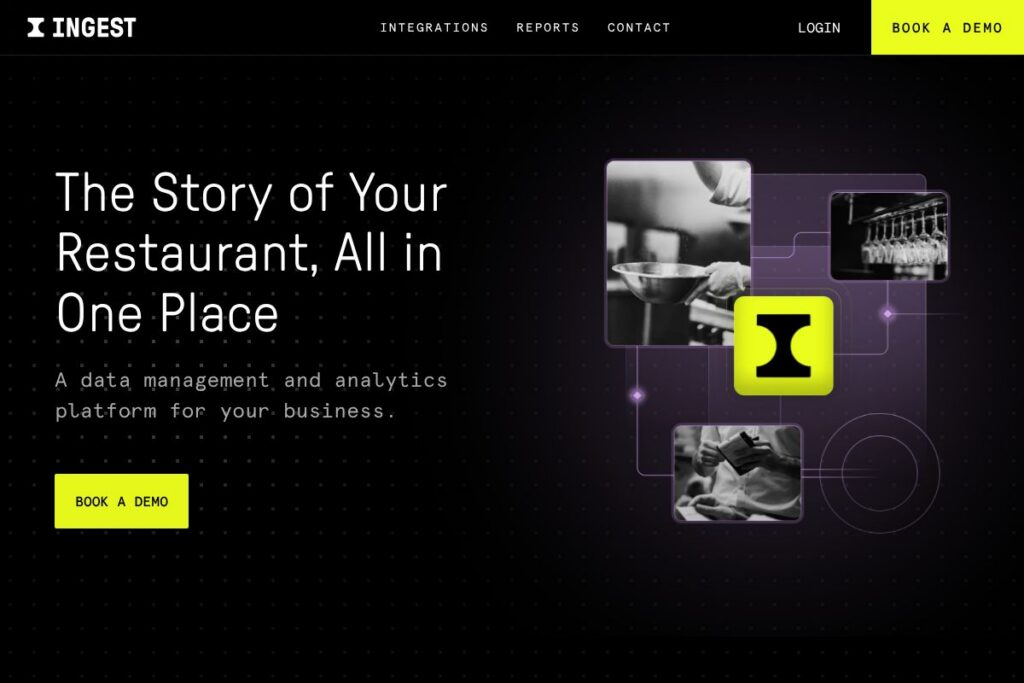
Ingest collects and consolidates operational data from restaurant systems into a single source of truth, then surfaces analytics and reports tailored to food and beverage workflows. The platform focuses on data quality, automated ETL, and role-specific dashboards so managers, chefs, and executives can make data-driven decisions without manual spreadsheet work.
Compared with broader restaurant platforms, Ingest emphasizes analytics over point-of-sale processing. For example, Toast is a full POS and payments provider with integrated software and hardware, while Square for Restaurants mixes POS with payment processing and simple reporting. Upserve combines POS, payments, and restaurant-specific analytics; Ingest slots in as a specialist analytics and data-management layer that integrates with POS providers rather than replacing them. This makes Ingest better suited to teams that want deep, customizable reporting on top of existing systems.
All of this makes Ingest particularly useful for multi-unit operators, group-level finance teams, and consultants who need consistent operational metrics across locations. The platform does well at eliminating siloed reporting, enforcing consistent metric definitions, and delivering role-based views that align kitchen, floor, and corporate decisions.
How Ingest Works
Ingest connects to source systems such as POS platforms, labor and scheduling tools, inventory systems, and financial accounts, then ingests and normalizes those feeds into a centralized data model. The pipeline handles common restaurant data challenges like missing SKUs, multi-location rollups, and time-zone aligned sales data so analytics reflect the true business story.
After normalization, data is stored in a managed warehouse or exported to the client’s preferred data store, and layered with business logic for metrics like sales per labor hour, menu contribution margin, and food cost by recipe. Users interact with the results through customizable dashboards, scheduled reports, and alerting rules that notify managers about anomalies.
A typical workflow starts with connectors pulling daily POS and inventory exports, followed by automated reconciliation and enrichment with labor schedules. From there a regional manager can open a dashboard to compare menu item performance, drill into recipe-level food cost, and assign tasks to reduce variance, all without manual joins or repeated CSV imports.
What does Ingest do?
Ingest is organized around reliable data ingestion, flexible reporting, and actionable operational analytics. Core capabilities include automated ETL, a normalized restaurant data model, customizable dashboards for different roles, and connectors to common restaurant systems. Recent emphasis has been on user-friendly dashboards and alerts so non-technical users can act on insights quickly.
Let’s talk Ingest’s Features
Data ingestion and normalization
Ingest automatically pulls data from POS, inventory, payroll, and accounting systems, then applies normalization rules to reconcile SKUs, modifiers, and outlet-level differences. Normalization ensures metrics like same-store sales, cost of goods sold, and menu mix are comparable across units.
Custom dashboards and role-based reporting
Dashboards can be configured per role, showing chefs menu contribution and gross margin metrics while presenting operations managers with labor efficiency and cover counts. Reports can be scheduled or exported for presentations and accounting reconciliation.
Menu analytics and recipe-level costing
The platform links sales lines to recipe definitions and inventory usage, making it possible to calculate food cost by dish and track real-time menu profitability. This supports dynamic menu engineering and targeted promotions tied to margin improvements.
Labor and scheduling analysis
Ingest combines scheduling data with sales to produce labor efficiency metrics such as labor cost percentage and sales per labor hour. Managers can use these insights to optimize shift patterns and staffing levels by daypart and location.
Alerts and anomaly detection
Automated alerts identify unusual drops in sales, spikes in voids, and inventory shrinkage so teams can investigate quickly. Alerts are configurable by severity and can be routed to the right stakeholder using email or in-app notifications.
The biggest benefit of these features is that teams move from fragmented, error-prone reporting to repeatable, auditable analytics workflows. That reduces time spent on manual data assembly and increases confidence in operational decisions.
Ingest pricing
Ingest uses a custom enterprise pricing model tailored to deployment needs, number of locations, and connector complexity. Pricing is not published on a standard public pricing page; potential customers typically engage sales to receive a proposal based on data volume and required integrations.
For current plan options and to get a pricing estimate suited to your operation, visit the Ingest homepage and request a demo or a tailored quote from their sales team.
What is Ingest Used For?
Ingest is commonly used to unify POS, inventory, labor, and accounting data so operators can produce consistent KPIs across single or multiple units. Teams rely on it for menu engineering, cost control, labor planning, and financial reconciliation without rebuilding ad hoc spreadsheets every week.
It is also used by finance and analytics teams when consolidating multi-brand or franchise reporting, and by consultants who need to standardize datasets to enable comparisons and benchmark performance across portfolios.
Pros and Cons of Ingest
Pros
- Consolidated operational data: Centralizes POS, inventory, labor, and financial feeds into a single model so reporting is consistent and auditable across locations.
- Role-specific dashboards: Provides tailored dashboards for kitchen staff, store managers, and executives which reduces the effort needed to extract relevant insights.
- Recipe-level costing: Links sales to recipes and inventory usage, enabling precise food cost and menu profitability analysis.
- Automated ETL and alerts: Reduces manual report assembly and surfaces anomalies quickly so teams can respond faster.
Cons
- Custom pricing and implementation: Because pricing is customized, smaller operations may face higher entry costs compared with out-of-the-box POS reporting bundled with provider platforms.
- Integration dependency: The quality of insights depends on the completeness of upstream data, so some connectors may require setup work or changes to existing workflows.
Does Ingest Offer a Free Trial?
Ingest offers demos and trial access on request. Prospective customers can request a demo or a short-term evaluation to validate connectors, dashboards, and the normalized data model before committing to a deployment. Contact options are available via the Ingest homepage to arrange a trial or pilot engagement.
Ingest API and Integrations
Ingest supports connectors to common restaurant systems and offers APIs for custom integrations. The integration layer covers major POS platforms, scheduling tools, and accounting systems so you can centralize feeds without rewriting exports.
For developers, the platform provides API endpoints for data ingestion and retrieval; review their API documentation for available endpoints, authentication methods, and example workflows.
10 Ingest alternatives
Paid alternatives to Ingest
- Toast — A full-service restaurant POS and payments platform with integrated hardware, payments, and analytics built into the POS experience. Useful for teams who want an all-in-one vendor.
- Square for Restaurants — A modular POS and payments product that combines simple reporting with flexible hardware options, suited to single-site and small multi-site operations.
- Upserve — A restaurant platform that combines POS, payments, and analytics, with tools for menu intelligence and guest management.
- 7shifts — Focused on labor, scheduling, and team communication that pairs well with analytics platforms for staffing optimization.
- Ctuit — Offers back-office reporting and analytics focused on inventory and recipe-level costing for multi-unit operations.
- Oracle MICROS — An enterprise-grade POS and back-office suite often used by larger chains requiring robust hardware and deep integration support.
- Revel Systems — A cloud POS with integrated reporting, inventory, and CRM features aimed at mid-market and enterprise hospitality customers.
Open source alternatives to Ingest
- Odoo — An open-source ERP with POS, inventory, and accounting modules that can be customized for restaurant workflows and analytics projects.
- ERPNext — An open-source business suite that includes inventory, accounting, and POS modules and can be extended to support restaurant reporting needs.
- Floreant POS — An open-source POS system for restaurants that can be paired with external reporting tools to build consolidated analytics.
- Unicenta — An open-source point-of-sale application that supports inventory and sales exports for downstream analysis.
Frequently asked questions about Ingest
What does Ingest do for restaurant data?
Ingest consolidates POS, inventory, labor, and accounting data into a normalized model. That normalization lets teams produce consistent KPIs, compare locations, and perform recipe-level costing without manual data joins.
Does Ingest integrate with my POS system?
Yes, Ingest provides connectors to major POS platforms and common restaurant tools. For a list of supported systems and custom integration options, see their integrations information on the Ingest integrations page.
How does Ingest charge for its service?
Ingest uses custom pricing based on deployment size and integration complexity. Pricing is typically provided via a tailored quote after a discovery call; request details through the Ingest homepage.
Can Ingest handle multi-location restaurant groups?
Yes, Ingest is designed for multi-unit consolidation and rollup reporting. It applies consistent business logic across outlets so finance and operations teams can compare performance and control costs at scale.
Does Ingest provide API access for developers?
Yes, Ingest exposes APIs and developer endpoints for data ingestion and exports. Developers can consult the API documentation for authentication, endpoints, and integration examples.
Final verdict: Ingest
Ingest stands out as a specialist data management and analytics layer for restaurants, focusing on reliable ETL, normalized operational metrics, and role-based dashboards that make restaurant performance easier to understand. It does particularly well at recipe-level costing, labor analytics, and consolidating multi-location datasets into an auditable single source of truth.
Compared with a competitor like Toast, which provides POS, payments, and built-in reporting, Ingest takes a different approach by integrating with POS systems rather than replacing them. That means Ingest offers deeper, customizable analytics for operators who already have preferred POS providers, while Toast delivers a packaged POS-plus-reporting experience. Pricing for Ingest is custom and typically scales with the number of locations and integration needs, whereas POS vendors often publish standard software tiers paired with optional hardware costs.
Overall, Ingest is a strong choice for restaurant groups and operators who need precise, centralized analytics and are prepared to engage for a tailored implementation. For organizations seeking a plug-and-play POS with basic reporting, a combined POS provider may be simpler, but for teams that require consolidated, auditable data across tools, Ingest is purpose-built for that challenge.