What is Kahoot!?
Kahoot! is a cloud-based platform that uses game-style quizzes, polls, and challenges to make learning interactive for classrooms, corporate training, and family or social play. Users create or search for short quizzes called kahoots, then host them live with real-time scoring or assign them for self-paced practice. The platform combines multimedia questions, leaderboards, and timed responses to encourage engagement and immediate feedback.
Kahoot! sits alongside other education tools but targets synchronous game-based interaction. Compared with Quizlet, which centers on flashcards and spaced repetition for individual study, Kahoot! is built around live group sessions and class-wide engagement. Against Nearpod, which focuses on interactive lessons and embedded formative assessment, Kahoot! is simpler to set up for quick review and high-energy participation. Compared with Mentimeter, which prioritizes polls and presentation interactivity for events and meetings, Kahoot! emphasizes competitive, score-driven quizzes suitable for classrooms and team events.
Kahoot! excels at short-form, high-energy interactions that drive participation and recall. It is especially well suited for K-12 teachers, corporate trainers, and event hosts who want fast setup and immediate audience response, and for students who benefit from retrieval practice in a playful format.
How Kahoot! Works
Teachers, trainers, or hosts build a kahoot by adding multiple-choice or true/false questions, images, videos, and timers, then either present the kahoot live or assign it for individual completion. During a live session participants join with a game PIN on a web browser or the mobile app, answer on their own device, and see real-time scores on a shared screen.
For self-paced or homework use, hosts assign kahoots with deadlines and track completion and results through reports. In workplace settings, presenters use Kahoot! to poll attendees, measure understanding during training, and gather post-event feedback with the same quiz mechanics.
What does Kahoot! do?
Kahoot! organizes learning around short, interactive activities and includes authoring, multiplayer hosting, self-paced challenges, and reporting. Core capabilities include a question editor with multimedia support, live and asynchronous play modes, class and team features, and basic analytics for tracking performance. The platform continues to add premium content libraries and workplace features intended to support training and event engagement.
Here are some key features worth highlighting:
Game-based quizzes
Kahoot! lets creators build timed multiple-choice and true/false questions that run as live games or assignments. The competitive scoring and leaderboard make review sessions fast-paced and encourage participation from large groups. This format benefits recall-based study and quick formative assessment in classrooms or meetings.
Templates and content library
Prebuilt templates and a shared library of public kahoots speed content creation for common subjects and corporate topics. Educators can adapt existing quizzes rather than starting from scratch, saving preparation time. Premium tiers also include additional curated content and question packs.
Self-paced challenges and homework
Assignments convert live kahoots into individual practice that students can complete on their own schedule. Self-paced mode supports remote learning and revision, and hosts can set deadlines and monitor completion. This capability extends Kahoot! beyond synchronous sessions into routine study and homework workflows.
Reports and insights
Activity reports capture participant answers, scores, and completion status for each kahoot. Teachers and trainers can export results for grading or analyze common wrong answers to inform instruction. In professional plans, reports include more detailed analytics and user-level tracking.
Integrations and classroom tools
Kahoot! integrates with common education platforms and presentation tools to simplify deployment at scale. Integration options are intended to streamline rostering, single sign-on, and launching kahoots from learning environments. These connections reduce administrative friction for teachers and corporate admins.
With these features, Kahoot! focuses on quick setup, live interactivity, and immediate formative feedback that makes review and training sessions more participatory.
Kahoot! pricing
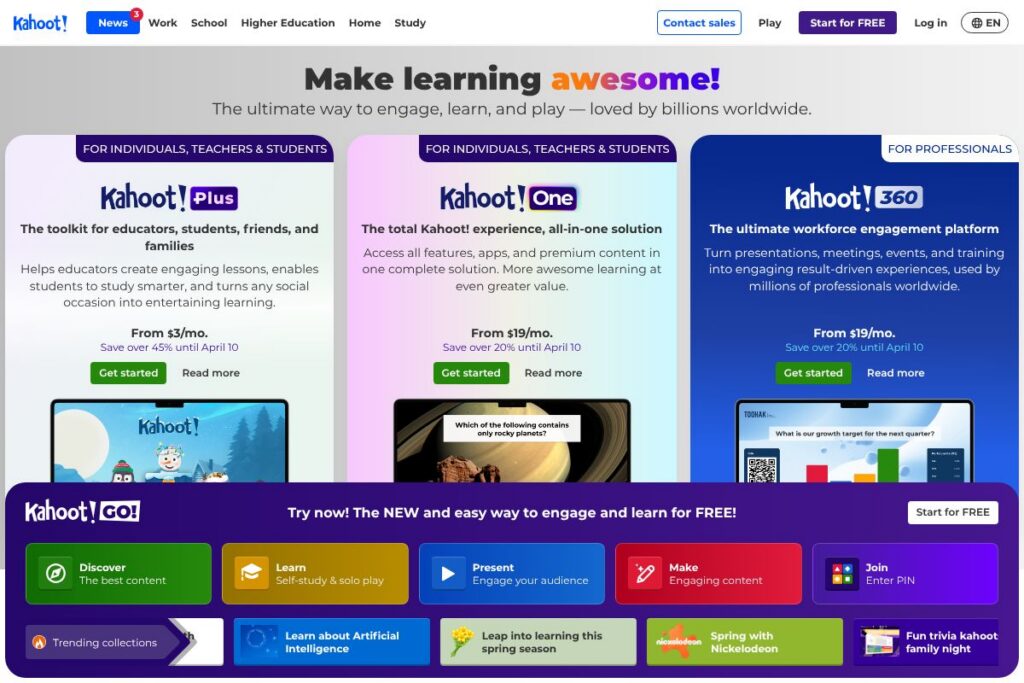
Kahoot! uses a subscription-based pricing model with tiered plans for individuals, educators, and professionals. Published marketing content lists entry-level pricing from $3/mo for individuals or basic educator packages, and higher tiers starting at $19/mo for fuller educator and professional feature sets. Discounts and promotional offers are sometimes available for annual billing or limited-time promotions.
Monthly Billing:
- Individuals – $3/mo (Basic quiz creation, play, and access to public kahoots)
- All-in-one (Educators & Students) – $19/mo (Access to premium content, apps, and the complete feature set)
- Professionals – $19/mo (Workplace engagement features, advanced reports, and event use)
Annual Billing:
Annual billing typically reduces the effective monthly cost and may include limited-time discounts such as multi-month savings. For exact annual pricing and current promotions, review the current pricing options provided by Kahoot!.
Enterprise
Enterprise and site licenses are offered with custom pricing for large schools, districts, or organizations that need rostering, SSO, and dedicated support. For detailed enterprise pricing and deployment details, consult Kahoot!’s enterprise information.
What is Kahoot! Used For?
Kahoot! is commonly used for classroom formative assessment, quick reviews, and icebreaker activities that require immediate audience participation. Teachers run kahoots live to check understanding after lessons, reinforce key facts before exams, or kick off discussions with a shared, playful activity.
In business settings, trainers and presenters use Kahoot! to make meetings and workshops interactive, to poll understanding during onboarding, and to gather quick feedback. Families and friends use the platform for trivia nights, learning games, and group challenges that turn knowledge checks into social play.
Pros and Cons of Kahoot!
Pros
- High engagement: Kahoot! encourages participation through game mechanics, leaderboards, and short timed questions that keep sessions lively. This format improves attention and recall compared with passive lectures.
- Easy to create and run: The authoring interface and template library make building a quiz fast, allowing teachers and trainers to launch activities with minimal setup. Participants join on any device using a simple PIN system.
- Flexible delivery modes: Kahoot! supports live, team-based, and self-paced modes which suit in-class teaching, remote learning, and corporate training. Assignments and reports extend utility beyond live sessions.
- Cross-platform access: Web and mobile apps allow learners to participate from browsers or phones, and integrations simplify launching activities from learning environments.
Cons
- Limited deep assessment tools: While excellent for short quizzes and review, Kahoot! is not designed for long-form assessments, essay grading, or complex question types. In-depth testing and adaptive assessments require other systems.
- Classroom management at scale: Managing very large classes or multiple synced sessions can become cumbersome without institutional rostering or enterprise features. District-level deployments often require custom agreements.
- Feature gating by tier: Some advanced content libraries, reports, and administrative tools are locked behind paid plans which can be a constraint for budget-limited users.
Does Kahoot! Offer a Free Trial?
Kahoot! offers a free plan that allows users to create, host, and play basic kahoots with no credit card required. Paid plans add premium content, advanced reports, and workplace features; current promotions and trial offers for paid tiers vary, so check the current pricing options for temporary discounts and trial details.
Kahoot! API and Integrations
Kahoot! provides integration options for common education and collaboration tools, including classroom rostering and single sign-on support. The platform advertises connections for launching kahoots from learning environments and for sharing activities across apps; see Kahoot!’s integration details for specifics.
A developer API and partner documentation exist to support custom integrations and embedding kahoot experiences in other platforms. Developers can consult the developer documentation for available endpoints, authentication methods, and examples for automation and LMS connectivity.
10 Kahoot! alternatives
Paid alternatives to Kahoot!
- Quizlet – Flashcard and study set platform with a focus on spaced repetition and individual study tools. Useful for self-paced memorization and practice testing.
- Nearpod – Interactive lesson platform that combines slides, quizzes, and formative assessment with classroom pacing and student devices. Designed for lesson delivery and assessment.
- Mentimeter – Audience polling and presentation tool that supports live polls, word clouds, and Q&A for meetings and events. Focused on presenter-driven interactivity.
- Socrative – Real-time classroom assessment tool with quick quizzes and exit tickets. Emphasizes simple formative assessment and immediate reports.
- Poll Everywhere – Live polling and Q&A for meetings and classes, with strong presentation integrations. Good for event-based audience interaction.
- Gimkit – Game-based quiz tool with economics and power-ups that reward continued play. Targets classroom motivation through game mechanics.
- Blooket – Gamified quiz platform that pairs quiz questions with different game modes to keep students engaged. Offers varied gameplay beyond simple scoring.
Open source alternatives to Kahoot!
- Moodle – Open source learning management system with quiz modules, assignments, and course management features. Suited for full course delivery and assessment.
- H5P – Interactive content framework for creating quizzes, interactive videos, and activities that embed into many LMS platforms. Good for authoring diverse interactive items.
- Sakai – Community-driven LMS that includes assessment and collaboration tools for institutions. Appropriate for organizations seeking a self-hosted platform.
- OpenOLAT – Open source LMS offering course creation, assessment, and repository features for institutions that need a customizable system.
Frequently asked questions about Kahoot!
What is Kahoot! used for?
Kahoot! is used to create and run game-based quizzes and interactive activities for classrooms, training, and social learning. It supports live play, self-paced assignments, and quick formative assessments to boost participation and recall.
Does Kahoot! have a free plan?
Yes, Kahoot! offers a free plan. The free tier allows basic creation and hosting of kahoots with public content access, while paid tiers add premium content, advanced analytics, and workplace features.
Can Kahoot! integrate with Google Classroom?
Yes, Kahoot! provides integrations with classroom tools including Google Classroom. These integrations simplify rostering, assignment distribution, and linking kahoots to classes.
Does Kahoot! provide an API for developers?
Yes, Kahoot! offers developer resources and an API for integrations. Developers can consult the developer documentation for endpoints, authentication, and integration examples.
How much does Kahoot! cost per month?
Kahoot! offers tiered subscriptions starting from around $3/mo for individual or basic educator packages, with fuller educator and professional tiers starting at about $19/mo. Exact pricing and available discounts can be found in the current pricing options.
Final verdict: Kahoot!
Kahoot! is highly effective when the goal is to increase live participation and make formative checks more memorable. Its simple authoring tools, fast multiplayer join flow, and game mechanics make it an efficient choice for teachers, trainers, and event hosts who need low-friction engagement and immediate feedback.
Compared with Quizlet, which is stronger for individual study and spaced practice, Kahoot! focuses on synchronous, competitive play and classroom energy. Kahoot! offers paid tiers beginning at $3/mo to unlock more content and administrative features, while Quizlet centers its value on flashcard study tools and subscription upgrades for advanced learner features. For organizations that prioritize live interaction and group dynamics, Kahoot! remains a top option; for self-paced study workflows, a flashcard-first tool may be more appropriate.