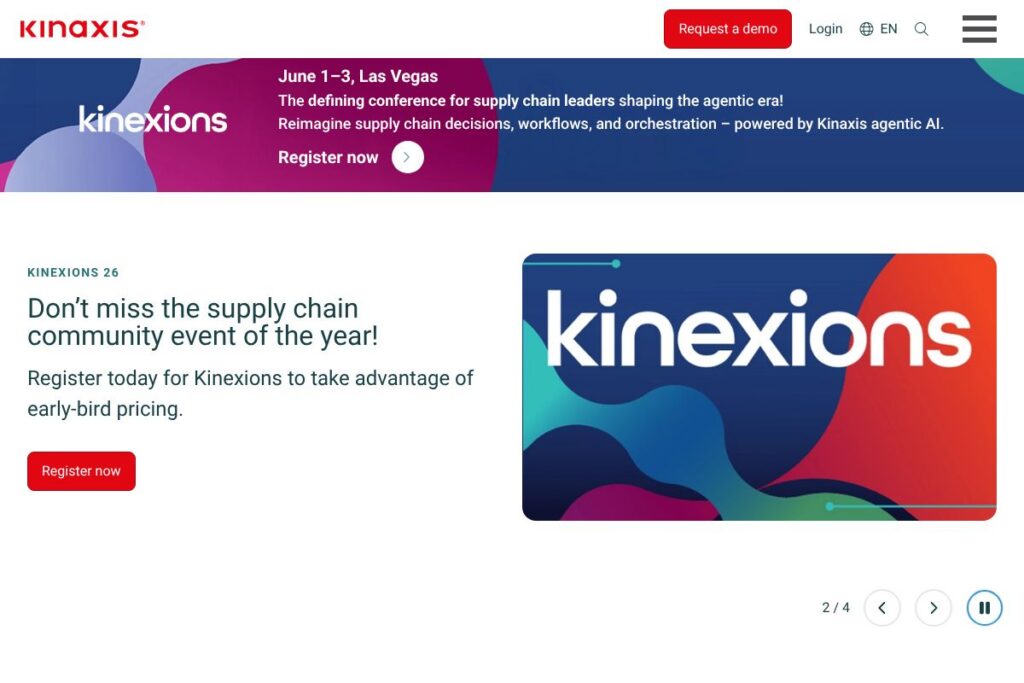
Kinaxis: An Overview
Kinaxis provides an enterprise-grade supply chain orchestration platform built around its Maestro capability. The platform unifies demand, supply, inventory, scheduling, transportation, and order management data to enable faster, evidence-driven decisions across functional teams. Explore the Maestro platform overview for more detail about how the product layers AI onto planning workflows.
Compared with SAP Integrated Business Planning, Anaplan, and Blue Yonder, Kinaxis places stronger emphasis on real-time, concurrent planning and agentic AI that can act on enterprise-wide context. SAP IBP is often chosen for deep ERP integration within SAP landscapes, Anaplan is favored for flexible connected planning and modeling, and Blue Yonder focuses on retail and distribution execution. Each platform targets large enterprises, but Kinaxis stands out when the requirement is continuous scenario simulation and automated decisioning across multiple functions.
All of this makes Kinaxis particularly well suited to large manufacturers, consumer products companies, and logistics-led enterprises that need continuous visibility and automated response capabilities. Organizations looking for agentic AI embedded inside planning workflows, as opposed to bolt-on analytics, will find Kinaxis designed for that use case. For product and solution listings, see the Kinaxis solutions hub.
How Kinaxis Works
Kinaxis ingests transactional and master data from ERP, warehouse, TMS, and order systems to create a single source of truth for planning and execution. The platform runs concurrent what-if simulations and consequence analysis so teams can compare scenarios quickly and see knock-on effects across cost, lead time, and service levels.
Maestro agents operate on the consolidated live model to sense anomalies, propose actions, and in supported configurations, execute routine decisions with human oversight. Typical workflows include demand sensing after a promotion, rapid supply rebalancing when a supplier delay occurs, and S&OP cycles that close financial and operational targets through collaborative plan adjustments.
Operational teams interact with Kinaxis through role-based dashboards, alerts, and collaborative threads that link decisions to data and simulation outcomes. Organizations commonly deploy Kinaxis as part of a phased program starting with one domain such as demand or inventory, then expanding to multi-domain orchestration; review deployment examples and case studies on the customer stories page.
Kinaxis features
Kinaxis centers its feature set on end-to-end visibility, AI-driven decision support, and rapid scenario modeling. Core capabilities include Maestro agentic AI, a control tower for real-time monitoring, connected S&OP, demand sensing, supply planning, inventory optimization, and execution-level modules like scheduling, order management, and transportation.
Maestro Agents
Maestro agents are context-aware AI modules that interpret the enterprise model, raise issues, suggest mitigations, and execute predefined actions when authorized. They reduce manual triage by surfacing recommended decisions alongside impact metrics, which speeds response to disruptions and frees planners to focus on exceptions.
Control Tower
The control tower consolidates signals from across the network into a single view for monitoring risk, tracking orders, and coordinating responses. It supports data-driven escalation and cross-functional collaboration so teams can resolve issues before they cascade into customer-impacting events.
Sales & Operations Planning (S&OP)
Kinaxis supports integrated S&OP workflows that align operational plans with financial targets through scenario comparison and consensus workflows. Built-in consequence analysis links proposed changes to financial and service outcomes, making it easier to reach balanced, approved plans.
Demand Sensing and Forecasting
Demand capabilities combine real-time signals with statistical forecasting and machine learning to create consensus-based demand plans. The tools let analysts incorporate promotions, market indicators, and short-term signals to improve forecast accuracy and responsiveness.
Supply Planning
Supply planning uses constraint-aware optimization and what-if scenario testing to produce feasible supply plans across plants and suppliers. Users can simulate supplier outages, capacity shifts, and alternate routings to understand tradeoffs before committing resources.
Inventory Optimization
Inventory features include multi-echelon optimization, event-driven simulations, and interactive dashboards for analyzing safety stock, service levels, and carrying costs. These tools help position inventory where it supports service objectives while controlling working capital.
Scheduling
Scheduling provides plant- and line-level sequencing integrated with higher-level plans to ensure feasible execution. It converts strategic supply plans into measurable shop-floor activities and highlights conflicts between production constraints and customer commitments.
Order Management
Order management offers lifecycle visibility and rule-based automation to prioritize fulfillment and improve on-time performance. The module connects orders to inventory, transportation, and production plans so exceptions surface early and are managed collaboratively.
Transportation and Logistics
Transportation capabilities give visibility across multi-modal networks, with planning and execution workflows that reduce cost and improve delivery reliability. The system supports collaboration with carriers and integrates transportation status into the broader control tower view.
Returns Management
Returns functionality manages reverse flows, repair and refurbishment routing, and return-to-supplier processes to recover value and reduce cost. It links returns decisions to inventory and order management so financial and inventory implications are visible.
With these capabilities, the biggest practical benefit is a single, live model that lets teams simulate options and act with confidence, reducing the time from signal to resolution across planning and execution. For a guided walkthrough, book a session with a Kinaxis expert via the platform demo booking.
Kinaxis pricing
Kinaxis uses a custom enterprise pricing model tailored to organization size, modules selected, deployment scope, and support requirements rather than public, fixed subscription tiers. Pricing typically factors in user roles, data volume, number of planning domains, and whether on-premises or cloud deployment is required.
For specific cost estimates and licensing options contact Kinaxis sales or request a demo through the contact and sales page. Enterprises considering Kinaxis often evaluate total cost against expected reduction in inventory carrying cost, improved service levels, and avoided disruption costs; sales can provide tailored ROI scenarios.
What is Kinaxis Used For?
Kinaxis is commonly used to connect planning and execution across supply chain functions so teams can respond faster to variability and disruption. Typical activities include demand sensing after promotional events, multi-echelon inventory rebalancing, and rapid supply re-planning when suppliers or transport capacity change.
It is particularly useful for companies that run high-volume manufacturing, complex supplier networks, or large-scale distribution operations and need continuous scenario comparison, audit trails for decisioning, and cross-functional collaboration. Industry-specific configurations and best-practice templates support deployments in life sciences, high-tech, consumer products, automotive, aerospace, and industrial sectors; see industry options on the industry pages.
Pros and Cons of Kinaxis
Pros
- Real-time concurrent planning: Kinaxis keeps a single live model so planners and operations work from the same updated truth, reducing reconciliation work and decision delay. This improves responsiveness to supply disruptions and demand shifts.
- Agentic AI that acts on context: Maestro agents propose and, when permitted, take routine actions with awareness of end-to-end impacts, lowering manual workload for repetitive triage and enabling faster resolution of common issues.
- Comprehensive scope across functions: The platform covers demand, supply, inventory, scheduling, transportation, and order management, which helps align operational actions with financial targets and S&OP outcomes.
Cons
- Enterprise deployment complexity: Implementing Kinaxis across multiple domains and integrating with legacy ERPs can require significant project governance and change management. Organizations should plan for phased rollouts and internal adoption work.
- Custom pricing and procurement cycle: Because pricing is tailored to each customer, procurement cycles can be longer and require detailed scoping to obtain accurate quotes and ROI analyses.
- Advanced capabilities require skilled users: To realize the full value of agentic AI and scenario modeling, teams need planners who understand tradeoff analysis and scenario-driven decision frameworks.
Does Kinaxis Offer a Free Trial?
Kinaxis offers demos and enterprise pilot programs rather than a public free plan. Prospective customers can request a guided demo or pilot to evaluate Maestro in their environment, and Kinaxis sales will outline pilot scope, objectives, and timelines; start the process through the request a demo page.
Kinaxis API and Integrations
Kinaxis provides APIs and prebuilt connectors to common enterprise systems so the Maestro model can consume ERP, WMS, TMS, and CRM data; integration capabilities are part of solution implementation. For developers and technical teams, review the integration and connector information and discuss specific connector needs with Kinaxis services.
The platform commonly integrates with systems such as SAP and Oracle ERP landscapes, major transportation and warehouse systems, and BI tools for downstream reporting, enabling data flow between planning and execution layers without manual exports.
10 Kinaxis alternatives
Paid alternatives to Kinaxis
- SAP Integrated Business Planning (SAP IBP): A comprehensive planning suite tightly integrated with SAP ERP environments, strong for organizations standardizing on SAP. IBP emphasizes deep ERP connectivity and advanced planning modules.
- Anaplan: A connected planning platform that focuses on flexible modeling and scenario planning across finance and supply chain, often used for cross-functional planning programs. Anaplan is known for its modeling flexibility and in-memory calculation engine.
- Blue Yonder (formerly JDA): Supply chain and retail planning software with strength in merchandising, demand forecasting, and transportation optimization, commonly used by retailers and distributors. It includes industry-specific execution tools.
- Oracle Supply Chain Management Cloud: An end-to-end suite that combines planning, procurement, manufacturing, and logistics within Oracle’s cloud ecosystem, chosen for organizations using Oracle infrastructure. It offers deep functional breadth across supply chain processes.
- E2open: A network-centric supply chain platform that emphasizes collaborative supply chain planning with supplier and logistics network connectivity. E2open is used for multi-enterprise visibility and orchestration.
- Dassault Systèmes DELMIA/DELMIA Apriso: Focused on manufacturing operations and digital continuity from planning to shop-floor execution, often used in complex manufacturing environments.
- Manhattan Associates: Strong in distribution, warehouse management, and transportation, with planning modules that focus on fulfillment and network optimization.
Open source alternatives to Kinaxis
- Odoo: A modular open source ERP that includes inventory, MRP, and procurement modules suitable for small to mid-sized businesses that prefer open source flexibility and self-hosting options.
- ERPNext: An open source ERP with manufacturing, inventory, and order management capabilities that works well for smaller organizations seeking an integrated system without large licensing fees.
- OpenBoxes: Open source supply chain management software focused on inventory and stock management, frequently used by global health and NGO supply chains to manage medicines and supplies.
- Apache OFBiz: A foundation framework for building ERP and supply chain solutions with components for inventory, order management, and fulfillment, requiring significant development to match packaged-suite functionality.
Frequently asked questions about Kinaxis
What does Kinaxis do for supply chain planning?
Kinaxis provides a unified platform for planning and execution that supports scenario modeling, S&OP, and control tower visibility. It combines statistical forecasting, constraint-aware planning, and agentic AI to help teams assess tradeoffs and act quickly.
Does Kinaxis provide integrations for ERP systems?
Yes, Kinaxis supports integrations and connectors for major ERP and execution systems. Implementations typically include connectors to SAP, Oracle, WMS, and TMS systems as part of solution deployments.
How much does Kinaxis cost for enterprise users?
Kinaxis uses custom enterprise pricing rather than fixed public tiers. Costs depend on modules selected, number of users, deployment scope, and integration needs; contact Kinaxis sales for a tailored quote via the contact page.
Can Kinaxis support industry-specific supply chain requirements?
Yes, Kinaxis offers industry-specific templates and best practices for sectors such as life sciences, high-tech, consumer products, and automotive. Those templates accelerate deployment and align planning workflows to industry constraints and regulations.
Does Kinaxis offer a demo or pilot program?
Yes, Kinaxis provides guided demos and pilot engagements to evaluate Maestro in context. Prospective customers can request a demo to see platform capabilities and discuss a pilot scope that tests critical workflows, via the demo request form.
Final Verdict: Kinaxis
Kinaxis excels at turning a complex, distributed supply chain into a single live model that supports rapid what-if analysis, cross-functional collaboration, and agentic AI-assisted decisions. Its strengths are concurrent planning, Maestro agents that act on end-to-end context, and industry-configured templates that reduce initial setup time. For organizations that must reduce time-to-decision and manage frequent disruptions, Kinaxis provides tools to make those workflows repeatable and auditable.
Compared with SAP Integrated Business Planning, both vendors use enterprise, custom pricing models, but they differ in emphasis. SAP IBP is often selected for deep ERP-native integration and a broad enterprise footprint, while Kinaxis is chosen when real-time concurrent planning and automated decision agents are priorities. Evaluate both platforms against your integration landscape, required planning cadence, and whether agentic AI within planning workflows is a decisive criterion.
Overall, Kinaxis is a strong option for large enterprises that need continuous orchestration across planning and execution and that are prepared to invest in integration and change management to capture end-to-end value. For next steps, request a tailored demo or pilot to validate fit against your operational requirements via the Maestro demo booking.