LiveChat: An Overview
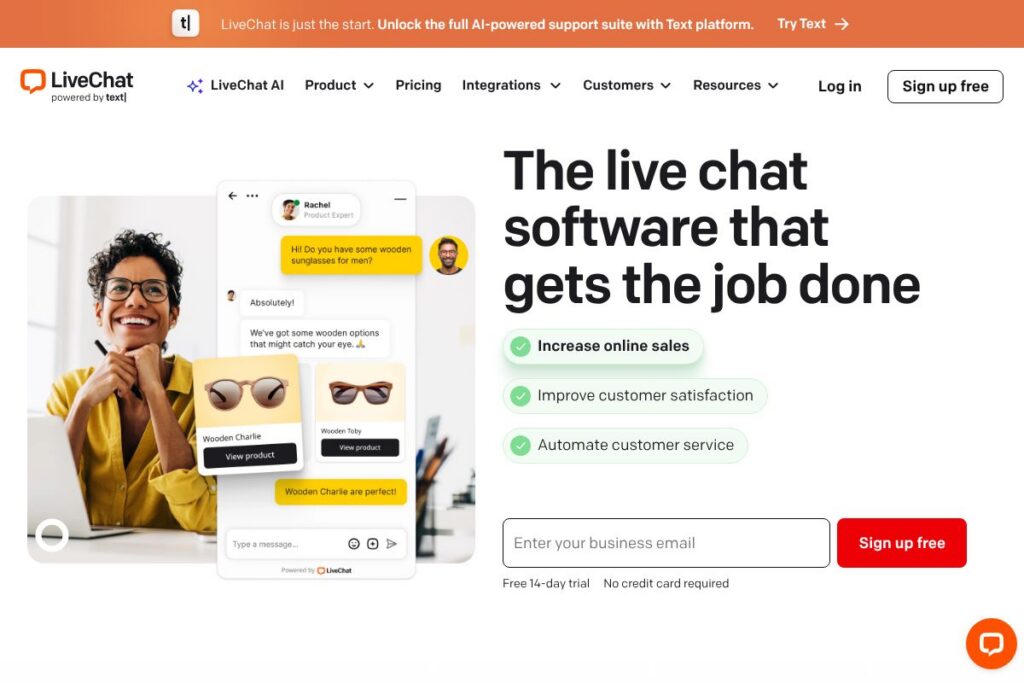
LiveChat provides a hosted live chat platform that places a website-facing chat widget on your site, routes incoming conversations to agents, and adds automation and analytics for sales and support teams. It is built for fast setup and day-to-day use by support agents, ecommerce stores, and B2B service teams that need real-time conversation handling and measurable outcomes.
Compared with competitors, LiveChat focuses on a straightforward live chat workflow and a comprehensive app ecosystem. Compared to Intercom, which emphasizes product messaging and in-app campaigns, LiveChat centers on chat performance and integrations for commerce. Against Zendesk, LiveChat is lighter on traditional ticketing but stronger for proactive chat and on-site engagement. Compared to Freshdesk, LiveChat offers a simpler agent experience tailored to immediate customer interactions rather than full-service helpdesk routing.
LiveChat performs best when teams want a reliable, low-friction chat channel with built-in automation and reporting. It suits ecommerce stores looking to increase conversion, B2B sales teams that need conversational selling, and support teams that want one inbox to manage web, social, and messaging channels. For organizations prioritizing lightweight deployment and fast ROI, LiveChat is a practical choice.
How LiveChat Works
The LiveChat workflow starts with adding the chat widget to your website, which captures visitor context such as page, referrer, and cart contents. Agents receive incoming chats in a browser or desktop app and can use pre-set greetings, canned responses, and customer data to shorten response time.
Automation is layered through chatbots and AI assistance to handle common questions and qualify leads before handing over to a human agent. The platform also connects with commerce and CRM systems so agents can reference orders, customer records, and conversation histories directly from the chat interface.
Day-to-day use typically follows a pattern: proactive messages trigger on key pages, bots handle repeatable queries, and agents step in for high-value or complex conversations. Managers monitor response times and satisfaction metrics through built-in reporting to optimize staffing and chat routing.
LiveChat features
LiveChat bundles core capabilities for live conversational commerce and customer service, including a customizable chat widget, chatbot automation, agent assistance with AI, multi-channel inboxing, and reporting. Recent additions emphasize AI assistance for agents and tighter chatbot integration to reduce repetitive work.
Chat widget and proactive messages
The chat widget is highly customizable and supports proactive greetings based on URL, referrer, or time on page. Proactive messages help start sales conversations and reduce abandonment by engaging visitors who show purchase intent.
ChatBot automation
LiveChat integrates with ChatBot tools to automate routine inquiries, qualify leads, and collect contact information before escalation. Automation reduces agent load and speeds resolution for common questions such as shipping, returns, and order status.
Copilot AI for agents
Copilot provides contextual suggestions and real-time drafting help inside the agent app, speeding responses and ensuring consistent tone. Agents can edit AI drafts, which decreases handling time and improves answer quality on complex issues.
Reporting and analytics
Built-in reports track metrics like response time, chat volume, conversion rate, and customer satisfaction. These reports help teams measure chat impact on sales and identify opportunities to improve agent performance and workflows.
Integrations and app marketplace
LiveChat connects with ecommerce platforms, CRMs, and messaging channels through an app marketplace and native integrations. Common connections include Shopify, WooCommerce, Salesforce, Slack, and Zapier to align chat data with backend systems.
Multi-channel inbox and routing
The platform consolidates messages from web chat, Facebook Messenger, Instagram, and other channels into a single inbox with routing rules. Centralizing conversations reduces context switching and keeps response times consistent.
With these features, LiveChat’s biggest practical benefit is converting real-time conversations into measurable business outcomes. Teams get a single environment for live engagement, automation, and analytics that supports both sales and support workflows.
LiveChat pricing
LiveChat follows a subscription SaaS pricing model with tiered plans and an enterprise option, and it offers an entry-level monthly plan starting at $19/month. Pricing scales by features such as advanced automation, reporting depth, and multi-channel support, while enterprise customers may receive custom bundles and SLAs.
Monthly Billing
- Entry-level plan – $19/month (basic live chat widget, chat history, standard support)
- Higher tiers – Feature sets increase to include automation, advanced reporting, and multi-channel inboxing; pricing varies by level and seat count
Annual Billing
- Annual subscriptions typically provide a discounted effective rate compared with monthly billing, and most organizations save when paying annually. For exact annual rates and current discounts, view the current pricing options.
Enterprise
- Enterprise – Custom pricing (advanced security, dedicated support, custom integrations). Contact LiveChat for a tailored proposal and volume discounts, see the enterprise contact options.
What is LiveChat Used For?
LiveChat is commonly used to convert website visitors into customers by enabling real-time conversations that can answer questions, suggest products, and complete sales without leaving the page. Ecommerce teams use it to recommend products, recover carts, and increase average order value.
Support teams use LiveChat to provide faster first responses, handle high-touch inquiries, and centralize messages from social channels and messaging apps. Sales and B2B teams use the platform for lead qualification, meeting scheduling, and handing qualified leads to the sales CRM.
Pros and Cons of LiveChat
Pros
- Fast setup and ease of use: LiveChat installs quickly on most websites and has an intuitive agent interface, reducing onboarding time and training cost.
- Strong ecommerce integrations: Native links to platforms like Shopify and WooCommerce let agents access cart and order data during chats, which helps close sales faster.
- Robust automation options: Chatbot integrations and Copilot reduce repetitive tasks and speed up agent responses, improving capacity without proportionally increasing headcount.
- Actionable reporting: Built-in analytics make it straightforward to measure chat impact on sales and support KPIs without external BI tools.
Cons
- Limited deep ticketing features: Organizations needing a full-feature helpdesk workflow may find LiveChat lighter on ticket lifecycle management compared with full helpdesk platforms.
- Advanced features add cost: Higher-tier features such as advanced automation, analytics, and multi-channel support are typically reserved for premium plans or enterprise agreements.
- Customization can require integrations: Very specific workflows or data syncs often rely on third-party integrations or custom development using the API.
Does LiveChat Offer a Free Trial?
LiveChat offers a 14-day free trial with no credit card required. The trial provides access to the chat widget, basic reporting, and core automation so teams can evaluate chat performance before committing to a paid plan.
LiveChat API and Integrations
LiveChat provides a developer API and SDKs for connecting chat data and automating workflows; see the API documentation for endpoints, webhooks, and authentication details. The API supports retrieving chat transcripts, managing agents, and integrating bot logic.
The platform also maintains an app marketplace with integrations for popular services such as Shopify, WooCommerce, Salesforce, Slack, and Zapier. Explore the integration catalog to connect LiveChat to CRMs, ecommerce stores, analytics, and automation tools.
10 LiveChat alternatives
Paid alternatives to LiveChat
- Intercom — A customer messaging platform that blends live chat with product tours and in-app messaging for SaaS and product-led teams.
- Zendesk — A full helpdesk suite with chat capability and deep ticketing, useful for larger support organizations.
- Freshdesk — An integrated support platform with multi-channel routing, chat, and ticketing for service teams.
- Drift — Conversational marketing platform focused on sales-qualified leads and account-based interaction.
- Tidio — Chat and chatbot solution geared toward small to medium ecommerce stores, with low-cost entry plans.
- Olark — Simple live chat with focus on ease of use and straightforward agent tools.
- HubSpot Live Chat — Tightly integrated with HubSpot CRM, useful if you already use HubSpot for marketing and sales.
Open source alternatives to LiveChat
- Chatwoot — Open source customer engagement platform with live chat, shared inbox, and self-hosting options.
- Rocket.Chat — Team and customer messaging platform that can be adapted for customer support and live chat scenarios.
- Mibew — Lightweight open source live chat solution you can self-host and customize.
- Live Helper Chat — Feature-rich open source live support software with self-hosting and plugin support.
Frequently asked questions about LiveChat
What is LiveChat used for?
LiveChat is used for real-time customer communication on websites and messaging channels. It helps teams answer questions, guide purchases, and collect leads directly from site visitors.
Does LiveChat offer chatbot automation?
Yes, LiveChat supports chatbot automation through integrations and native automation options. Chatbots handle repetitive queries, qualify leads, and hand off to agents when needed.
How much does LiveChat cost per month?
LiveChat plans start at about $19/month for entry-level subscriptions. Feature-rich tiers and enterprise agreements increase the price depending on seats, automation, and reporting requirements.
Can LiveChat integrate with ecommerce platforms?
Yes, LiveChat integrates with major ecommerce platforms and CRMs. Common integrations include Shopify, WooCommerce, Salesforce, and Zapier to sync chat context with orders and customer records.
Does LiveChat provide an API for developers?
Yes, LiveChat offers an API and developer documentation. The API supports webhooks, chat transcript retrieval, and agent management for custom integrations and automations.
Final Verdict: LiveChat
LiveChat is a practical, well-focused live chat platform that balances ease of use with enough automation and reporting to make it valuable for ecommerce and B2B teams. Its chat widget, chatbot integrations, and agent AI help reduce response times and support conversion-oriented workflows while keeping the platform approachable for small to mid-size teams.
Compared with Intercom, LiveChat starts at a lower entry point with its $19/month reference price and emphasizes live chat performance and straightforward integrations. Intercom offers broader product messaging and in-app engagement capabilities at a higher cost, so choose LiveChat when real-time chat and sales-driven conversations are the priority, and consider Intercom if you need an all-in-one product messaging and support suite.