LivePerson: An Overview
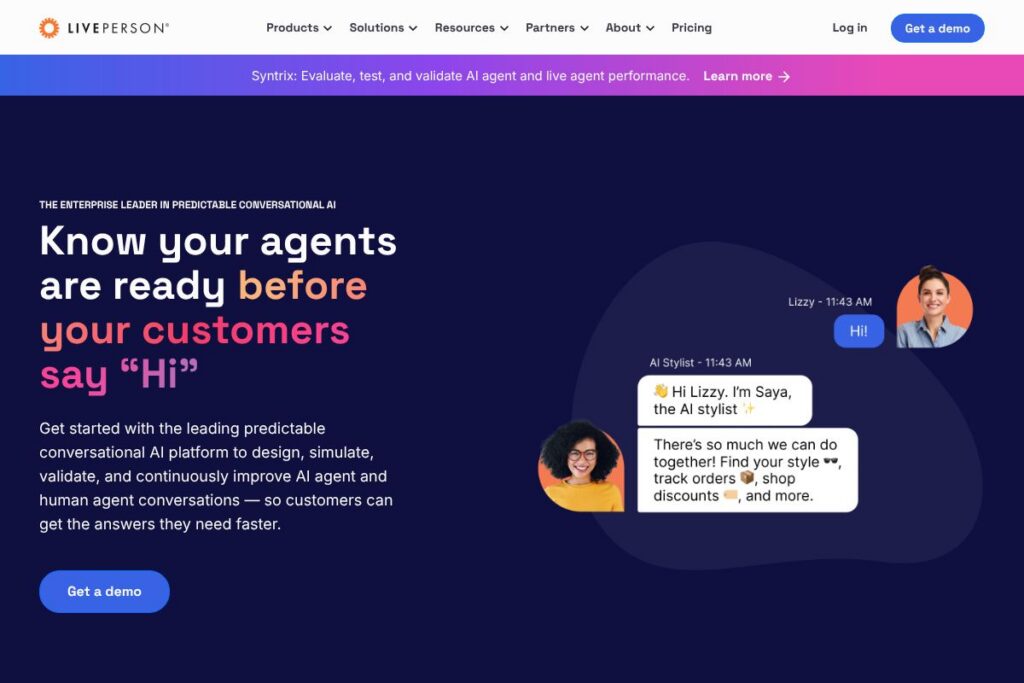
LivePerson is an enterprise conversational AI platform focused on predictable, scalable customer conversations. The platform supports designing, simulating, validating, and continuously improving automated and human agent interactions across messaging and voice channels, and it emphasizes data-driven monitoring to reduce risk and improve outcomes.
Compared with vendors such as Zendesk, Genesys, and Salesforce Service Cloud, LivePerson concentrates on conversational orchestration and AI-first automation at scale. Unlike Zendesk, which centers on ticketing workflows, LivePerson prioritizes conversational design and pre-launch validation. Compared with Genesys, LivePerson leans more heavily on bringing your own large language models and unified conversation analytics. Against Salesforce Service Cloud, LivePerson provides deeper specialized conversational tooling and simulation capabilities rather than a broad CRM-centric suite.
LivePerson is best suited for large enterprises and regulated organizations that need predictable, auditable AI behavior and broad channel coverage. Its strengths include built-in experiment and simulation tooling like Syntrix, high-volume message handling, and compliance controls that support GDPR, HIPAA, and PCI DSS requirements.
How LivePerson Works
The platform lets teams build conversational agents, connect them to messaging and voice channels, and run simulations to validate responses before customer exposure. Teams author conversation flows, plug in a chosen LLM or use built-in models, and run Syntrix scenarios to test how agents respond to thousands of realistic customer prompts.
In production, LivePerson routes conversations between AI agents and human agents based on intent, confidence thresholds, and business rules. Conversation data feeds unified analytics that surface where AI succeeds, where handoffs are needed, and which customer journeys produce revenue, enabling continuous improvement.
What does LivePerson do?
LivePerson provides a suite of capabilities for conversational automation, agent orchestration, analytics, and compliance. Recent emphasis includes generative AI tooling for drafting responses, the Syntrix simulation engine for pre-launch validation, and integrations that let you use your preferred LLMs and contact center systems.
Let’s talk LivePerson’s Features:
Syntrix simulation
Syntrix lets teams simulate large sets of realistic customer interactions to validate AI agents and train human agents before live deployment. This reduces unexpected behavior in production, shortens validation cycles, and provides measurable test coverage against failure scenarios.
Omnichannel messaging
LivePerson supports messaging channels such as web messaging, mobile SDKs, WhatsApp, SMS, and major social platforms, allowing brands to meet customers where they prefer to engage. Channel-level routing and context preservation ensure conversations remain coherent across switches between messaging and voice.
Bring-your-own-LLM and model orchestration
The platform is designed to connect to customer-selected language models as well as hosted models, giving teams flexibility to run in-house or third-party models. Model orchestration features let you route intents to different models and apply guardrails for safety and compliance.
Conversational commerce
LivePerson provides tools to embed commerce flows inside conversations, including product recommendations, checkout flows, and personalization controls. This capability is aimed at driving revenue directly from conversational interactions while maintaining transactional security.
Voice integration and hybrid experiences
Voice is supported alongside messaging so teams can create unified agent experiences that combine automated voice interactions with messaging transcripts. Integrations with telephony providers and analytics enable consistent reporting and handoff logic between voice and chat.
Generative AI productivity tools
Generative features help agents and bots draft replies, summarize long conversations, and surface next-best actions to shorten handling times. These tools are intended to improve agent efficiency while ensuring responses stay aligned with brand and compliance rules.
Unified conversational analytics
Conversation data is aggregated into dashboards and reports that highlight intent performance, escalation drivers, revenue signals, and agent effectiveness. These insights are usable for both AI tuning and workforce coaching to drive measurable ROI.
Enterprise security and compliance
LivePerson provides security controls and certifications required for enterprise deployments, including data handling policies to support GDPR, HIPAA, and PCI DSS. The platform scales to handle high message volume while giving administrators control over data residency and access.
With these features, the biggest benefit is the ability to validate and monitor conversational AI at enterprise scale, reducing operational risk while improving both agent productivity and customer outcomes.
LivePerson pricing
LivePerson uses enterprise-grade, custom pricing rather than published self-serve plans; pricing is typically negotiated based on channels, message volume, integrations, and support requirements. This model is common for platforms that provide bespoke deployments, dedicated SLAs, and compliance features.
Enterprise
Enterprise – Custom pricing (Includes platform access, Syntrix simulation, channel connectors, security and compliance support, and enterprise SLA). For tailored plans and deployment options, view LivePerson’s enterprise pricing details.
For procurement, vendors typically provide quotes that factor in monthly message volumes, required integrations, and professional services for setup and migration. To get a proposal suited to your environment, request a demo or contact sales through LivePerson’s contact and demo pages.
What is LivePerson used for?
LivePerson is used to automate customer conversations across channels, reduce contact center load, and create revenue-generating conversational journeys. Typical tasks include answering FAQs, handling order status and transactions, qualifying leads, and routing complex requests to human agents.
Ideal users are large customer service organizations, financial institutions, telecoms, retail brands, and healthcare providers that need secure, auditable conversational workflows and strong analytics to measure business impact.
Pros and cons of LivePerson
Pros
- Predictable AI validation: Syntrix and simulation tooling let teams validate AI behavior at scale before deployment, reducing live errors and reputational risk.
- Omnichannel orchestration: The platform connects messaging, voice, and contact center systems so conversations remain continuous and context-rich across channels.
- Enterprise compliance and scalability: Built-in controls and certifications support GDPR, HIPAA, and PCI DSS requirements while handling high message volumes.
- Model flexibility: Ability to connect customer-chosen LLMs avoids vendor lock-in and supports specialized model requirements for sensitive industries.
Cons
- Enterprise focus: The platform is optimized for large organizations, which can make it less cost-effective for small teams or startups with light conversation volume.
- Custom pricing complexity: Because pricing is negotiated, budget planning can require direct vendor engagement rather than relying on published tiers.
- Implementation effort: Integrating existing systems and tuning conversational flows for enterprise requirements can require professional services and internal resources.
Does LivePerson Offer a Free Trial?
LivePerson does not publish a free plan; it provides demos, proofs of concept, and custom trial arrangements for enterprise customers. Prospective customers can request a demo to see Syntrix simulations, conversational analytics, and channel integrations in context before committing to a contract.
LivePerson API and Integrations
LivePerson provides developer APIs and connectors to integrate with CRMs, telephony systems, and messaging providers. The LivePerson developer portal and documentation explain endpoints for message routing, conversation state, and analytics, see the LivePerson developer documentation for details.
Common integrations include CRM systems, workforce management tools, conversational channels like WhatsApp and SMS, and analytics pipelines to central BI. The platform is designed to be open so you can connect third-party monitoring and compliance tools as needed.
10 LivePerson alternatives
Paid alternatives to LivePerson
- Zendesk — Ticketing-first customer service suite with messaging and answer bot capabilities, better suited to support-ticket workflows.
- Genesys — Contact center platform with strong voice routing and workforce optimization features for large-scale telephony operations.
- Salesforce Service Cloud — Integrated CRM and service platform that combines case management with messaging and AI features tied to Salesforce data.
- Intercom — Conversational support and product messaging focused on customer engagement and lifecycle messaging for mid-market companies.
- Ada — AI-driven chatbot platform focused on automated customer support and self-service at scale.
- Amazon Connect — Cloud contact center service with pay-as-you-go telephony and integrations into AWS AI services for voice automation.
- Nuance (now part of Microsoft) — Conversational AI and voice biometrics tools widely used in voice-first contact center scenarios.
Open source alternatives to LivePerson
- Rasa — Open source conversational AI framework for building custom chatbots with on-premise deployment options and strong developer controls.
- Botpress — Modular, developer-focused platform for building conversational experiences with a visual flow editor and self-hosting options.
- Rocket.Chat — Open source team messaging platform that can be extended with bot integrations to support conversational workflows.
- OpenDialog — Open source conversational design platform for modeling complex dialog flows and decision logic.
- Chatwoot — Open source customer messaging platform with multichannel support and helpdesk features for smaller teams.
Frequently asked questions about LivePerson
What is LivePerson used for?
LivePerson is used to run conversational AI and human-agent orchestration for enterprise customer engagement. Organizations use it to automate routine interactions, route complex cases to agents, and capture conversation-driven business insights.
Does LivePerson integrate with Salesforce?
Yes, LivePerson integrates with Salesforce and other CRMs. Integrations allow conversation context, customer records, and case data to flow between systems for a unified agent experience.
Can LivePerson connect to my own LLM?
Yes, LivePerson supports bring-your-own-LLM connections. The platform lets teams route intents to customer-selected models, enabling use of in-house or third-party LLMs while applying safety and compliance guardrails.
How does LivePerson handle security and compliance?
LivePerson provides enterprise-grade security and compliance controls. The platform supports data handling policies and certifications such as GDPR, HIPAA, and PCI DSS to meet regulated industry requirements.
Is LivePerson suitable for voice and messaging together?
Yes, LivePerson supports unified voice and messaging experiences. Conversations can move between channels with preserved context, and analytics combine voice and message data for consistent reporting.
Final verdict: LivePerson
LivePerson excels at predictable, enterprise-grade conversational AI with strong validation, orchestration, and compliance features. Tools like Syntrix for simulation, the ability to bring your own LLM, and unified conversational analytics make it a practical choice for large organizations that need auditable AI behavior and measurable business outcomes.
Compared with Salesforce Service Cloud, LivePerson is more focused on conversation-first automation and pre-launch validation, while Salesforce offers broader CRM integration and packaged service features. Pricing is custom for both vendors, but LivePerson typically aligns with enterprise budgets that prioritize conversational orchestration and compliance over out-of-the-box CRM functionality. For enterprises that need tight control over AI behavior and full-channel orchestration, LivePerson is a strong candidate; smaller teams may find simpler or lower-cost alternatives more appropriate.