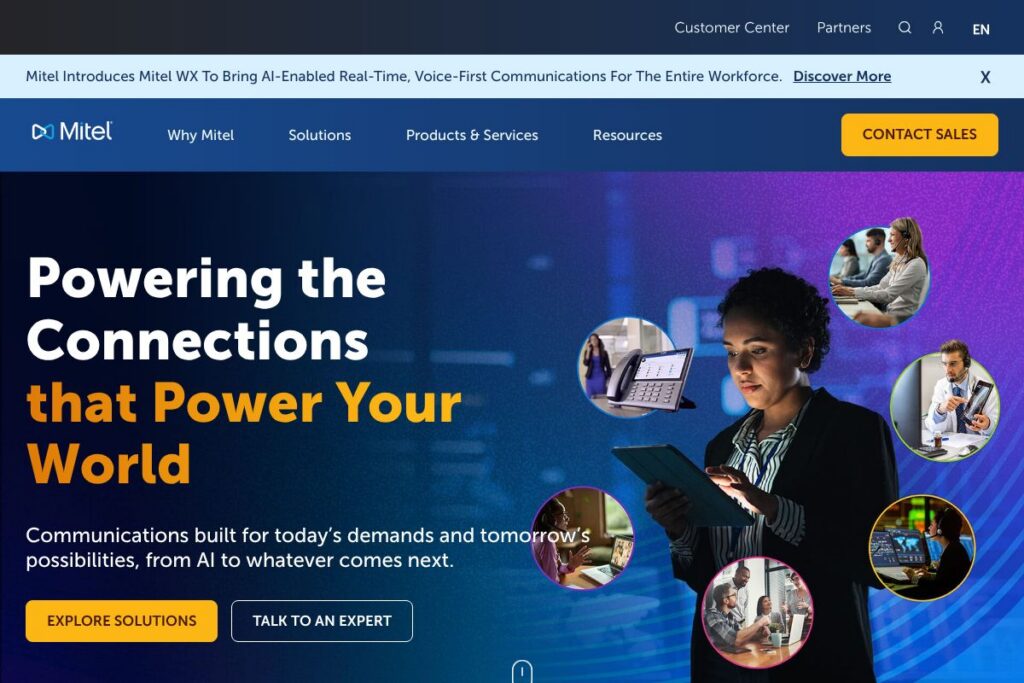
Mitel: An Overview
Mitel is a communications provider focused on unified communications, contact center platforms, and hybrid deployment models that combine cloud and on-premises components. The company positions its portfolio for organizations that need resilient voice, collaboration, and customer engagement tools across distributed workforces and regulated industries.
Compared with competitors like Cisco, Avaya, and RingCentral, Mitel is notable for its hybrid deployment flexibility and large global partner network that supports on-premises refreshes and gradual cloud migration. Cisco tends to lead on enterprise networking integration and global scale, Avaya emphasizes legacy enterprise telephony and deep contact center features, while RingCentral focuses on a cloud-first, subscription-based model with transparent per-user pricing.
All of this makes Mitel especially well suited for organizations that require a mix of cloud and on-premises control, regulated-industry compliance, or partner-led managed services. Its strengths are hybrid deployments, a broad portfolio of voice and contact center features, and a global partner ecosystem that helps tailor implementations for specific industries.
How Mitel Works
Mitel combines PBX-class telephony, softphones and desktop/mobile clients, and cloud-hosted services into a single portfolio that administrators can deploy on-premises, in Mitel-hosted cloud environments, or with hybrid configurations. Core components include the telephony platform, a unified communications client, contact center software, session border controllers, and management/analytics tools.
Typical workflows connect end users via IP desk phones or soft clients to enterprise voice services, while contact center agents route customer interactions across voice, chat, and digital channels using skills-based routing and workforce management. Integrations link Mitel systems to CRM platforms and productivity suites so agents and knowledge workers can surface customer context during interactions.
Deployment is often partner-driven: Mitel-certified resellers and managed service providers handle system design, provisioning, phone inventory, SIP trunking, and ongoing support. Administrators use web-based dashboards for configuration, reporting, and troubleshooting, and APIs extend automation and integrations into existing IT systems.
Mitel features
Mitel’s platform is organized around unified communications and contact center capabilities with a strong focus on hybrid deployment and industry-specific compliance. Core capabilities include IP telephony, soft clients for desktop and mobile, omnichannel contact center features, reporting and analytics, and APIs for integrations; the company also emphasizes partner services for deployment and managed operations.
Unified Communications
Mitel provides voice, presence, messaging, and conferencing in a single client that runs on desktop and mobile devices, enabling consistent calling and collaboration across locations. This benefits teams by reducing context switching and keeping voice and collaboration tools accessible from the same interface.
Contact Center
The contact center product supports omnichannel routing, queue management, interactive voice response, and workforce optimization tools to manage agent capacity and service levels. These features help customer service operations balance efficiency and customer experience across voice and digital channels.
Hybrid Deployment Options
Mitel supports on-premises, cloud-hosted, and hybrid architectures so organizations can maintain sensitive workloads locally while moving other services to the cloud. This flexibility fits enterprises that require phased migrations or data locality for compliance.
Security and Compliance
The portfolio includes session border controllers, encryption for signaling and media, role-based administration, and features designed to help meet industry regulations. These controls assist IT teams with securing communications and demonstrating compliance for audits.
Analytics and Reporting
Built-in dashboards and historical reporting surface call metrics, queue performance, and agent productivity, with options to export data for deeper analysis. Managers can use these insights to tune staffing, routing, and training programs.
Partner and Deployment Services
Mitel’s global partner network offers system design, installation, and managed services that simplify life cycle management for customers that prefer outsourced operations. This reduces the internal administrative burden for organizations without large UC teams.
With features spanning enterprise telephony, collaboration, contact center, and security, Mitel’s biggest benefit is its ability to deliver consistent communications across mixed on-premises and cloud environments while leveraging partner expertise for implementation and support. Explore Mitel’s contact center solutions and Mitel’s unified communications solutions for product details and configuration options.
Mitel Pricing
Mitel uses a flexible, enterprise-oriented pricing model that is typically provided through custom quotes for organizations based on deployment type, seat counts, feature bundles, and partner services. For accurate costs and licensing options you should review Mitel’s solution pages and contact sales to request a tailored quote via Mitel’s contact sales page.
What is Mitel Used For?
Mitel is commonly used for enterprise telephony and team collaboration, replacing legacy PBX systems with IP telephony and unified clients that support remote and hybrid workers. Organizations use Mitel to provide consistent voice, chat, and conference services to employees across offices, branches, and home locations.
It is also widely used for contact center operations where omnichannel routing, agent desktop integration, and workforce management are required to manage customer service at scale. Regulated industries such as healthcare, financial services, and government use Mitel to meet data locality and compliance needs while modernizing communications.
Pros and Cons of Mitel
Pros
- Hybrid deployment flexibility: Mitel supports on-premises, cloud, and mixed models, allowing organizations to migrate services at their own pace and maintain local control where required. This is useful for regulated environments and multi-site businesses that need phased cloud adoption.
- Strong partner ecosystem: A global network of certified partners provides deployment, managed services, and industry-specific customizations, which reduces internal project load and accelerates time to value. Partners often provide SIP trunking, phone provisioning, and ongoing support.
- Enterprise-grade telephony and contact center features: The platform includes PBX-level telephony, omnichannel routing, and workforce optimization tools suitable for medium to large contact centers. Reporting and analytics support operational decision making and SLA tracking.
Cons
- Pricing through custom quotes: Mitel’s enterprise-oriented pricing model requires contacting sales or partners for detailed pricing, which can be slower for buyers who want transparent per-user plans. Organizations seeking published per-seat plans may find this approach less convenient.
- Partner dependency for complex deployments: Large or hybrid implementations often rely on Mitel-certified partners for design and managed services, which adds vendor coordination and can increase overall project timelines. Smaller IT teams may prefer cloud-native providers with stronger self-service portals.
Does Mitel Offer a Free Trial?
Mitel offers demonstrations and custom trial options through its sales and partner channels. Prospective customers can request product demonstrations, pilot deployments, or trial access by contacting Mitel or an authorized partner, which allows organizations to evaluate features and integration before committing to a full deployment.
Mitel API and Integrations
Mitel provides developer resources and APIs to integrate telephony, contact center events, and presence data with business systems; refer to the Mitel developer documentation for API endpoints and integration guides. Common integrations include CRM and productivity platforms such as Microsoft Teams, Salesforce, and single sign-on solutions, and partners provide prebuilt connectors for many enterprise applications.
For integration options and partner-built connectors, review Mitel’s partner network and integration pages to see connectors for popular business systems and industry-specific adapters.
10 Mitel alternatives
Paid alternatives to Mitel
- Cisco — Enterprise networking and collaboration suite with deep integration between telephony, conferencing, and networking hardware suited for large enterprises.
- Avaya — Longstanding enterprise telephony and contact center vendor with strong on-premises capabilities and cloud transition options.
- RingCentral — Cloud-first communications platform offering simple per-user subscription plans and a broad app ecosystem for SMBs and mid-market teams.
- Zoom — Primarily known for video conferencing, Zoom also offers phone and contact center products focused on ease of use and cloud-native deployments.
- Microsoft Teams — Collaboration platform with integrated calling and conferencing that ties tightly into Microsoft 365 productivity tools and identity services.
- 8×8 — Cloud communications provider offering unified communications and contact center features with transparent subscription pricing for SMBs and mid-market customers.
- Nextiva — Business phone and customer experience platform focused on cloud telephony, CRM integration, and straightforward per-user pricing.
Open source alternatives to Mitel
- Asterisk — A widely used open source telephony engine that can be customized to build PBX and contact center solutions on self-hosted infrastructure.
- FreeSWITCH — A scalable telephony platform for building voice, video, and messaging applications with strong routing and media handling capabilities.
- Kamailio — An open source SIP server used for high-performance signaling, routing, and carrier-grade SIP deployments.
- OpenSIPS — SIP routing platform for scalable, flexible telephony backbones and carrier-grade services.
- FusionPBX — Web-based GUI built on top of FreeSWITCH that simplifies management of multi-tenant PBX systems.
Frequently asked questions about Mitel
What is Mitel used for?
Mitel is used for unified communications and contact center operations. Organizations deploy it to replace legacy telephony, enable softphone and mobile clients, and run omnichannel contact centers.
Does Mitel offer cloud and on-premises deployment?
Yes, Mitel supports cloud, on-premises, and hybrid deployments. Customers can choose fully hosted services, maintain local systems, or combine both to meet compliance and operational needs.
Can Mitel integrate with Salesforce and Microsoft Teams?
Yes, Mitel integrates with CRM and productivity platforms including Salesforce and Microsoft Teams. Integrations are available through native connectors, APIs, and partner-built adapters to surface customer context and streamline workflows.
How does Mitel handle security and compliance?
Mitel provides encryption, role-based access, and features to support regulatory compliance. Session border controllers, administrative controls, and audit-capable logging help organizations meet industry requirements.
Does Mitel offer developer APIs for custom integrations?
Yes, Mitel provides developer APIs and documentation for integration. Use the Mitel developer documentation to find endpoints for telephony events, presence, reporting, and contact center automation.
Final verdict: Mitel
Mitel excels at delivering hybrid communications that let organizations mix cloud and on-premises components while relying on a large partner network for deployment and managed services. Its strengths are enterprise telephony, omnichannel contact center features, and flexible deployment models that fit regulated industries and distributed organizations.
Compared with RingCentral, which adopts a cloud-first, per-user subscription model with public pricing and built-in integrations, Mitel takes a partner-centric, customizable approach that typically uses bespoke pricing and implementation. For teams that require transparent subscription pricing and rapid cloud-first deployment, RingCentral may be a better fit; for organizations that need phased cloud migration, on-premises control, or partner-managed operations, Mitel is a strong choice.
To evaluate fit and obtain pricing, request demos or pilots through Mitel’s contact sales page and review Mitel’s contact center solutions and Mitel’s unified communications solutions for technical details and deployment options.