What is Mitel
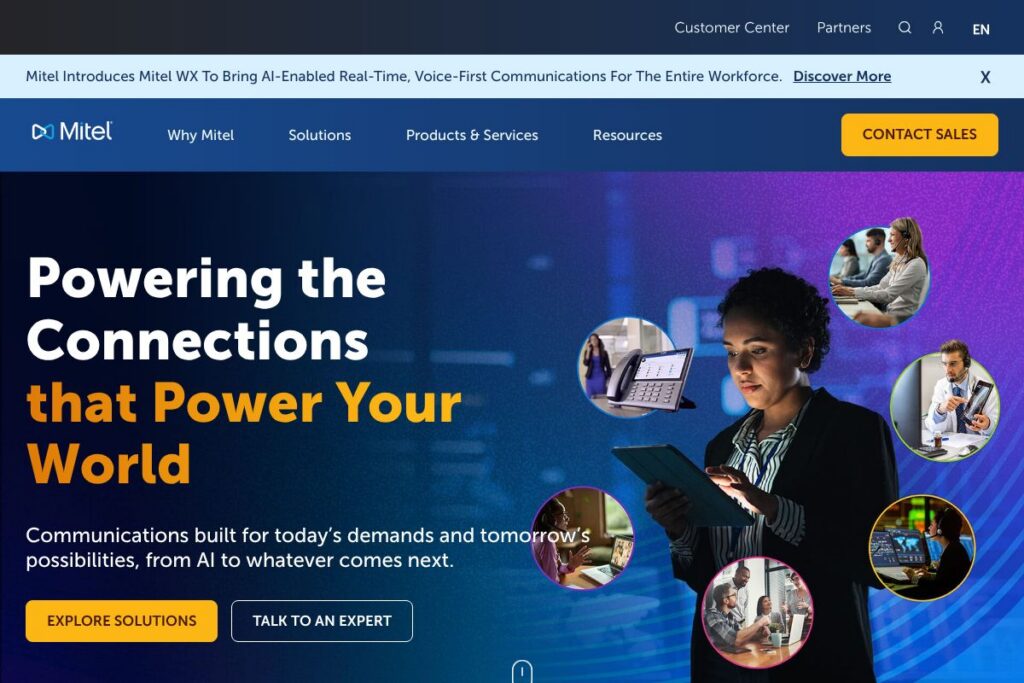
Mitel is a provider of unified communications and contact center technology designed for enterprises and public sector organizations. Its portfolio covers business telephony, collaboration, contact center routing, and hybrid deployment options that combine cloud and on-premises components to meet regulatory, latency, and continuity needs.
Compared with competitors, Mitel emphasizes hybrid architectures and long-term telecom experience. Cisco focuses on integrated networking and collaboration with deep hardware and services bundles, Avaya has a long history in contact center and telephony with migration paths from legacy systems, and Microsoft Teams competes on collaboration and presence by bundling UC features into Microsoft 365. Mitel sits between those approaches by offering specialist telephony and contact center capabilities along with integrations into the collaboration stacks of larger cloud vendors.
Mitel performs particularly well in environments that need a mix of deployment models, carrier interoperability, and industry-specific compliance. This makes the platform suitable for organizations that require resilient voice infrastructure, scalable contact centers, and a partner network for local deployment and support.
How Mitel Works
Mitel delivers communications through a set of modular products that can be deployed in cloud, on-premises, or hybrid configurations. Core components include a telephony platform, contact center applications, and collaboration clients that connect via SIP, cloud APIs, and carrier trunks.
Deployment typically begins with an assessment of network and regulatory needs, followed by a design that maps voice services, contact routing, and endpoints. Organizations can migrate line-by-line from legacy PBX systems or deploy new cloud instances and keep critical telephony on-premises for redundancy.
Operational workflows use standard telecom protocols and APIs to integrate presence, CRM data, and workforce management. Administrators manage users, call routing rules, and analytics from centralized management consoles, while agents and employees use desktop or mobile apps to handle voice, messaging, and multichannel contacts.
Mitel features
Mitel’s platform combines telephony, contact center, and hybrid deployment tools with an increasing focus on AI-assisted workflows and integrations. Core capabilities address enterprise voice, multichannel customer engagement, compliance and security, and extensibility through APIs and partner integrations.
Unified Communications
Mitel provides enterprise telephony, audio/video calling, messaging, and presence in a single solution set so teams can use consistent workflows across desktop and mobile clients. The integration of voice and collaboration reduces context switching and centralizes directory and presence information for distributed teams.
Contact Center Applications
Contact center products include omnichannel routing, workforce optimization, reporting, and real-time dashboards to manage voice, chat, and digital channels. These capabilities help organizations route contacts based on skills, context, and customer history to improve service levels and agent productivity.
Hybrid Cloud Deployment
Hybrid options let organizations place call control and sensitive services on-premises while moving contact center or collaboration workloads to the cloud for scale. This supports regulatory requirements, low-latency voice, and phased migrations from legacy systems.
Security and Compliance
Mitel implements encryption, secure trunking, and role-based administration to support regulated industries such as healthcare, finance, and government. The platform supports audit logging and can be configured to meet common compliance frameworks.
AI and Automation
Mitel includes AI-assisted features for call routing, agent assist, and analytics that help reduce handle times and surface relevant customer data. These capabilities are built to augment agent workflows rather than replace human decision making.
APIs and Extensibility
A developer-facing API surface allows integration with CRM, workforce management, and third-party applications for automation and data exchange. This extends Mitel functionality into existing enterprise systems and bespoke workflows.
With these features combined, Mitel aims to provide resilient, adaptable communications for organizations that need both traditional telephony strength and modern contact center capabilities.
Mitel pricing
Mitel offers flexible, enterprise-oriented pricing tailored to deployment model, seat counts, feature modules, and support level rather than fixed public per-user plans. Pricing is typically provided through sales channels and authorized partners, with configurations that vary by on-premises licensing, cloud subscriptions, and hybrid blends.
For specific rates, licensing options, and partner-managed plans, see Mitel’s enterprise information and contact options on the official site at the Mitel business communications page.
What is Mitel Used For?
Mitel is used for enterprise telephony, contact center operations, and secure communications that must meet regulatory or continuity requirements. Organizations deploy Mitel to replace legacy PBX systems, unify distributed voice services, and consolidate contact center routing across channels.
Typical vertical use cases include education for campus safety and hybrid learning, healthcare for secure patient communications and compliance, finance for regulated client interactions, manufacturing for operational communications, hospitality for guest services, and government for secure citizen-facing and internal voice services.
Pros and cons of Mitel
Pros
- Hybrid deployment flexibility: Provides cloud, on-premises, and mixed models so organizations can balance latency, compliance, and scalability needs.
- Contact center depth: Offers omnichannel routing, workforce optimization, and reporting tools that support enterprise-grade contact centers.
- Large partner network: A global channel of more than 6,000 partners helps with local deployment, customization, and ongoing support.
- Industry focus: Features and configurations geared toward regulated industries such as healthcare, finance, and government with attention to security and compliance.
Cons
- Enterprise sales model: Licensing and pricing are custom and typically require engagement with sales or a partner, which can slow procurement for smaller buyers.
- Complexity for small teams: The breadth of capabilities and deployment choices can be more than needed for very small organizations that prefer simple, self-service cloud subscriptions.
- Migration effort: Moving from legacy PBX environments to hybrid setups may require professional services and careful planning to preserve number portability and feature parity.
Does Mitel Offer a Free Trial?
Mitel offers demos and trial engagements through its sales and partner channels. Prospective customers can request demonstrations, pilot programs, or trial access to specific modules such as contact center features by contacting Mitel or an authorized partner, which helps validate deployment and integrations before full rollout.
Mitel API and Integrations
Mitel provides developer resources and APIs that support integration with CRM and business systems, enabling automated contact routing, presence propagation, and data exchange. The Mitel Developer Portal contains documentation, SDKs, and guidance for building integrations and custom workflows.
The platform also integrates with common enterprise systems including Microsoft Teams, Salesforce, Google Workspace, and workforce management tools to connect telephony and contact center context with broader business applications.
10 Mitel alternatives
Paid alternatives to Mitel
- Cisco — Comprehensive networking and collaboration suite with strong hardware, unified communications, and contact center solutions suitable for large enterprises.
- Avaya — Long-standing telephony and contact center vendor offering migration paths from legacy Avaya systems and cloud contact center options.
- Microsoft Teams — Collaboration and meeting platform bundled with Microsoft 365 that includes calling and meeting features for organizations already invested in Microsoft services.
- RingCentral — Cloud-first UCaaS and contact center provider with predictable subscription pricing and a focus on rapid cloud deployments.
- Five9 — Cloud contact center platform focused on omnichannel routing, AI assist, and workforce optimization for customer service teams.
- Zoom — Meeting-first platform that has expanded into phone systems and contact center capabilities for hybrid work scenarios.
- 8×8 — Global cloud communications provider offering UCaaS and CCaaS with integrated analytics and global PSTN coverage.
Open source alternatives to Mitel
- Asterisk — Open source communications toolkit that allows building custom PBX and call routing systems, widely used for bespoke telephony solutions.
- FreeSWITCH — Scalable telephony platform for building voice, video, and messaging systems with flexible routing and media handling.
- Kamailio — High-performance SIP server used for registration, routing, and SIP proxying in large-scale VoIP deployments.
- OpenSIPS — SIP server focused on load balancing, routing, and carrier-grade features for telephony architectures.
- FusionPBX — Web-based GUI for FreeSWITCH that simplifies deployment of PBX features and domain-based telephony configurations.
Frequently asked questions about Mitel
What is Mitel used for?
Mitel is used for enterprise telephony, unified communications, and contact center operations. Organizations deploy it to manage voice, messaging, and multichannel customer engagements across cloud and on-premises infrastructure.
Does Mitel have an API?
Yes, Mitel provides APIs and developer resources. The Mitel Developer Portal contains documentation and SDKs for integrating telephony and contact center functions with CRM and business systems.
How much does Mitel cost?
Mitel uses custom pricing tailored to deployment and features. Costs vary by seat count, cloud versus on-premises components, and optional modules; contact Mitel or an authorized partner for a tailored quote via the Mitel business communications page.
Can Mitel integrate with Microsoft Teams?
Yes, Mitel supports integrations with Microsoft Teams. These integrations allow presence, calling, and contact center context to flow between Mitel systems and Teams collaboration environments.
Does Mitel support cloud and on-premises deployments?
Yes, Mitel supports cloud, on-premises, and hybrid deployments. That flexibility lets organizations meet regulatory, latency, and continuity requirements while migrating at their own pace.
Final verdict: Mitel
Mitel is a mature option for organizations that need enterprise-grade telephony and contact center capabilities with flexible deployment choices. Its strengths are hybrid architectures, carrier interoperability, and vertical-specific features that suit regulated industries and large distributed operations.
Compared with collaboration-first alternatives such as Microsoft Teams, Mitel focuses more on telephony depth and contact center functionality rather than bundling with office productivity suites. For organizations already committed to Microsoft 365, Teams can be a lower-friction, lower-cost entry point, while Mitel is better suited when advanced telephony, compliance, and hybrid control are primary requirements.
Overall, Mitel is a practical choice for enterprises and public sector organizations that require resilient voice services and a partner-driven deployment model that balances cloud scale with on-premises control. For detailed solution options and pricing conversations, contact Mitel or a certified Mitel partner through the Mitel solutions hub.