NextGen Healthcare: An Overview
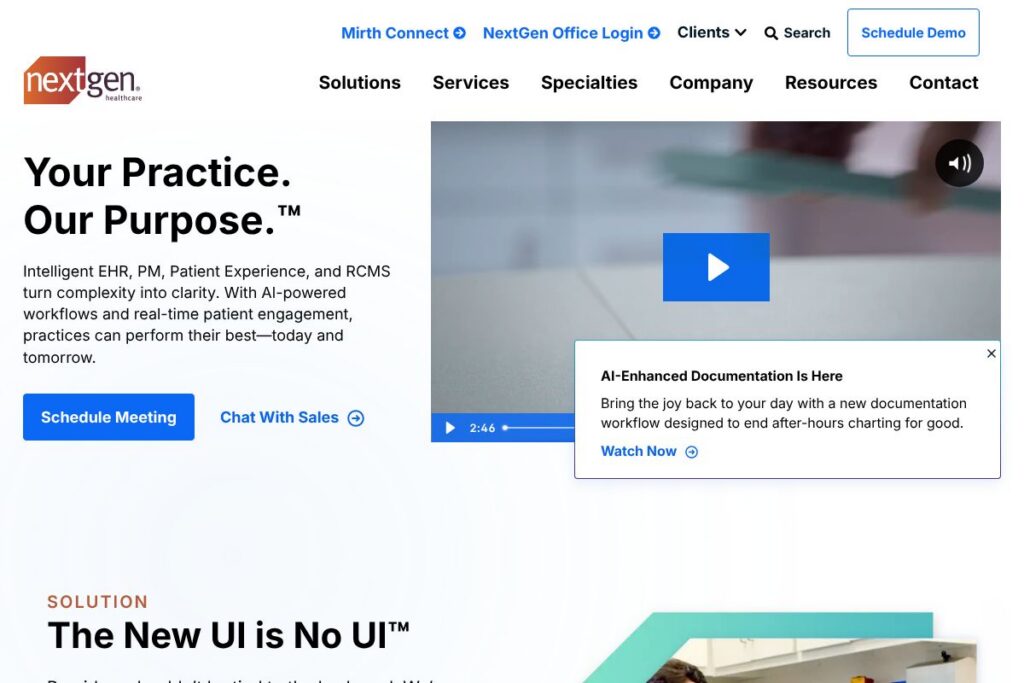
NextGen Healthcare provides cloud EHR and practice management solutions targeted at specialty practices and mid-size to enterprise organizations. The platform combines specialty-specific clinical templates, a practice management suite, patient engagement tools, and revenue cycle management to support clinical workflows and financial operations from scheduling through billing.
NextGen places a strong emphasis on AI-assisted documentation and voice-driven workflows. Features such as Ambient Assist for automated SOAP note generation and the NextGen Intelligent Agent for voice and text orchestration aim to reduce administrative burden and speed charting, while integrations and AWS hosting support scalability and security.
Compared with Epic and Cerner, NextGen is more focused on specialty customization and cloud-delivered practice management for independent and multi-site practices. Compared with Athenahealth and eClinicalWorks, NextGen offers deeper specialty clinical templates and on-platform RCM tools, while Athenahealth emphasizes networked revenue services and eClinicalWorks focuses on ambulatory cloud workflows. All of this makes NextGen Healthcare especially suited to specialty clinics and multi-location practices that need configurable clinical content with built-in revenue and patient engagement features.
How NextGen Healthcare Works
NextGen runs as a cloud-hosted EHR and PM system where clinical documentation, scheduling, billing, patient engagement, and analytics live in a single platform that syncs across devices. Providers document with templates or use Ambient Assist on mobile to convert conversations into structured SOAP notes, with AI suggestions for ICD-10 coding, medications, and orders.
Staff use the Intelligent Agent to trigger tasks by voice or text, such as checking schedules, pulling a patient chart, or launching RCM workflows. The practice management module handles eligibility checks, claims processing, and automated messaging to reduce manual follow-up and billing leakage.
Implementations typically start with specialty template configuration, staff training, and integration with payer and HIE connections. Mobile and desktop access keep documentation and order entry consistent because everything flows back into the centralized patient chart in real time.
What does NextGen Healthcare do?
NextGen Healthcare centers on delivering an integrated EHR and practice management platform with clinical workflows that reflect specialty needs. Core capabilities include specialty-specific templates, AI-assisted documentation, scheduling and self-scheduling, telehealth, RCM services, and patient engagement through portals and secure messaging.
Let’s talk NextGen Healthcare’s Features
Ambient Assist
Ambient Assist listens to clinician-patient conversations and converts them into structured SOAP notes that can be reviewed and edited. This reduces charting time, improves documentation completeness, and speeds up coding and charge capture for clinicians on mobile or desktop.
NextGen Intelligent Agent
The Intelligent Agent acts as an always-on orchestration layer that accepts voice and text commands to perform tasks across the platform. It routes requests to specialized AI agents for scheduling checks, chart retrieval, claims status, and patient messaging, enabling hands-free access to insights and actions.
Specialty Clinical Templates
NextGen provides pre-built clinical content for 26 specialties that clinicians can further customize to match local workflows. Templates speed documentation, standardize data capture for quality reporting, and reduce build time for specialty-specific orders and procedures.
Practice Management and RCM
The practice management suite handles eligibility verification, claims submission, denials management, and automated patient statements. Integrated RCM tools and clearinghouse connections aim to shorten revenue cycles and reduce administrative overhead.
Patient Engagement and Virtual Front Door
NextGen includes self-scheduling, appointment reminders, automated wait-listing, secure messaging, patient intake forms, and online bill pay through the patient portal. These tools are intended to improve access, reduce no-shows, and simplify patient communications.
Telehealth and Virtual Visits
Integrated telehealth lets clinicians run virtual visits with documentation and billing workflows tied directly to the patient chart. Telehealth sessions, e-prescribing, and follow-up messaging are supported without separate vendor logins.
Interoperability and Population Health
NextGen supports payer, HIE, and state reporting integrations to exchange clinical data securely across systems. The population health capabilities provide risk stratification, gap identification, and outreach workflows that leverage EHR data for care management.
Mobile EHR and Direct-to-Desktop
A mobile EHR extension and direct-to-desktop access allow providers to document, prescribe, and review charts from anywhere. All documentation flows into the centralized chart so billing and quality reporting use the same data set.
Secure Hosting with AWS
NextGen runs on scalable cloud infrastructure with AWS-hosted environments to reduce on-prem IT burden. AWS hosting contributes to performance, security controls, and predictable update cycles for a cloud-first practice.
With this mix of features, NextGen Healthcare focuses on reducing clinician administrative time, aligning workflows to specialty needs, and keeping revenue and patient engagement processes centralized and auditable.
NextGen Healthcare pricing
NextGen Healthcare offers flexible, enterprise-focused pricing tailored to practice size, specialty requirements, and deployment options, with custom quotes for cloud-hosted EHR, practice management, and RCM services. Prospective customers typically work with sales to get pricing that reflects seat count, modules, and managed services.
For detailed pricing and to request a quote or demo, consult the NextGen Healthcare solutions page or contact their sales team through the NextGen Healthcare contact portal for pricing specific to your practice.
What is NextGen Healthcare Used For?
NextGen is commonly used to run ambulatory specialty practices that need configurable clinical templates, integrated billing, and patient engagement on a single platform. Practices use it to manage visits, documentation, claims, patient intake, and telehealth without stitching together multiple vendors.
It is also used for population health management and multi-site operations where consistent templates, centralized revenue cycle workflows, and interoperability with payers and HIEs are important. Organizations that need specialty-specific content and an extensible AI layer for documentation and task automation will find this system suited to those demands.
Pros and Cons of NextGen Healthcare
Pros
- Specialty-focused clinical content: Pre-built templates for 26 specialties reduce configuration time and help standardize documentation across providers. These templates support quality reporting and reduce custom build work for common specialty workflows.
- AI-assisted documentation and orchestration: Ambient Assist and the Intelligent Agent reduce charting time and offer hands-free command capability, which helps clinicians spend more time with patients and less time on paperwork.
- Integrated RCM and patient engagement: Combining practice management, claims processing, patient self-scheduling, and portal payments in one platform reduces the number of systems staff must use and improves revenue capture.
- Cloud hosting and scalability: AWS-backed hosting lowers local IT maintenance, supports multi-site deployments, and delivers predictable system performance and security controls.
Cons
- Enterprise deployment model: Pricing and implementation are tailored and may be less cost-effective for very small practices that prefer pay-as-you-go or low-cost standalone EHRs. Larger implementations require project management and change management to realize benefits.
- Learning curve for advanced features: The Intelligent Agent and specialty template configuration provide powerful capabilities but may require training and optimization to integrate into existing workflows effectively.
- Customization complexity: Deep template customization can increase initial setup time, and over-customization may make future upgrades more complex without governance.
Does NextGen Healthcare Offer a Free Trial?
NextGen Healthcare offers demo and trial options through sales engagement for prospective customers. Interested organizations can request an interactive demo or pilot to evaluate workflows, AI documentation features, and specialty templates before committing to a deployment.
NextGen Healthcare API and Integrations
NextGen provides developer resources and APIs to connect external applications and enable data exchange across systems. The NextGen Healthcare developer portal describes available endpoints for clinical data, scheduling, and billing integrations.
Key integrations include payer interfaces, HIE connections, patient portal links, telehealth gateways, and standard clinical exchange using industry protocols. Popular integrations for practices combine NextGen with practice analytics, lab systems, and payment processors to create end-to-end workflows.
10 NextGen Healthcare alternatives
Paid alternatives to NextGen Healthcare
- Epic — Enterprise EHR with deep specialty support and extensive interoperability across hospitals and large health systems. Epic is often selected by large health systems for integrated inpatient and outpatient workflows.
- Cerner — Broad EHR platform suitable for hospitals and ambulatory care, offering comprehensive clinical, administrative, and interoperability tools for large organizations.
- Athenahealth — Cloud-native ambulatory EHR and RCM platform with strong network-enabled services and outsourced revenue cycle options for practices seeking a managed approach.
- eClinicalWorks — Cloud EHR and practice management focused on ambulatory care with telehealth, patient engagement, and population health modules.
- Allscripts — Offers ambulatory and acute solutions with configurable workflows and a marketplace of partner integrations for specialty care.
- DrChrono — EHR and PM with strong mobile-first capabilities and patient engagement tools for smaller practices and specialty clinics.
- AdvancedMD — Integrated EHR, practice management, and RCM services tailored to independent practices and medical groups.
Open source alternatives to NextGen Healthcare
- OpenEMR — Open source electronic medical record and practice management system that supports scheduling, clinical documentation, e-prescribing, and billing. It is community-driven and widely used for custom deployments.
- OpenMRS — An open source medical record platform focused on extensibility and use in low-resource settings, often used for public health and research projects.
- Oscar EMR — Open source EHR with modular clinical workflows, commonly used in primary care and adaptable for specialty needs.
Frequently asked questions about NextGen Healthcare
What is NextGen Healthcare used for?
NextGen Healthcare is used to provide cloud EHR and practice management for specialty and multi-site ambulatory practices. It supports clinical documentation, scheduling, billing, patient engagement, telehealth, and population health workflows.
Does NextGen Healthcare offer specialty templates?
Yes, NextGen Healthcare provides pre-built clinical templates for 26 specialties. Templates are configurable and designed to accelerate documentation, orders, and reporting for specialty workflows.
Can NextGen Healthcare integrate with payers and HIEs?
Yes, NextGen Healthcare supports integrations with payers and health information exchanges. The platform includes connectivity for eligibility, claims, state reporting, and secure clinical data exchange.
Is NextGen Healthcare cloud-hosted and secure?
Yes, NextGen Healthcare offers cloud hosting with AWS and enterprise-grade security controls. Cloud hosting reduces local IT burden while providing scalability, backups, and managed updates.
Does NextGen Healthcare provide an API for developers?
Yes, NextGen Healthcare provides APIs and developer resources for integrations. Developers can consult the NextGen Healthcare developer portal for documentation on available endpoints and integration patterns.
Final Verdict: NextGen Healthcare
NextGen Healthcare combines specialty-focused clinical templates, a cloud-first practice management platform, and AI-assisted documentation features designed to reduce clinician charting time and centralize revenue workflows. The Ambient Assist and Intelligent Agent add practical automation that can produce measurable time savings for clinicians who want hands-free documentation and task orchestration.
Compared with Athenahealth, NextGen stands out for deeper specialty template coverage and embedded AI documentation capabilities, while Athenahealth emphasizes networked RCM and managed services. Pricing for both platforms is typically customized for each organization, so practices should evaluate functionality against RCM models and total cost of ownership when comparing the two.
Overall, NextGen Healthcare is well suited to specialty practices and multi-site organizations that need configurable clinical content, integrated billing, and AI-enabled documentation in a cloud-hosted package. For practices seeking those capabilities with managed hosting, the platform offers a robust set of features to support clinical and financial objectives.