What is Nolt
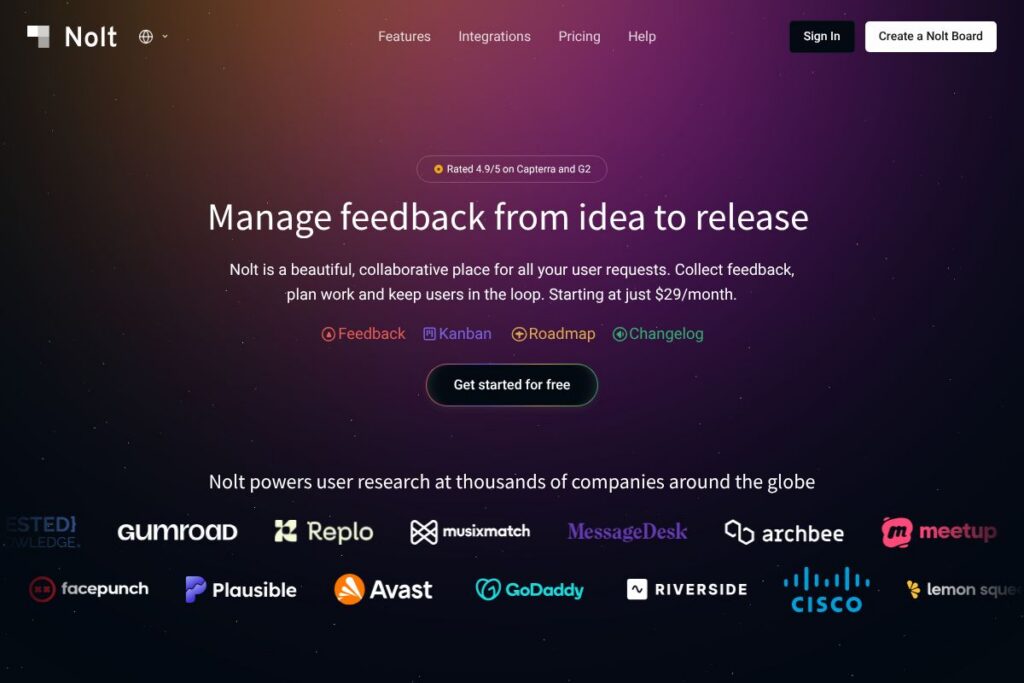
Nolt is a user feedback and roadmap platform that centralizes requests, public voting, and product updates in one place. It provides a feedback board, changelog, roadmap, and a Kanban-style workflow so teams can collect community suggestions, triage them, and publish progress back to users. The product emphasizes simplicity and an embeddable interface that can live inside your app or website.
Compared with direct competitors, Nolt focuses on a lightweight, community-friendly experience. Canny targets larger product teams with deeper feature prioritization and enterprise controls, and Productboard emphasizes customer insight and feature prioritization for scaled product organizations. UserVoice has long offered enterprise feedback management with sophisticated analytics but can be heavier to set up.
Nolt does well at offering an easy-to-use feedback loop for small to mid-size product teams that want public boards, a changelog, and straightforward workflows without complex configuration. Its combination of board voting, Kanban task flow, and embeddable widgets makes it a practical fit for SaaS teams and consumer products that want to keep users engaged and informed.
How Nolt Works
Boards capture feedback items that users can submit, vote on, and comment on. Each feedback item can include custom fields for context, and moderators can merge duplicates or close requests to reduce noise.
Teams convert selected feedback into work by creating tasks from board items and moving them through a Kanban pipeline where assignees, deadlines, and visibility are controlled. Completed items can be auto-published to a changelog and emailed to relevant users so contributors see their feedback turn into releases.
Nolt can be embedded as a modal, iframe, or button inside your product, and supports single-sign-on so end users can access boards with your app credentials. This keeps feedback tied to real users and reduces friction in contribution and follow-up.
What does Nolt do?
Nolt’s core capabilities are organized around collecting feedback, triaging ideas, and communicating outcomes. The platform offers public or private boards, voting and commenting, a Kanban view for turning feedback into tasks, a roadmap to display priorities, and a changelog to announce releases. It also includes moderation controls, SSO, custom fields, and embeddable components to integrate with your product.
Let’s talk Nolt’s Features
Feedback board
The feedback board serves as the primary collection point where users submit ideas, upvote entries, and follow progress. Public boards encourage crowdsourced prioritization while private boards allow internal collection from support or sales teams, giving product managers a consolidated view of demand.
Custom fields and context
Custom fields let you add structured metadata to feedback items, such as affected product area, user tier, or estimated impact. This improves filtering and reporting so teams can segment requests and make prioritization decisions with more context.
Commenting and discussion
Users and team members can comment directly on feedback items which keeps the conversation attached to the request. That threaded context helps product teams clarify requirements, ask follow-up questions, and validate proposed solutions before scheduling work.
Kanban workflow
The Kanban view converts feedback into actionable tasks that can be assigned, dated, and moved through stages like Backlog, Planned, In Progress, and Done. This visual workflow helps teams manage the lifecycle from idea to release without switching tools.
Roadmap publishing
The roadmap component highlights what is planned, in progress, or under consideration to build transparency with your audience. You can control what is public, keep internal discussions private, and style the view to match your product branding.
Changelog and release announcements
The changelog lets you publish release notes and schedule posts, with the option to auto-publish completed items from your workflow. Embedding the changelog and scheduling posts helps you keep users informed on when their requests ship.
Moderation and duplicate handling
Administrators can manually moderate submissions or use automated tools to detect duplicates and merge posts. This reduces clutter and improves the signal-to-noise ratio on boards so the most popular and actionable ideas surface.
Single-sign-on and embedding
SSO support lets users sign into boards using your app credentials, preserving user identity and access control. Embeddable options include modals, iframes, or buttons so boards and changelogs can appear directly inside your product interface.
With these features combined, the biggest benefit is a single, continuous feedback-to-release workflow that keeps product teams aligned with user priorities and ensures contributors see the results of their input.
Nolt pricing
Nolt uses a SaaS subscription model with paid plans that scale by feature set and usage; the vendor advertises entry-level pricing starting at $29/month. Enterprise options and custom contracts are available for teams that need SSO, advanced controls, or higher-volume usage. For the latest plan breakdowns and billing options, see Nolt’s current pricing options.
Monthly Billing:
Starter – $29/mo (public feedback boards, changelog, basic Kanban, embeddable widgets)
Team – Custom monthly pricing (includes SSO, advanced moderation, integrations, and team controls)
Annual Billing:
Starter – Discounted annual rate available (billed yearly, same features as monthly Starter)
Enterprise – Custom annual contracts (additional security, SLAs, and priority support)
For details on enterprise features and user-based seat pricing, review Nolt’s plans and service options.
What is Nolt used for?
Nolt is commonly used to collect and prioritize product feedback from customers, communities, and internal teams. Product managers use it to centralize requests, identify high-demand features through voting, and turn top ideas into scheduled work using Kanban flows.
Support and community teams use Nolt to surface recurring issues or feature requests so product teams can act with clear customer context. Marketing and customer success teams use the public roadmap and changelog to communicate upcoming features and release notes to users.
Nolt is ideal when you want a tight feedback loop where users can contribute ideas, see progress, and receive release notifications without complex onboarding or heavyweight analytics.
Pros and cons of Nolt
Pros
- Simple, user-friendly boards: The interface focuses on making it easy for users to submit and vote on ideas, which increases engagement and lowers contribution friction.
- End-to-end feedback workflow: From public boards to Kanban and changelogs, the platform keeps idea collection, task tracking, and release announcements in one place.
- Embeddable and SSO support: Embedding options and single-sign-on make it straightforward to integrate Nolt into your product while preserving user identity and access control.
- Moderation and duplicate handling: Manual and AI-assisted moderation plus merging tools keep boards cleaner and more actionable for product teams.
Cons
- Limited advanced analytics: For teams that need deep customer-signal analytics and segmentation, Nolt’s reporting is lighter than some enterprise alternatives.
- Scaling to large enterprise needs: Organizations with complex governance, multi-product structures, or strict compliance may need more extensive controls than the base plans provide.
- Pricing transparency for larger teams: While entry pricing is published, full enterprise pricing and seat-based tiers require contacting sales which can slow procurement for some buyers.
Does Nolt Offer a Free Trial?
Nolt offers paid plans starting at $29/month. Trial availability and any free tier details can change, so check Nolt’s current pricing options for information on trials or discounted annual billing.
Nolt API and Integrations
Nolt supports integrations and connections that let teams push feedback into existing workflows and tools. The platform advertises connectors and embedding options to link boards with product workflows, and SSO is available for enterprise access control; see Nolt’s integration and embedding documentation for specifics.
For teams that need automated flows, Nolt can be connected to external systems either via built-in integrations or webhooks; reach out to Nolt through their site to access developer documentation and integration guides.
10 Nolt alternatives
Paid alternatives to Nolt
Canny – A purpose-built feedback and changelog platform for product teams with deeper prioritization features and enterprise controls, suitable for mid-size to large teams. See Canny’s product page for details.
Productboard – Focuses on customer insights and feature prioritization with strong roadmapping and customer segmentation capabilities. Explore Productboard at their homepage.
UserVoice – Enterprise-grade feedback management with advanced analytics and support workflows tailored to large organizations. Learn more on UserVoice’s site.
Aha! – Roadmapping and product management software that combines strategic planning with feature tracking and release communications. View Aha! on their website.
Roadmunk – Roadmap-first platform for visualizing plans and collecting stakeholder feedback, suited for teams focused on communicating plans. See Roadmunk at their site.
Upvoty – Simple feedback boards with voting, roadmapping, and changelogs aimed at small to medium teams that need a straightforward public board. Check Upvoty on their homepage.
Trello – Flexible kanban boards that can be adapted for feedback tracking and lightweight roadmapping, often used by small teams for ad hoc workflows. Find Trello at their site.
Open source alternatives to Nolt
Fider – Open-source feedback platform that supports upvoting and basic moderation, useful for teams that want to self-host a public feedback board. See Fider on their project site.
Discourse – Forum software that can be configured as a feedback board with categories, voting plugins, and community moderation, commonly used to gather feature requests. Learn about Discourse at their site.
OpenProject – Open-source project management and roadmap tool that supports issue tracking and can be used to manage feedback alongside development tasks. Explore OpenProject on their homepage.
GitLab – The open-source GitLab CE includes issue tracking and boards that teams sometimes use to collect and prioritize feedback directly in the development workflow. See GitLab at their site.
Frequently asked questions about Nolt
What is Nolt used for?
Nolt is used to collect user feedback, prioritize ideas, and communicate releases. Product and support teams use boards, voting, and changelogs to centralize requests and keep users informed.
Does Nolt integrate with other tools?
Yes, Nolt supports integrations and embedding options. The platform can connect to external workflows and be embedded inside apps; check Nolt’s integration options for specifics.
Can Nolt be embedded inside my app?
Yes, Nolt can be embedded as a modal, iframe, or button. Embedding keeps the feedback experience inside your product and supports single-sign-on for seamless user access.
How does Nolt handle duplicate feedback?
Nolt provides tools to merge duplicates and moderate submissions. Teams can manually merge posts or use automated moderation features to reduce repeated entries and consolidate votes.
Is Nolt suitable for small teams?
Yes, Nolt is well suited for small to mid-size product teams. Its simple boards, Kanban flow, and changelog make it easy to collect feedback and run a compact product process without heavy configuration.
Final verdict: Nolt
Nolt is a practical feedback management tool that emphasizes a concise workflow from idea capture to release announcement. It combines public feedback boards, voting and commenting, a Kanban task flow, a customizable roadmap, and a changelog into a single product that is straightforward to embed and operate. For teams wanting a compact, user-facing feedback loop, Nolt delivers the essential pieces with a modest entry price of $29/month.
Compared to Canny, which targets larger product teams with more advanced prioritization and enterprise governance, Nolt is more lightweight and budget-friendly. Canny often positions itself for teams that need granular feature analytics and may carry a higher starting cost, while Nolt makes it easier to get a board up and running and keep users informed through scheduled changelog posts.
In short, choose Nolt when you need a simple, embeddable feedback workflow that keeps users involved and reduces friction between idea and release. For organizations requiring advanced analytics, highly granular access controls, or multi-product governance, evaluate enterprise-focused alternatives like Canny or Productboard as part of the decision process.