OpenTable: An Overview
OpenTable is a real-time online reservations network focused on dining. It aggregates inventory from restaurants worldwide so diners can search by date, time, location, cuisine, and dining category, then book a table instantly via the website or mobile app. The platform also collects verified diner reviews and operates a points-based rewards program that credits diners for eligible reservations.
Compared with other reservation platforms, OpenTable emphasizes scale and breadth. Resy focuses on curated lists and boutique establishments with a reputation for curated dining experiences, while Yelp Reservations ties bookings to a broader local discovery and review ecosystem. Tripadvisor combines reviews and travel planning with dining listings but does not match OpenTable’s real-time global booking coverage and integrated reservation management.
OpenTable does particularly well when you need broad coverage across cities and neighborhoods, reliable real-time availability, and a single interface for booking and managing reservations. It is best suited for everyday diners, frequent travelers, and restaurants that want to reach a large audience through an established reservation network. For restaurants that need deeply customizable guest management or integrated marketing services, specialized platforms may offer different feature sets.
How OpenTable Works
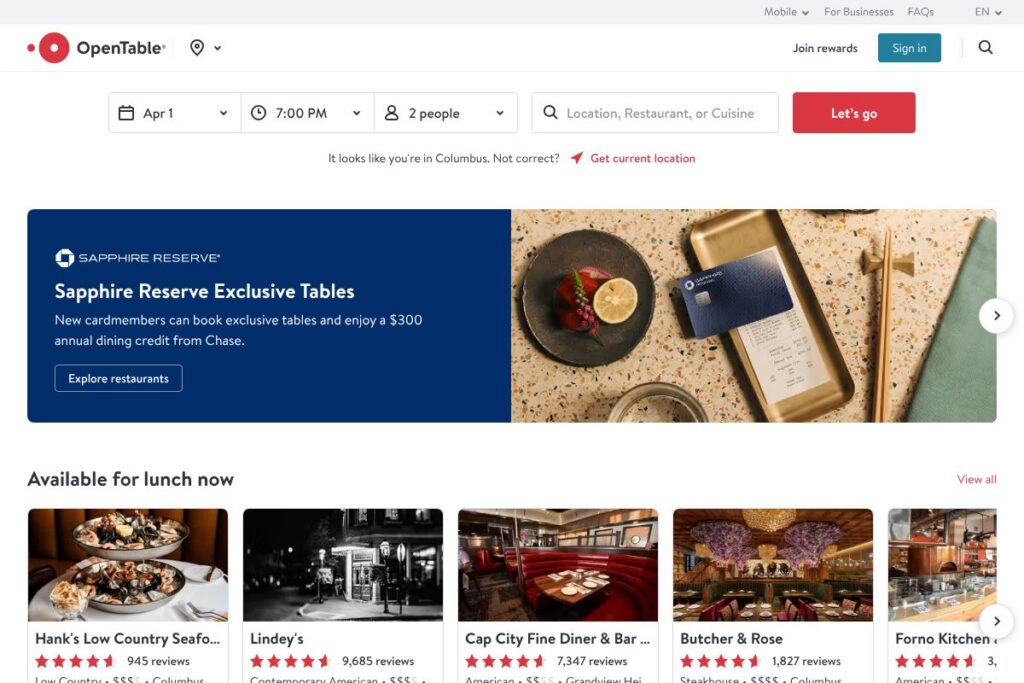
Search starts with date, time, and party size; the platform returns available slots from participating restaurants in real time. Filters let you narrow results by neighbourhoods, cuisine, price range, outdoor seating, and other categories so you can find options that match the occasion.
Once you select a time, a reservation is confirmed immediately and recorded in your OpenTable account and the restaurant’s reservation system. The platform sends confirmations and reminders, and it allows you to modify or cancel reservations from the web or mobile app.
After dining, verified guests are prompted to leave a review; OpenTable associates reviews with completed reservations so diner feedback reflects real visits. For restaurants, the platform provides table management and reporting tools that sync reservations to the restaurant’s front-of-house workflows.
What does OpenTable do?
OpenTable acts as a multi-faceted reservation and discovery platform. Core capabilities include real-time availability and booking, verified diner reviews, search filters for neighbourhoods and cuisines, reservation management and notifications, and a loyalty program that awards points for eligible bookings.
Let’s talk OpenTable’s Features
Real-time availability and booking
OpenTable connects to restaurant reservation systems to show live availability and release or hold seats in real time. Diners can secure bookings instantly, which reduces back-and-forth with restaurants and helps avoid double-booking issues.
Verified diner reviews
Reviews are tied to completed reservations so feedback comes from verified diners rather than anonymous submissions. This improves the reliability of ratings and helps other users make informed choices about where to dine.
Search and discovery filters
Advanced filters let you find restaurants by neighbourhoods, landmarks, cuisine types, price range, dietary tags, and categories like kid friendly or late night dining. The platform also surfaces curated lists and local guides to highlight new and notable restaurants.
Reservation management and notifications
Diners can view, modify, or cancel reservations from the web or mobile app. OpenTable sends confirmations and timely reminders, and restaurants receive bookings directly in their table management console to coordinate seating and staffing.
Dining Rewards and points
OpenTable credits points for eligible reservations that can be redeemed for dining certificates or discounts at participating restaurants. The rewards program encourages repeat bookings and gives diners an incentive to use the platform consistently.
OpenTable for Restaurants
The platform provides restaurant-facing tools for table management, guest profiles, reporting, and marketing exposure within OpenTable’s network. These features help restaurants manage covers, track no-shows, and build direct relationships with repeat diners.
With these capabilities OpenTable combines discovery, booking, guest management, and loyalty into a single experience that benefits both diners and restaurants.
OpenTable pricing
OpenTable uses a hybrid model: booking is free for most diners, while partner restaurants usually pay for reservation services through subscription plans or per-cover fees depending on their contract and service package. Pricing for restaurant partners varies by market, service level, and feature set.
For details on partner packages and any consumer-facing changes to rewards or fees, see OpenTable’s partner and consumer information on the OpenTable homepage or explore the restaurant partner site for the most current offerings and contact options.
What is OpenTable Used For?
OpenTable is used to find and book restaurants for everyday meals, special occasions, travel, and group dining. Its neighborhood, landmark, and cuisine filters make it easy to locate specific options like MICHELIN-starred restaurants, kid friendly venues, or places near major attractions.
Restaurants use OpenTable to accept reservations, manage seating and covers, collect guest feedback, and promote availability to a broad customer base. The platform is particularly useful for diners traveling to unfamiliar cities because of its global coverage and consistency of reservation workflows.
Pros and Cons of OpenTable
Pros
- Large restaurant network: The platform covers tens of thousands of restaurants worldwide, making it easy to find options across cities and neighbourhoods. This breadth increases the odds of finding available slots, especially when traveling.
- Verified reviews: Reviews are linked to completed reservations, which improves trustworthiness and helps diners make decisions based on actual visits. This reduces the noise from unverified or spam reviews.
- Integrated reservation management: Diners get confirmations, reminders, and simple modification options, while restaurants receive reservation data and tools to manage front-of-house operations. This reduces operational friction for both sides.
- Rewards program: Points for eligible reservations give regular users tangible value for repeat bookings and can influence repeat business for participating restaurants.
Cons
- Restaurant fees and contracts: Restaurants typically pay to be part of the network, which can be a barrier for smaller venues or those that prefer direct-booking strategies. Fees and contract terms vary and can affect pricing decisions for restaurants.
- Discoverability bias toward listed restaurants: Restaurants not on the platform are not discoverable through OpenTable, which can limit options for diners seeking independently managed venues or direct-booking restaurants.
- Feature depth varies by market: Advanced guest management and integrations depend on the restaurant’s chosen package and local integrations, so capabilities can feel inconsistent across regions.
Does OpenTable Offer a Free Trial?
OpenTable offers a free experience for diners and does not charge guests to search and book most reservations. Restaurants interested in partner services should contact OpenTable via the restaurant partner site to discuss trial options, subscription tiers, and any onboarding details specific to their market.
OpenTable API and Integrations
OpenTable provides restaurant-facing integrations and connectivity with point-of-sale systems, website reservation widgets, and other hospitality technology partners through its partner services. Information for restaurants and partners is available on the OpenTable for Restaurants site.
Developers and restaurant operators can request access to integration options and documentation through OpenTable’s partner channels, which describe available endpoints, widget options, and supported POS integrations for synchronizing reservations and guest data.
10 OpenTable alternatives
Paid alternatives to OpenTable
- Resy — A reservation platform focused on curated and higher-end restaurants with tools for guest relations and waitlist management. See the Resy platform for service details.
- Yelp Reservations — Booking integrated with Yelp’s local discovery and review ecosystem, making it easy for diners to book while reading local reviews. Explore Yelp Reservations.
- Tock — A reservation and ticketing system aimed at restaurants and events, with options for pre-paid experiences and ticketed dining. Learn about Tock’s service.
- SevenRooms — A guest experience and retention platform focused on CRM, marketing, and reservations for hospitality brands. Review SevenRooms solutions.
- Quandoo — A global reservations platform offering booking and table management tools for restaurants and diners. Visit Quandoo.
- Tablein — An online booking and table management system for small to medium restaurants, with simple setup and web widget options. See Tablein’s features.
- Bookatable — A dining reservation system used across Europe that integrates restaurant profiles and booking services for diners. Explore Bookatable.
Open source alternatives to OpenTable
- Booked — An open-source scheduling and reservation system that can be adapted for table bookings; useful for restaurants that want a self-hosted solution. More at Booked Scheduler.
- Odoo — An open-source ERP with a variety of modules; restaurants can use booking and website modules to accept reservations through a self-hosted setup. See Odoo’s business apps.
- ERPNext — An open-source business management suite that can be extended to manage reservations and customer records for restaurants operating their own systems. Visit ERPNext.
- DayPilot Lite — An open-source scheduling component that developers can use to build custom reservation interfaces for web applications. Explore the project on the DayPilot GitHub repo.
Frequently asked questions about OpenTable
What is OpenTable used for?
OpenTable is used to discover restaurants and make real-time reservations. Diners search by date, time, party size, and various filters, then book and manage reservations through the app or website.
Does OpenTable charge diners to make reservations?
No, OpenTable typically does not charge diners for making standard reservations. Charges and fees, if any, are more commonly part of restaurant agreements or specific ticketed events, so check the reservation details before booking.
Can restaurants use OpenTable to manage guest information?
Yes, restaurants can use OpenTable’s partner tools to manage reservations, guest profiles, and reporting. Those features are available through OpenTable’s restaurant services and partner packages on the restaurant partner site.
Does OpenTable have a mobile app?
Yes, OpenTable offers a mobile app for searching, booking, and managing reservations. The mobile app mirrors the website’s search and booking capabilities and sends confirmations and reminders to users.
Is OpenTable available internationally?
Yes, OpenTable operates in many countries and covers tens of thousands of restaurants worldwide. Its global coverage makes it useful for travelers seeking consistent booking workflows across cities.
Final verdict: OpenTable
OpenTable stands out for its broad restaurant coverage, reliable real-time availability, and integrated reservation management for diners and restaurants. Its verified review system and rewards program add practical value for repeat diners, while the scale of its network increases chances of finding a table, especially when traveling.
Compared with Resy, OpenTable offers wider global reach and a larger inventory of participating restaurants, while Resy emphasizes curated experiences and boutique restaurants. Pricing for diners is similar because both platforms are typically free to use for booking; for restaurants, each platform uses different partner models and fee structures, so restaurants should compare contract terms and feature sets before choosing a provider.
Overall, OpenTable is a practical choice for diners who want easiest access to reservations across cities and for restaurants that want exposure to a large audience with built-in guest management tools.