Orderly Health: An Overview
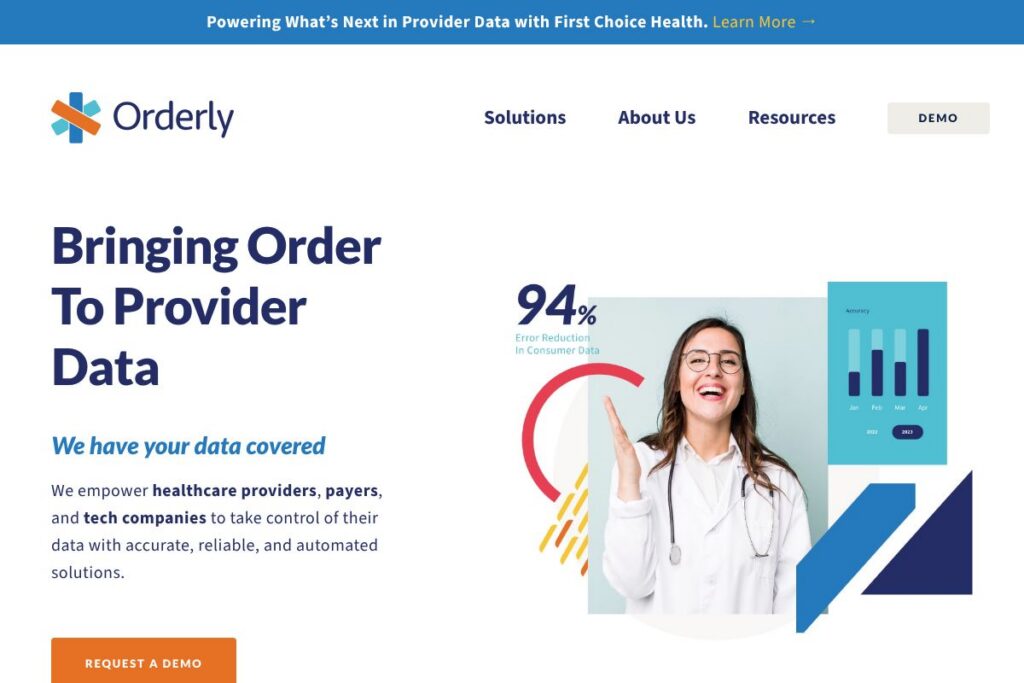
Orderly Health specializes in provider data accuracy and roster automation for healthcare organizations. The platform ingests roster updates, applies AI and machine learning to reconcile records, and exposes a curated provider directory that teams use for market intelligence, patient access, and regulatory compliance. Visit the Orderly Health homepage to review product descriptions or request a demo via the Orderly Health request demo page.
Compared with alternatives, Orderly Health emphasizes automated roster processing and a single source of truth for provider data. Kyruus focuses more on provider search, patient-provider matching, and access management; LexisNexis Risk Solutions provides broad healthcare data and identity services with extensive linkages; Healthgrades is consumer-facing with a strong emphasis on provider profiles and patient reviews. Orderly Health positions itself between pure directory/patient-facing products and broad data vendors by concentrating on roster accuracy, traceability, and operational integrations.
All of this makes Orderly Health particularly well suited for payers, health systems, and health technology vendors that need reproducible, high-accuracy provider records. The platform is designed for teams that must reduce manual effort on roster updates, meet regulatory data expectations, and surface provider hierarchies and entity relationships for analytics and provider network management.
How Orderly Health Works
Orderly Health ingests provider rosters from multiple sources such as payer feeds, EHR exports, credentialing systems, and public records. It normalizes incoming feeds, then applies machine learning models to deduplicate, match, and enrich records with identifiers like NPI and taxonomy codes.
Rosters flow through the Roster Automation Suite, which applies business rules, flags uncertain matches for verification, and pushes validated changes back into the organization’s downstream systems. Organizations can set validation thresholds and review traces of every change to support audits and compliance workflows.
Validated provider records are stored in the Orderly Provider Directory and made available via search interfaces, data exports, or programmatic access. Common workflows include automated roster processing (reduce manual updates), on-demand directory queries for patient access, and aggregated views for network planning and reporting.
Orderly Health features
Orderly Health organizes around roster automation, data quality, and a searchable provider directory. Core capabilities include AI-driven record matching, a Roster Automation Suite that reduces upstream errors, the Orderly Provider Directory with millions of practitioner profiles, and tools for entity hierarchy and market intelligence. The platform prioritizes traceability and compliance while offering integrations to make validated data actionable across systems.
Let’s dive into Orderly Health’s Features
Data Updates and Reconciliation
Orderly Health automatically compares incoming roster changes against existing records and applies machine learning to reconcile differences, reducing manual reconciliation work. This feature improves directory accuracy by learning common patterns in provider moves, name variations, and affiliation changes.
Roster Automation Suite
Roster Automation Suite accelerates processing of full rosters from days to minutes by automating ingestion, validation, and rule-based approvals, while surfacing only high-risk exceptions for manual review. Organizations typically configure the suite to align with their governance and compliance processes.
Orderly Provider Directory
The provider directory aggregates curated, data-science backed sources into a single searchable index with more than 6.4 million practitioner profiles, including NPIs and taxonomy details. Teams use the directory for patient access, network adequacy checks, and to extract population-level provider insights.
Entity Profiles and Hierarchies
Orderly Health maps clinicians to organizations, facilities, and group hierarchies so users can understand referral networks, parent-subsidiary relationships, and practice coverage. These profiles help with market planning and detecting network leakage.
AI and Machine Learning Enrichment
The platform uses ML models to enrich records, infer missing attributes, and flag likely inaccuracies based on historical patterns and external data signals. Enrichment improves match rates and supports downstream analytics and routing decisions.
Compliance and Traceability
Every change to a provider record is traceable with timestamps, data provenance, and the applied rule or model outcome, which assists auditability and regulatory reporting. This traceability is useful for meeting state and federal data governance requirements.
With these capabilities, Orderly Health aims to reduce manual work, improve accuracy, and provide a single source of truth for provider data that teams can query on demand.
Orderly Health pricing
Orderly Health uses an enterprise subscription model with customized pricing tailored to organization size, data volume, and integration needs. For specific plan options, seat counts, and deployment models, contact sales or request a demo through the Orderly Health request demo page for a tailored quote.
Enterprise and Custom Pricing
Enterprise – Custom pricing (Provider roster automation, Orderly Provider Directory access, integrations, SLAs)
Platform Add-ons – Custom pricing (Advanced analytics, additional data sources, prioritized onboarding)
For procurement and deployment details, review the Orderly Health platform overview or contact their team through the Orderly Health contact page.
What is Orderly Health Used For?
Orderly Health is commonly used to maintain accurate provider directories that support patient access and call center routing. Payors and health systems use the platform to reduce patient appointment errors, prevent unnecessary denials, and ensure provider listings reflect current credentialing and affiliations.
The platform is also used for market intelligence, network adequacy and planning, and to reduce network leakage by keeping provider relationships and coverage up to date. Health technology vendors embed provider data to improve product accuracy, analytics, and user-facing search experiences.
Pros and cons of Orderly Health
Pros
- High roster automation impact: Orderly Health reduces manual roster processing and can shorten processing time from days to minutes, which lowers operational burden and speed of updates.
- Traceability and compliance: Every update includes provenance and audit trails, which helps meet regulatory reporting needs and internal governance.
- Large provider coverage: The Orderly Provider Directory includes millions of practitioner profiles, enabling broad coverage for analytics and patient access use cases.
Cons
- Enterprise pricing model: Organizations seeking transparent, per-seat pricing may find Orderly Health’s custom enterprise pricing requires vendor engagement to get a quote. This is typical for solutions that involve integrations and custom onboarding.
- Integration effort for legacy systems: Tying roster automation into older credentialing or claims systems can require additional integration work and configuration.
Does Orderly Health Offer a Free Trial?
Orderly Health offers enterprise deployments with demo access rather than a public free plan. Prospective customers can request a demo to see roster processing, directory search, and data exports in a sandboxed environment; pilot engagements and proof-of-concept projects are commonly arranged for larger customers through the sales team.
Orderly Health API and Integrations
Orderly Health provides programmatic access to validated provider records and roster processing via APIs and integration connectors. The Orderly Health integrations documentation describes supported connectors and common integration patterns for EHRs, claims systems, and downstream analytics platforms.
Common integration points include EHRs and credentialing systems, payer enrollment feeds, FHIR and HL7 data exchanges, and data warehouses for analytics. Teams typically use the API to automate syncs into directories, power search in consumer or provider-facing applications, and export enriched datasets for reporting.
10 Orderly Health alternatives
Paid alternatives to Orderly Health
- Kyruus — Focuses on provider search, patient-provider matching, and access management for health systems; strong at scheduling and patient access workflows.
- LexisNexis Risk Solutions — Provides broad healthcare identity and provider data products used for verification, identity resolution, and risk scoring.
- Healthgrades — Consumer-facing provider profiles and appointment booking capabilities, often used for patient-facing directories and marketing.
- Doximity — Clinician network and profile platform with strong clinician engagement and recruitment tools.
- IQVIA — Large healthcare data and analytics vendor that offers provider data as part of broader market intelligence services.
- ProviderTrust — Provider data management with an emphasis on monitoring and credentialing lifecycle workflows.
- CASTO — Provider data and directory management tools for health plans and networks, focusing on compliance and accuracy.
Open source alternatives to Orderly Health
- OpenEMPI — An open source enterprise master patient index and identity management project that can be extended to support provider identity and matching workflows.
- OpenMRS — A medical record system platform that provides data structures and modules which can be adapted for provider and facility registries in resource-constrained deployments.
- OpenEHR — A standards-based open platform for clinical data modeling that teams can use to store and model provider and organizational relationships for integrations.
Frequently asked questions about Orderly Health
What is Orderly Health used for?
Orderly Health is used for provider data management, roster automation, and maintaining a centralized provider directory. Organizations use it to improve patient access, reduce manual roster work, and ensure accurate provider listings for operational and regulatory needs.
Does Orderly Health have an API for programmatic access?
Yes, Orderly Health provides APIs and integration connectors for programmatic access to validated provider records and roster automation. Integration documentation and typical connector patterns are available through their integrations and developer resources.
How does Orderly Health improve provider data accuracy?
Orderly Health improves accuracy by ingesting multiple data feeds and applying machine learning to reconcile and enrich records. The platform uses automated rules and verification workflows that reduce duplicate records and incorrect attributes.
Can Orderly Health integrate with EHRs and payer systems?
Yes, Orderly Health supports integrations with EHRs, credentialing systems, payer roster feeds, and data warehouses. Common exchange formats include FHIR and HL7, and integrations are configurable to align with existing data pipelines.
How is Orderly Health priced?
Orderly Health uses an enterprise pricing model with custom quotes based on scope, data volume, and integration needs. For tailored pricing details, contact their sales team or request a demo through the Orderly Health request demo page.
Final verdict: Orderly Health
Orderly Health is focused on the operational problem of maintaining accurate provider directories through automated roster ingestion, reconciliation, and an indexed provider directory. It excels at reducing manual roster work, improving traceability for audit purposes, and providing a centralized data source that feeds patient access, network analytics, and compliance workflows.
Compared to Kyruus, which centers on search-driven patient access and scheduling, Orderly Health offers deeper automation for roster updates and data reconciliation while still supporting directory search and entity hierarchies. Pricing for both vendors is enterprise and custom; organizations should evaluate whether their primary need is roster pipeline automation and data provenance (Orderly Health) or patient-facing access and scheduling optimizations (Kyruus).