Peek: An Overview
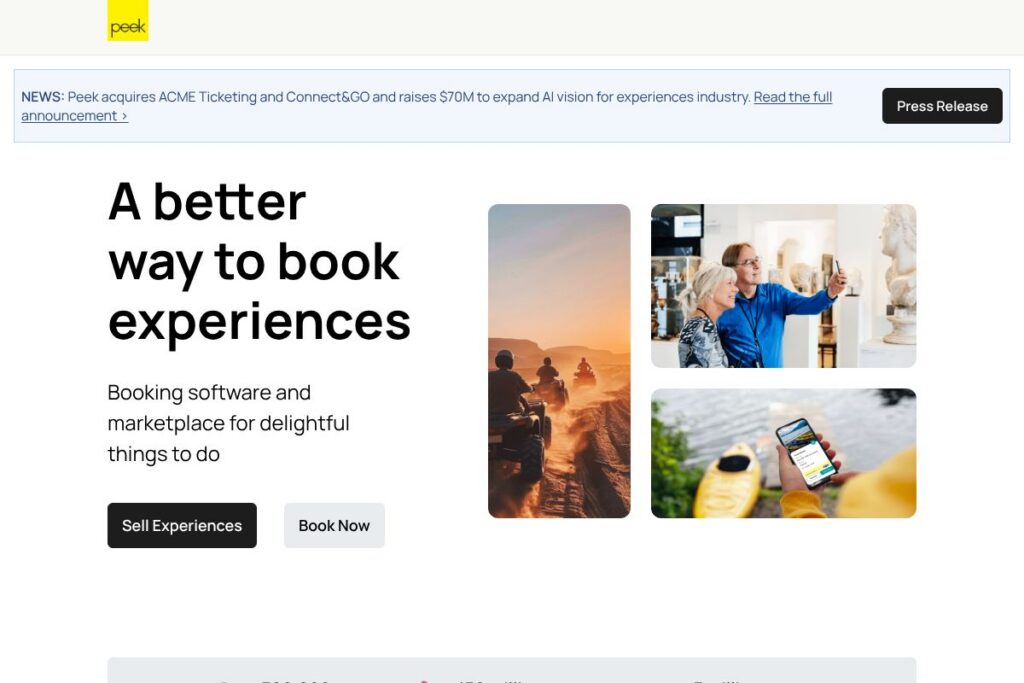
Peek is an online booking and reservation system built for tour operators, activity providers, museums, and experience sellers. The platform combines a customer-facing booking engine and marketplace distribution with back-office tools for scheduling, capacity control, payments, and reporting.
Peek’s closest competitors include FareHarbor, Rezdy, and Checkfront. Compared with FareHarbor, Peek emphasizes marketplace reach and consumer discovery in addition to its booking tools. Against Rezdy and Checkfront, Peek focuses on an end-to-end product that blends direct booking widgets with a consumer-facing marketplace to help operators sell more experiences.
All of this makes Peek well suited for small-to-mid-sized tour operators and attraction managers who want a single solution to accept bookings, manage schedules, process payments, and list inventory on third-party channels. The product is especially useful for operators who want marketplace exposure alongside a standalone booking site.
How Peek Works
Operators configure experiences by defining time slots, capacity limits, cancellation rules, pricing tiers, add-ons, and availability windows inside Peek’s manager console. That configuration drives both a hosted booking page and embeddable widgets you can place on your own website for direct bookings.
When a customer books, Peek handles checkout, applies taxes and fees, and records reservation details in the operator dashboard. The dashboard includes a calendar view, manifest exports, and automated confirmation emails so staff can run daily operations without switching tools.
Peek also provides marketplace distribution so operators can appear in consumer searches on Peek’s marketplace. That channel option can supplement direct sales and is managed through the same inventory and scheduling rules as direct bookings.
What does Peek do?
Peek’s product is organized around booking, fulfillment, and distribution. Core capabilities include a hosted booking site and embeddable widgets, reservation management, payment processing, reporting, and a marketplace that exposes experiences to consumers. The platform has added features over time to improve conversion, mobile checkout, and operator reporting.
The platform includes several powerful capabilities worth highlighting:
Online booking engine
A mobile-friendly booking engine accepts reservations from your website and from Peek’s marketplace. The booking flow supports time-based or capacity-based inventory, optional add-ons, coupon codes, and confirmation emails that reduce manual follow up.
Reservation management
A central dashboard consolidates bookings, guest details, and manifests. Staff can view daily rosters, edit reservations, apply refunds, and export manifests for check-in or guide briefings.
Payment processing
Peek supports integrated payment capture and merchant processing so you can take card payments at checkout and reconcile transactions inside the platform. Payment workflows include prepayment and deposit options to protect bookings.
Marketplace distribution
Listing on Peek’s marketplace puts experiences in front of consumers browsing the platform and nearby attractions. Marketplace bookings use the same availability and capacity settings as direct sales so inventory stays synchronized.
Reporting and analytics
Built-in reports cover revenue, bookings by experience, no-show rates, and channel performance. Operators can use these reports to compare direct versus marketplace bookings and identify trends by date or product.
Review and reputation tools
Peek collects verified reviews from customers and surfaces review summaries in your operator dashboard. Review management helps operators monitor guest feedback and respond to issues in a centralized place.
Integrations and channel management
The platform connects to external systems for calendar sync, email marketing, and POS reconciliation. Channel management features help distribute inventory to third-party resellers while keeping availability consistent.
With these capabilities, Peek focuses on reducing manual booking tasks, improving conversion on mobile checkout, and providing distribution options for operators who want both direct bookings and marketplace exposure.
Peek pricing
Peek offers a SaaS-style reservation platform with options for direct bookings and marketplace distribution, and pricing is tailored to the operator type and needs. For current plan options, fees, and whether marketplace listings incur separate commissions, review Peek’s official pricing information on their site.
For details about subscriptions and partner programs, see Peek’s current pricing options. For enterprise or high-volume operators who need custom contracts, check Peek’s enterprise and partnership information.
What is Peek Used For?
Tour operators, activity providers, museums, and attraction managers use Peek to accept online reservations, manage daily schedules, and process payments in one system. The tool replaces manual spreadsheets and phone bookings with a consistent workflow for confirmations, manifests, and customer communication.
Marketing teams use Peek’s marketplace and analytics to increase visibility and measure channel performance, while operations staff use its calendar and roster features to run tours and manage guides. The combined booking plus marketplace approach helps small operators scale without adding multiple point solutions.
Pros and Cons of Peek
Pros
- Unified booking and marketplace presence: Centralizes direct bookings and marketplace distribution so inventory and schedules remain synchronized. This reduces double-booking risk and simplifies operations.
- Operator-focused reservation tools: The dashboard provides manifests, calendar views, and refund workflows designed for tour and activity logistics. Staff workflows are streamlined for daily operations.
- Built-in payments and reviews: Payments are managed inside the platform and verified customer reviews are collected automatically to support reputation management.
Cons
- Marketplace fees may apply: Using Peek’s marketplace for distribution often involves commissions or fee structures that can impact per-booking margin and should be evaluated against direct booking volume.
- Customization limits for complex products: Operators with highly custom pricing rules or multi-component packages may need additional integrations or bespoke development to model complex offerings.
- Enterprise-level negotiation: Large operators looking for custom SLAs, advanced reporting, or dedicated onboarding may need an enterprise contract rather than standard plans.
Does Peek Offer a Free Trial?
Peek offers trial and demo options for new customers. Operators can request a demo or trial to test core booking features, booking widgets, and the operator dashboard before committing; reach out through Peek’s sales and demo pages to arrange access.
Peek API and Integrations
Peek provides integration options for common operator needs and connects to payment processors, calendar systems, and marketing tools. For developers and partners, Peek documents integration endpoints and partner programs on its developer and integrations pages.
Key integrations commonly used with Peek include payment gateways, calendar sync, email marketing platforms, and channel partners for distribution. See Peek’s integration options for connector details and partner workflows.
10 Peek alternatives
Paid alternatives to Peek
- FareHarbor – A widely used booking and reservation platform focused on tours and activities with strong backend scheduling and channel features.
- Rezdy – Offers real-time inventory management, reseller distribution, and marketplace integrations for tour operators.
- Checkfront – Booking management software with website widgets, payments, and reporting for tours, rentals, and experiences.
- Xola – Combines checkout flows, automation, and marketing tools aimed at activity operators and travel experiences.
- TrekkSoft – Focuses on online booking and reseller networks with a variety of distribution and payment options.
- Viator (for distribution) – A large consumer-facing marketplace that helps operators reach global travelers through listings.
- Peek Pro – Peek’s commercial offering for operators who want the full set of management and distribution tools.
Open source alternatives to Peek
- Booked Scheduler – An open source scheduling system suitable for appointment-based bookings that can be adapted for simple activity reservations.
- ERPNext – An open source ERP with modules for service and sales management that can be configured to handle bookings and customer records.
- Solidres – A reservation system with open source roots primarily used for accommodations but adaptable to experience bookings with some customization.
Frequently asked questions about Peek
What is Peek used for?
Peek is used for online bookings and reservation management for tours, activities, and attractions. Operators use it to accept payments, manage schedules, and distribute inventory through direct widgets and a consumer marketplace.
Does Peek integrate with payment processors like Stripe?
Yes, Peek supports integrated payment processing with major gateways. Integrated payments allow you to accept card payments at checkout and reconcile transaction records inside the platform.
How much does Peek cost?
Peek offers tiered pricing and marketplace options that vary by operator needs. For specific subscription rates, commission structures, and enterprise terms, consult Peek’s current pricing options.
Can Peek distribute experiences to third-party marketplaces?
Yes, Peek offers marketplace distribution for listed experiences. Marketplace listings share the same availability and capacity rules as direct bookings so inventory remains synchronized.
Does Peek provide an API for developers?
Peek provides integration and partner APIs for developers and enterprise customers. See Peek’s integration options for documentation and partner program details.
Final verdict: Peek
Peek combines a consumer-facing marketplace with a practical back-office booking engine that fits the needs of tour operators and attractions. It handles the core tasks operators care about: online checkout, capacity management, manifests, payments, and a channel to reach customers beyond a business website.
Compared with FareHarbor, Peek leans more toward marketplace-driven demand alongside direct booking tools, while FareHarbor often emphasizes deep backend customization and enterprise deployments. For operators evaluating options, Peek is a strong choice if you value marketplace exposure and an all-in-one booking workflow; FareHarbor may be preferable for larger organizations requiring bespoke integrations and negotiated enterprise pricing.
For plan details, trial arrangements, and enterprise discussions, review Peek’s resources and contact their team via Peek’s official homepage.