Productboard: An Overview
Productboard is a product management platform built to centralize user feedback, prioritize features, and create shareable roadmaps. It organizes customer requests, evidence, and strategic objectives in a single repository so product teams can connect what they build to why it matters to customers and the business.
Compared with Aha!, which emphasizes strategy mapping and detailed roadmaps, Productboard focuses more on feedback aggregation and customer-driven prioritization. Against Jira, Productboard is less about issue tracking and delivery management and more about discovery and prioritization; teams commonly use Productboard alongside Jira for handoff into engineering. Compared with Asana, Productboard provides deeper product-centric workflows such as linking user insights to feature ideas and scoring features for impact.
Productboard is particularly strong at collecting and surfacing customer needs, connecting them to feature ideas, and aligning stakeholders around prioritized roadmaps. This makes it a fit for product-led companies, product operations functions, and larger organizations that want a centralized source of truth for why product decisions are made.
How Productboard Works
Productboard ingests feedback from many sources into a single, searchable feedback repository. Teams connect conversations from support, sales, user research, and in-product tools, then tag and map feedback to related feature ideas so user needs are visible during prioritization.
Prioritization uses a data model that links customer segments and requests to feature ideas and higher-level objectives. Product managers score and rank initiatives, build roadmaps that reflect those priorities, and share status with stakeholders to maintain alignment across product, engineering, sales, and marketing.
Workflows frequently include discovery, validation, and handoff: collect evidence during discovery, validate with customers using built-in release notes and feedback loops, and then push validated features into delivery systems like Jira or GitHub for implementation.
What does Productboard do?
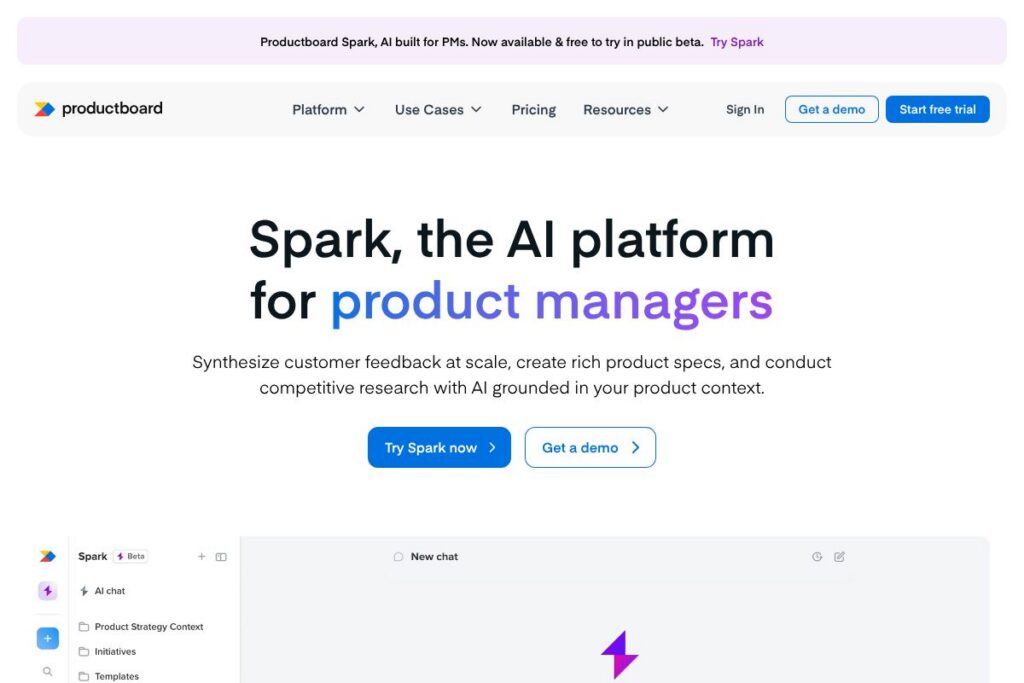
Productboard’s platform centers on feedback-driven product discovery, objective-linked prioritization, and roadmap communication. Recent additions include the Spark AI assistant for synthesizing feedback, drafting specs, and surfacing competitive insights within the product context.
Key functionality includes:
Feedback collection and consolidation
Productboard consolidates customer feedback from email, support tools, CRMs, and direct uploads into a single database, allowing teams to search, tag, and link raw data to feature ideas. This reduces scattered spreadsheets and preserves context for prioritization.
Prioritization and scoring
The platform provides scoring models to evaluate features by customer importance and business impact, letting teams filter and rank ideas based on custom criteria. Scores can be adjusted to reflect target segments, effort estimates, and strategic objectives.
Roadmapping and visualization
Productboard creates shareable roadmaps that map initiatives to company objectives and release timelines, with options for public or internal roadmaps to communicate progress. Visual roadmaps help stakeholders see how planned work supports business goals.
Spark AI assistant
Spark uses AI grounded in your product context to synthesize feedback, draft product specs, and run competitive research, accelerating discovery and spec writing while keeping outputs tied to actual customer evidence. AI outputs can be edited and linked directly to feature records.
Integrations and workflow handoff
Productboard integrates with tools such as Jira, GitHub, Zendesk, Intercom, Salesforce, and Slack to sync requests and hand off validated features into delivery pipelines. Integrations preserve the customer context that informed each decision.
Customer validation and release communication
The platform includes tools to gather targeted feedback from selected customers, close the loop as features progress, and publish release notes that highlight which customer requests were addressed. This helps turn early adopters into referenceable advocates.
With Productboard you get an integrated discovery-to-delivery workflow that ties feedback to priorities and roadmaps, improving transparency and making product decisions traceable to customer evidence.
Productboard pricing
Productboard uses a tiered SaaS pricing model with plans tailored to individuals, teams, and large enterprises, plus a free trial for new users. Enterprise customers typically get custom quotes that include advanced security, SSO, and onboarding services; small teams can choose simpler plans based on seat counts and feature needs.
For the latest plan structure and any public per-seat pricing, view Productboard’s pricing options. Enterprise teams can contact sales for a tailored quote and information about volume discounts and implementation services.
What is Productboard Used For?
Productboard is used for feedback-driven product discovery, prioritizing feature roadmaps, and maintaining visible alignment between product work and company objectives. Product managers use it to capture customer needs, score initiatives, and present prioritized roadmaps to stakeholders.
It is also used for cross-functional communication: sales and customer success submit insights, engineering receives validated and scoped work, and marketing coordinates launches using the same source of truth. Teams scale product processes and standardize decision-making across multiple product lines or business units.
Productboard’s Benefits and Limitations
Pros
- Strong feedback consolidation: Productboard centralizes customer requests and collates evidence so product decisions are based on a searchable, auditable record. This reduces reliance on scattered spreadsheets and email chains.
- Customer-driven prioritization: The platform links customer segments and requests to features, enabling prioritization based on user importance as well as business impact. That makes trade-offs more defensible to stakeholders.
- Clear roadmap communication: Built-in roadmap views and status sharing help product teams broadcast priorities and release plans to executives, sales, and marketing with context for each initiative.
- AI-assisted discovery (Spark): Spark provides AI workflows for synthesizing feedback and drafting specs, speeding up common product tasks while remaining tied to product context and evidence.
Cons
- Enterprise focus can increase cost: Large organizations may find the required feature set and enterprise services are priced at a premium relative to lightweight roadmap tools. Custom quotes are common for larger deployments.
- Not a delivery tool: Productboard is built for discovery and prioritization, not issue tracking; teams typically must integrate with Jira or GitHub to manage delivery and sprints.
- Learning curve for large teams: Adopting a feedback-driven process and the product data model takes time and governance; smaller teams may need to simplify their usage initially.
Does Productboard Offer a Free Trial?
Productboard offers a free 15-day trial. The trial provides access to core product management workflows including feedback collection, prioritization, and roadmap creation so teams can validate fit before committing to a subscription.
Productboard API and Integrations
Productboard provides an API and developer resources to automate workflows, import feedback, and sync feature and roadmap data with other systems. See the Productboard developer documentation for endpoints, authentication, and API examples.
Key native integrations include support for Jira, GitHub, Zendesk, Intercom, Salesforce, and Slack, plus connectors via platforms like Zapier to extend automation across a wider app ecosystem.
10 Productboard alternatives
Paid alternatives to Productboard
- Aha! — Roadmapping and strategy platform focused on product strategy, release planning, and idea management with deep strategy mapping capabilities.
- Jira Product Discovery — Atlassian’s product discovery add-on that pairs with Jira for prioritized idea capture and handoff to engineering.
- ProductPlan — Visual roadmap tool that simplifies roadmap creation and stakeholder sharing using timeline and roadmap templates.
- Asana — General work management tool that teams use for lightweight roadmaps and feature tracking with strong task and project workflows.
- airfocus — Prioritization and roadmap software that emphasizes scoring frameworks and easy roadmap exports.
- Roadmunk — Roadmap-focused platform with custom views for stakeholders and exportable product plans.
- Pendo — Product experience platform that adds in-app guidance and analytics to prioritization and product decisions.
Open source alternatives to Productboard
- OpenProject — Open source project management with roadmap and product planning features suitable for teams that want self-hosted control.
- Taiga — Agile project management platform with backlog and roadmap features, useful for small teams running agile discovery.
- Redmine — Flexible issue tracking and project management system that can be configured for feedback and roadmap management.
- Fider — Open source feedback collection tool designed for gathering and voting on user feature requests and ideas.
Frequently asked questions about Productboard
What is Productboard used for?
Productboard is used for feedback-driven product discovery, prioritization, and roadmap communication. Product teams consolidate user insights, score and prioritize feature ideas, and publish roadmaps that show how work maps to company objectives.
Does Productboard integrate with Jira?
Yes, Productboard integrates with Jira. Integrations allow teams to sync validated features and context directly into Jira issues for engineering to consume.
How much does Productboard cost?
Productboard uses tiered SaaS plans and custom enterprise pricing, with a free trial available. For detailed plan options and seat-based pricing, check Productboard’s pricing options.
Can Productboard support large enterprise security requirements?
Yes, Productboard offers enterprise-grade features such as SSO and administrative controls. Enterprise plans commonly include advanced security, onboarding, and support tailored to organizational needs.
Does Productboard offer an API?
Yes, Productboard has a public API for developers. The Productboard developer documentation describes available endpoints for integrating feedback, features, and roadmap data.
Final Verdict: Productboard
Productboard excels at turning dispersed customer feedback into prioritized feature work and clear roadmaps. Its data model that connects user needs to feature ideas, combined with Spark AI to synthesize feedback and draft specs, makes it a strong choice for product teams that want evidence-based decision-making and stakeholder alignment.
Compared with Aha!, which emphasizes built-in strategy mapping and has a different pricing posture, Productboard places more emphasis on feedback consolidation and customer-driven prioritization while offering flexible SaaS plans and enterprise options with a free 15-day trial. For teams that need a discovery-first tool that integrates into delivery systems like Jira, Productboard is a practical, centralized solution.