RingCentral: An Overview
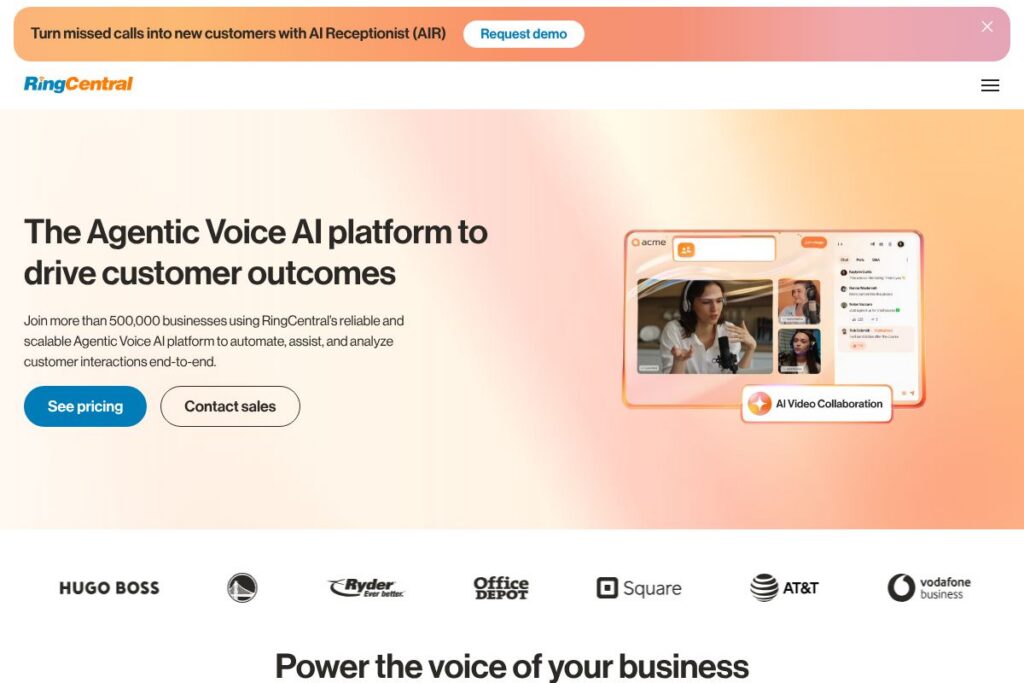
RingCentral is a unified communications and contact center platform built around voice, messaging, meetings, and contact center workflows with embedded Agentic Voice AI capabilities. Its AI suite includes AI Receptionist (AIR), AI Virtual Assistant (AVA), and AI Conversation Expert (ACE), which are designed to automate routine interactions, assist agents in real time, and extract insights from every conversation.
Compared with Microsoft Teams, which focuses on team collaboration and is commonly bundled with Microsoft 365, RingCentral places more emphasis on telephony, contact center features, and conversational AI for customer-facing operations. Against Zoom, RingCentral provides a broader set of integrated voice and contact center features rather than only meetings and webinar tools. Versus Genesys Cloud, RingCentral competes on unified communications plus integrated AI capabilities, while Genesys emphasizes an enterprise-grade contact center feature set and deep workforce engagement tools.
RingCentral is well suited for organizations that need a single vendor for business telephony and contact center functionality, particularly when automated voice interactions and conversation intelligence are priorities. Its feature set is aimed at contact centers, customer experience teams, and IT organizations managing unified communications across distributed workforces.
How RingCentral Works
RingCentral combines cloud telephony, contact center software, and collaboration tools into a single platform. Calls, SMS, video meetings, and contact center queues flow through the platform, and AI modules operate on those channels to automate call handling, transcribe conversations, and generate agent coaching insights.
In a typical deployment an organization provisions phone numbers and users in the RingCentral admin console, configures call routing and IVR flows, then enables AI capabilities for reception and conversation analytics. Contact center supervisors can monitor agent performance, launch coaching workflows, and link call intelligence into CRM systems to preserve context for follow-up.
Operational workflows include AI reception handling inbound voice and SMS 24/7, agent assist prompts during live calls, post-call conversation analysis, and automated summaries for sales or support teams. IT teams integrate RingCentral with identity providers, CRM systems, and workforce management tools to centralize management and reporting.
RingCentral features
RingCentral’s platform centers on unified communications and Agentic Voice AI for contact centers and business voice. Core capabilities include cloud phone system features, AI Receptionist, virtual agents, conversation intelligence, video meetings with AI notes, and pre-built integrations for CRM and collaboration platforms. Recent emphasis is on agentic AI features that support no-code agent creation and deeper CRM embedding.
Let’s talk RingCentral’s Features
Agentic Voice AI
Agentic Voice AI automates and assists voice interactions at scale by combining automated reception, virtual assistants, and conversation intelligence to route calls, answer common questions, and provide agents with suggested responses. This reduces hold times and accelerates resolution by keeping interaction context available across channels.
AI Receptionist (AIR)
AI Receptionist offers a 24/7 digital concierge that answers calls, routes to the right team, and can escalate to agents when required. It supports voice and SMS interactions and can be tailored for industry needs to handle high volumes of routine requests without human intervention.
AI Virtual Assistant (AVA)
AI Virtual Assistant manages more complex conversational flows across voice, chat, and SMS and can integrate with backend systems to fetch account details or submit requests. It is useful for reducing agent load on repeatable transactions while preserving escalation paths for exceptions.
AI Conversation Expert (ACE)
AI Conversation Expert analyzes calls and messages to produce searchable transcripts, topic tags, sentiment signals, and coaching insights. These outputs feed into CRM records and quality management workflows to improve agent performance and customer outcomes.
RingCX / Contact Center
RingCX centralizes contact center routing, workforce management, and reporting, with built-in AI tools for automated quality scoring and agent coaching. Supervisors can create queues, apply routing rules, and use analytics to identify training opportunities.
RingEX / Cloud Communications
RingEX provides the underlying cloud telephony and collaboration services that handle calling, messaging, and meetings across devices. It supports call routing, number management, and global reach for distributed teams.
AI Meetings and Summaries
AI Meetings add automated meeting summaries, notes, and action items for video and event workflows, helping teams capture decisions and follow-ups without manual note taking. Summaries can be attached to calendar events or passed to CRM systems for record-keeping.
AIR Pro and No-Code AI Agents
AIR Pro lets teams build custom conversational agents across voice, SMS, chat, and social using natural language prompts and industry-ready templates. The no-code approach accelerates rollout and lets business users iterate on dialogs without developer support.
Integrations and Open APIs
RingCentral exposes APIs and pre-built connectors to integrate with CRM platforms, workforce tools, and third-party applications so voice and conversation intelligence are available where agents already work. Integrations preserve context across systems and support automated downstream actions.
With these capabilities RingCentral helps businesses reduce manual handling of routine contacts, surface actionable insights from conversations, and manage voice and contact center operations from a single cloud platform. The biggest benefit is a cohesive set of AI and telephony features that work across channels and integrate with existing enterprise systems.
RingCentral pricing
RingCentral uses a subscription pricing model tailored for businesses and enterprises, with custom options for contact center deployments and advanced AI features. Pricing is typically arranged by plan, feature set, and seat volume, and larger deployments receive volume or enterprise agreements.
For specific plan options and to get a quote for contact center or AI capabilities, view the RingCentral plans and contact options on the RingCentral homepage or reach their sales team via the RingCentral contact page. See the RingCentral homepage or the RingCentral contact page to request a tailored pricing proposal.
What is RingCentral Used For?
RingCentral is used to consolidate business telephony, contact center operations, messaging, and video meetings on a single cloud platform. Organizations deploy it to replace legacy phone systems, add scalable contact center capabilities, and introduce AI-driven reception and conversation intelligence to customer-facing teams.
Common use cases include 24/7 automated call handling, agent-assisted support with real-time suggested responses, post-call analytics and coaching, AI-generated meeting notes, and integration of call context into CRM records. It is suitable for enterprises, mid-market companies, and distributed teams that require global reach and compliance features.
Pros and Cons of RingCentral
Pros
- Integrated AI voice and contact center: RingCentral combines telephony, contact center features, and Agentic Voice AI to automate routine calls and surface conversation intelligence for agents and managers.
- Global scale and reliability: The platform supports global number management and cloud routing with service-level practices that accommodate large deployments and high call volumes.
- No-code AI agent building: AIR Pro enables business teams to design and launch conversational agents across channels without deep developer involvement, accelerating time to production.
- Extensive integrations and developer platform: A broad set of pre-built integrations and the RingCentral Developer Platform let organizations embed telephony and conversation data into CRMs and workflows.
Cons
- Enterprise-oriented pricing and procurement: Pricing is typically arranged by contract and may require sales engagement, which can delay evaluation for smaller buyers seeking transparent per-seat pricing.
- Complexity for small teams: The breadth of features and contact center options can be more complex than lightweight phone systems, so small teams may need guidance during setup and configuration.
- Customization and integration work: Advanced use cases that require deep CRM integration or bespoke AI behavior can require implementation effort and integration resources.
Does RingCentral Offer a Free Trial?
RingCentral offers free trials and trial access to selected features for prospective customers. Trial options are commonly available for collaboration and phone system features, and RingCentral’s sales team can arrange demonstrations or trial access for contact center and AI capabilities; use the RingCentral homepage to start a trial or request a demo.
RingCentral API and Integrations
RingCentral provides a developer platform with REST APIs and SDKs for voice, messaging, and meetings, enabling programmatic call control, message exchange, and access to conversation data. The RingCentral Developer Platform documents endpoints for telephony, messaging, meetings, and webhooks for real-time events.
The platform includes pre-built integrations with common business systems such as Microsoft Teams, Salesforce, Zendesk, and workforce management tools. For a catalog of connectors and apps, see the RingCentral integrations and apps directory at the RingCentral apps page.
10 RingCentral alternatives
Paid alternatives to RingCentral
- Microsoft Teams — Unified collaboration and calling features often bundled with Microsoft 365, with integrated chat, meetings, and calling for organizations that prefer Microsoft’s ecosystem.
- Zoom — Video-first platform that also offers Zoom Phone and contact center capabilities, suitable for organizations prioritizing meetings and webinars with integrated telephony add-ons.
- Cisco Webex — Enterprise communications platform with calling, meetings, and contact center products, focused on security and large-scale deployments.
- Genesys Cloud — Contact center centric platform with advanced routing, workforce engagement, and analytics for large customer service organizations.
- Vonage Business — Cloud communications and contact center solutions with telephony, messaging, and integrations oriented toward SMB and mid-market customers.
- 8×8 — Cloud communications and contact center suite with global coverage and unified analytics for voice and customer experience.
Open source alternatives to RingCentral
- Asterisk — Open source telephony engine for building PBX, IVR, and custom voice applications on self-hosted infrastructure.
- FreeSWITCH — Telephony platform for scaling voice and video applications, suitable for organizations that want to build custom communication services.
- Jitsi — Open source video conferencing that can be combined with SIP gateways and telephony components for a self-managed solution.
- Kamailio — SIP server for routing and load balancing of SIP calls, useful as a core component in custom voice architectures.
Frequently asked questions about RingCentral
What does RingCentral do for contact centers?
RingCentral provides a cloud contact center with AI-driven routing, conversation intelligence, and agent tools. It centralizes queues, reporting, and AI-assisted coaching to improve first contact resolution and agent efficiency.
Does RingCentral integrate with Salesforce?
Yes, RingCentral integrates with Salesforce via a pre-built connector and API integrations. Integration surfaces call and message context in CRM records and can log transcripts and activity automatically.
How much does RingCentral cost for teams?
RingCentral uses subscription pricing tailored to business needs and deployment size. For specific plan options and a custom quote, contact RingCentral sales through the RingCentral contact page or request pricing via the RingCentral homepage.
Can RingCentral handle global phone numbers and compliance?
Yes, RingCentral supports global number provisioning and compliance features for regulated industries. The platform includes region-specific telephony management and controls for security and data residency where required.
Is RingCentral’s AI available across voice and messaging?
RingCentral’s Agentic Voice AI capabilities operate across voice, SMS, chat, and social channels. AI modules like AIR and AVA can be configured to handle inbound voice and messaging flows while tying outputs into analytics and CRM systems.
Our Take on RingCentral
RingCentral stands out for combining cloud telephony, contact center features, and Agentic Voice AI in a single platform that focuses on automating customer interactions and surfacing conversation intelligence. Its AI receptionist, virtual agents, and conversation analytics make it a strong choice for organizations that need scalable voice automation alongside unified communications.
Compared with Microsoft Teams, which often arrives as part of Microsoft 365 and provides predictable per-user pricing for collaboration, RingCentral is oriented toward organizations that require advanced telephony and contact center AI and therefore typically negotiates subscription and enterprise contracts. For teams prioritizing voice automation and integrated contact center capabilities, RingCentral offers deeper built-in AI features than general collaboration suites.