What is Salesforce
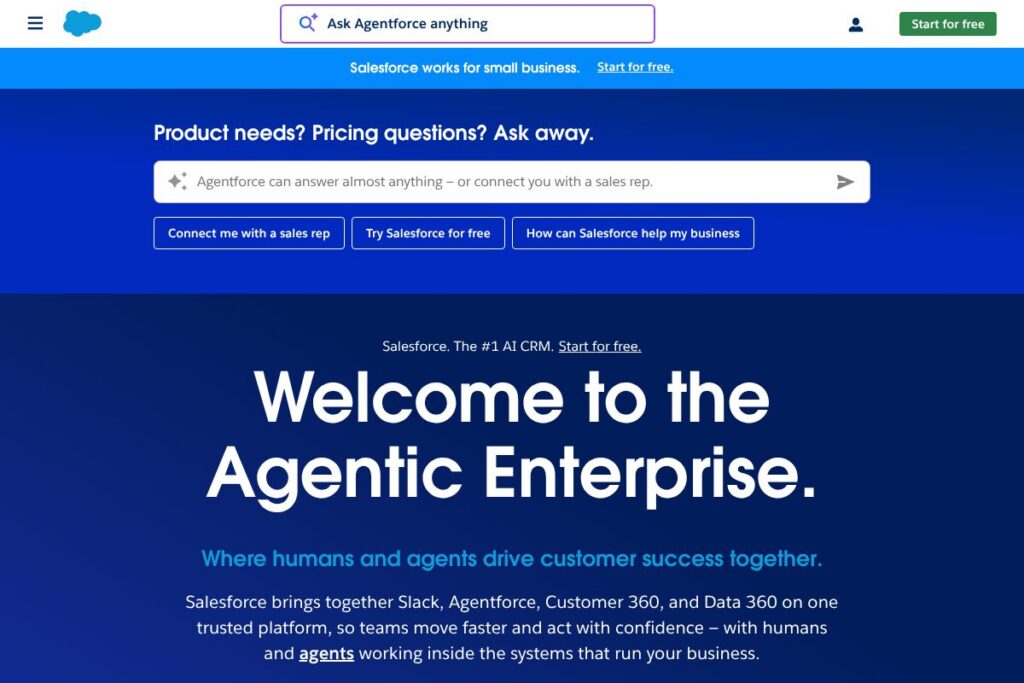
Salesforce is a cloud CRM platform that combines traditional sales, service, and marketing capabilities with agentic AI, data management, and collaboration tools. It packages Customer 360 data, Agentforce automation, Slack collaboration, and Data 360 data services into a single platform so teams can access the same customer record and AI-driven workflows across touch points. Salesforce targets small businesses with products like Starter Suite and scales to large enterprises with industry-specific Agentforce solutions and governed AI controls.
Compared with Microsoft Dynamics 365, Salesforce places more emphasis on integrated agentic AI and third-party collaboration through Slack, while Dynamics 365 is tightly integrated with Microsoft 365 and Azure services. Against SAP Customer Experience, Salesforce offers a broader set of CRM-native AI and conversational agent tools rather than SAP’s ERP-centric approach. Compared with HubSpot CRM, Salesforce provides a more extensive enterprise feature set and governance tools, though HubSpot may be more accessible for small teams that want a free entry point.
Salesforce does well at unifying data, automation, and collaboration for customer-facing teams. Its strength is delivering governed AI and agent workflows that operate alongside human agents, which is useful for organizations that need real-time automation, a single customer view, and enterprise-grade security. All of this makes Salesforce particularly suitable for mid-market and enterprise customers that require a consolidated platform for sales, service, marketing, and industry-specific workflows.
How Salesforce Works
Salesforce stores customer records in a central Customer 360 layer that unifies contacts, transactions, and interaction histories across modules. Agentic AI components like Agentforce can access that unified data to automate tasks such as lead qualification, case resolution, and personalized messaging, while human agents can intervene or take over from AI at any point.
Teams use Salesforce through modular apps for sales, service, marketing, and commerce, plus Slack for collaboration. Typical workflows include routed service cases that attempt automated resolution via Agentforce, escalations to human agents with context preserved, and sales sequences that combine AI-suggested next actions with CRM pipeline tracking. Administrators configure data models, governance, and integrations from a centralized setup, enabling consistent policies across the platform.
Salesforce features
Salesforce is organized around unified customer data, agentic AI, and modular business apps. Core capabilities include Customer 360 for data unification, Agentforce for conversational and autonomous workflows, Slack for team collaboration, and Data 360 for data activation. The platform also includes industry-specific packaged solutions that speed deployment and align AI with sector workflows.
What Salesforce Brings to the Table
Customer 360
Customer 360 consolidates records from sales, service, commerce, and marketing into a single profile per customer. This unified view reduces duplicate records, powers personalized experiences, and supplies the context Agentforce and other automation need to make accurate decisions.
Agentforce
Agentforce provides agentic AI that can execute multistep tasks such as triaging cases, qualifying leads, and drafting personalized outreach. It integrates with CRM data and workflows so agents can approve, modify, or take over automated actions while maintaining audit trails and governance.
Data 360
Data 360 centralizes data ingestion, identity resolution, and activation across the platform so teams can use the same verified dataset for analytics and AI. It supports real-time updates and feeds for operational use cases, which helps reduce latency between data collection and action.
Slack integration
Slack is embedded for cross-team collaboration and operational notifications, enabling agents to coordinate on escalations, share context from records, and trigger workflows without leaving their collaboration workspace. This reduces handoff friction and preserves conversational context for customer work.
Industry Agentforce solutions
Salesforce offers prebuilt Agentforce templates and workflows for industries such as financial services, retail, education, and manufacturing. These industry solutions align AI behavior with common processes, accelerating deployment and reducing customization effort.
With these capabilities combined, Salesforce helps organizations automate repetitive work, keep a single source of truth for customer data, and coordinate human and AI efforts across the full customer lifecycle.
Salesforce pricing
Salesforce uses a subscription-based SaaS model with entry-level plans for small businesses and custom pricing for larger enterprise deployments. The vendor offers an explicitly named Starter Suite for small businesses and negotiates enterprise agreements that include additional products, industry solutions, and enterprise support. For current plan composition and enterprise options, view the current pricing options.
Monthly Billing:
Starter Suite – $25 USD/user/month (Core sales, service, and marketing features with built-in AI suitable for small businesses)
Enterprise and Custom Pricing:
Enterprise – Custom pricing (Includes expanded automation, industry Agentforce solutions, single sign-on, and dedicated support; pricing varies by product mix and contract size)
For comprehensive plan details and volume discounts, check the Salesforce product catalog and pricing. Large organizations should contact Salesforce sales to obtain tailored quotes that reflect packaged Agentforce solutions and data usage needs.
What is Salesforce Used For?
Salesforce is commonly used to manage sales pipelines, automate customer service workflows, and run personalized marketing campaigns using a unified customer profile. Organizations deploy it to centralize customer data, route work across teams, and apply AI-driven automation that reduces manual tasks and improves response times.
It is also used for industry-specific scenarios such as banking client lifecycle management, retail customer acquisition, higher education student support, and manufacturing partner management. Teams that need governed AI, auditability, and tight integration between CRM and operational systems benefit most from Salesforce.
Pros and cons of Salesforce
Pros
- Unified platform: Consolidates customer data, AI agents, and collaboration tools so teams work from a single source of truth and reduce data silos. This helps preserve context across sales, service, and marketing interactions.
- Agentic AI at scale: Provides automation that can execute multistep actions and hand off to humans when needed, which increases case resolution rates and improves lead conversion in real workflows.
- Industry solutions: Offers out-of-the-box Agentforce templates and industry-specific packages that accelerate time to value and lower initial configuration effort.
- Ecosystem and integrations: Extensive marketplace and APIs let organizations connect ERP systems, analytics platforms, and third-party apps, which supports broad enterprise requirements.
Cons
- Complexity for small teams: The platform’s breadth and configuration options can be overwhelming without dedicated administrators or consultants, which may increase implementation time and cost.
- Cost at enterprise scale: Total cost can grow quickly when adding multiple products, large data volumes, or advanced Agentforce solutions; budgeting and contract negotiation are often required.
- Customization overhead: Highly customized deployments require governance and change management to prevent fragmented data models and inconsistent processes across teams.
Does Salesforce Offer a Free Trial?
Salesforce offers a 30-day free trial for new users, providing access to core CRM features so organizations can evaluate product fit before purchasing. Trials typically include sales, service, and basic AI features, and no credit card is required to start.
Salesforce API and Integrations
Salesforce provides a comprehensive developer platform and APIs for building custom integrations, automations, and apps. The Developer API documentation details REST and SOAP endpoints, Apex development, platform events, and authentication flows for programmatic access.
Key integrations include Slack, data warehouses, marketing automation platforms, ERP systems, and analytics tools. The platform supports prebuilt connectors and a large partner ecosystem for adapters and managed integrations.
10 Salesforce alternatives
Paid alternatives to Salesforce
- Microsoft Dynamics 365 — Enterprise CRM with deep Microsoft 365 and Azure integrations, suited for organizations already invested in the Microsoft ecosystem.
- SAP Customer Experience — CRM and commerce solution that ties closely to SAP ERP capabilities, often chosen by large enterprises with SAP back ends.
- Oracle CX Cloud — CRM and CX suite with strong analytics and campaign capabilities, tailored for enterprise environments with Oracle infrastructure.
- HubSpot CRM — Offers a freemium model with inbound marketing and sales features that are easy to adopt for smaller teams.
- Zoho CRM — Cost-effective CRM with a broad app suite for small to mid-market teams, notable for flexible pricing and integrations.
- Adobe Experience Cloud — Focuses on marketing, content, and commerce experiences with tight integration to Adobe’s digital experience products.
- Zendesk — Strong customer support platform with integrated CRM elements, optimized for service-centric workflows.
Open source alternatives to Salesforce
- SuiteCRM — An open source CRM forked from SugarCRM that provides sales, marketing, and service modules for self-hosting organizations.
- EspoCRM — Lightweight open source CRM with core sales and service features and an extensible architecture for custom modules.
- CiviCRM — CRM focused on nonprofit and public sector use cases with contact management, fundraising, and event modules.
- ERPNext — An open source ERP with a built-in CRM module, suitable for organizations that want integrated ERP and CRM functionality.
Frequently asked questions about Salesforce
What is Salesforce used for?
Salesforce is used for managing customer relationships across sales, service, marketing, and commerce. Organizations use it to centralize customer data, automate workflows, and deliver personalized interactions at scale.
Does Salesforce include AI capabilities like Agentforce?
Yes, Salesforce includes agentic AI tools such as Agentforce. Those capabilities automate multistep tasks, assist agents with recommendations, and enable conversational automation across service and sales workflows.
How much does Salesforce cost per user?
Salesforce starts with the Starter Suite at a list price of $25 USD/user/month. Enterprise pricing varies by product mix and contract size, and larger deployments typically involve custom quotes.
Can Salesforce integrate with Slack and third-party apps?
Yes, Salesforce integrates with Slack and many third-party systems. The platform offers native Slack integrations, prebuilt connectors, and extensible APIs for custom integrations.
Is Salesforce suitable for small businesses?
Yes, Salesforce offers the Starter Suite aimed at small businesses and a 30-day free trial. Starter Suite includes core CRM features and built-in AI to support sales, service, and marketing from day one.
Final verdict: Salesforce
Salesforce stands out for combining a mature CRM with agentic AI, unified customer data, and a broad partner ecosystem. Its strengths are governed AI workflows, Customer 360 data unification, and industry-aligned Agentforce solutions that reduce time to value for complex use cases.
Compared with HubSpot CRM, Salesforce offers deeper enterprise capabilities and governance but at a higher starting commitment; HubSpot provides a stronger freemium entry point and simpler pricing for small teams. For organizations that need unified data, advanced automation, and enterprise controls, Salesforce is a comprehensive option; for smaller teams focused primarily on marketing and basic sales, a lighter tool like HubSpot CRM may be more cost-effective.
Salesforce is best for mid-market and enterprise customers that need a single platform to coordinate AI, data, and human workflows across sales, service, marketing, and commerce. To explore product options and tailored quotes, review the Salesforce product catalog or consult the current pricing options.