Schoox: An Overview
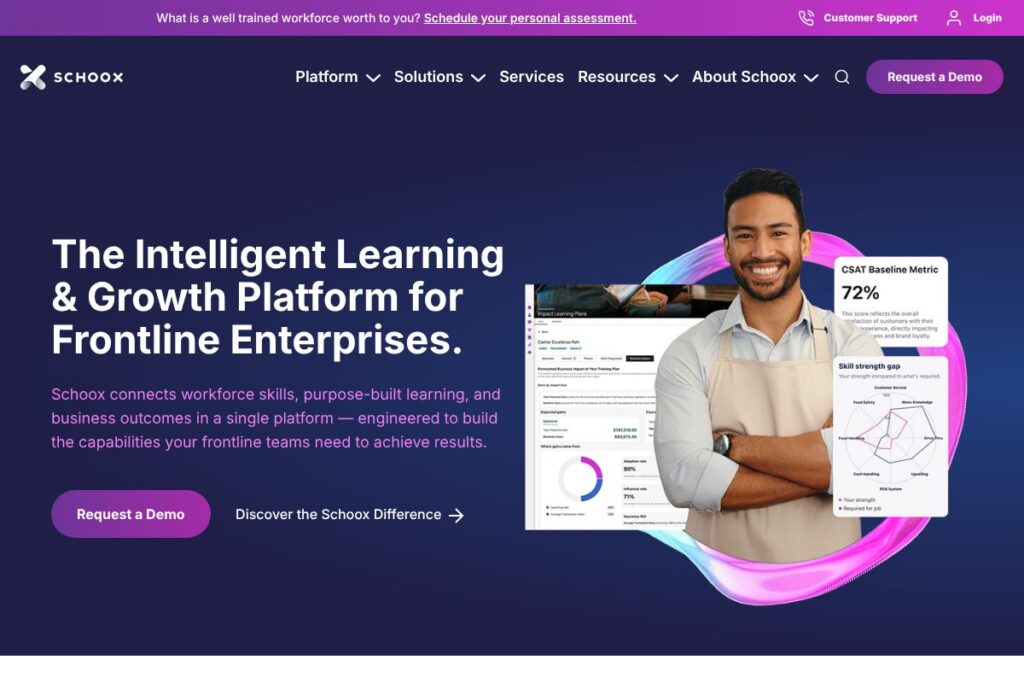
Schoox is an AI-powered corporate LMS designed specifically for frontline enterprises. The platform combines skills mapping, role-based learning paths, content authoring, and outcome tracking so L&D teams can identify capability gaps, deliver targeted training, and measure business impact.
Schoox positions itself against generalist and enterprise LMS providers by focusing on the operational realities of hourly, distributed, and franchise workforces. Compared with Cornerstone OnDemand, which targets broad enterprise HR functions, Schoox emphasizes frontline-ready features such as mobile-first access and franchise rollouts. Against SAP Litmos, Schoox narrows its scope toward skills intelligence and measurable ROI rather than an expansive HR suite. Compared with Docebo, Schoox differentiates with a dedicated Learning Impact Suite that maps training to performance outcomes.
All of this makes Schoox a practical option for organizations that need to scale training across stores, field teams, or franchise networks while linking learning to operational metrics and return on investment.
How Schoox Works
Schoox starts with a skills model that maps job roles to required capabilities and existing worker skills. The platform uses AI to surface skill gaps and recommend targeted learning paths, which administrators can edit or build using the built-in authoring tools.
Once courses and learning paths are assigned, Schoox delivers content via mobile apps, web, and offline sync for field workers with intermittent connectivity. Administrators track completion, assessments, and certification status, and the Learning Impact Suite ties those metrics back to business KPIs to quantify training effectiveness.
Operational workflows typically include role-based onboarding, periodic compliance refreshers, product knowledge rollouts, and skill upskilling tied to promotion paths, with the platform supporting multi-tenant franchise structures and distributor hierarchies for delegated administration.
Schoox features
Schoox centers on skills intelligence, purpose-built content delivery, and measurable business outcomes. Core capabilities include AI-driven gap analysis, learning path automation, mobile and offline learning, content authoring with SCORM and xAPI support, and analytics that feed into a value calculator for projected ROI. Recent platform focus has been on expanding practical AI features and frontline-focused reporting.
Let’s talk Schoox’s Features
AI skills intelligence
The platform maps roles to skills and uses AI to detect capability gaps across locations or teams, producing prioritized learning recommendations. That helps L&D leaders focus development where it will most quickly affect operations and reduce time-to-competency.
Learning Impact Suite
Schoox links learning activities to business outcomes so administrators can measure the effect of training on KPIs such as time-to-productivity or operational errors. This capability supports cost-justification and continuous improvement of learning programs.
Role-based learning paths
Administrators create curriculum bundles for job families, certification tracks, and progression plans, then automate assignments based on role, location, or hire date. This streamlines onboarding and standardizes training across distributed workforces.
Mobile learning and offline access
Native mobile apps deliver bite-sized modules and support offline progress synchronization for frontline workers with spotty connectivity. Mobile-first design improves completion rates for hourly teams working outside traditional office environments.
Content authoring and standards support
Built-in authoring tools let teams create microlearning, quizzes, and assessments without external tools, while the platform also accepts SCORM and xAPI packages for existing content libraries. That flexibility makes it easier to combine vendor and in-house content.
Assessments, certifications, and competency tracking
Schoox includes testing, practical assessments, and certification workflows that verify skill attainment and maintain regulatory compliance. Results feed back into the skills model so training can be adjusted based on demonstrated outcomes.
Analytics and ROI/value calculator
Dashboards surface completion, assessment performance, and business impact metrics, and an interactive value calculator helps quantify expected returns from training investments. These analytics support communications with stakeholders and investment decisions.
Franchise and multi-entity support
The platform supports multi-tenant hierarchies for franchises, distributors, or regional operations with delegated admin roles and localized content. That structure reduces central administration work while preserving local control.
Integrations and extensibility
Schoox integrates with HRIS, SSO providers, and common business systems so user records and business data stay synchronized. Integration options reduce manual user provisioning and help feed business KPIs into the Learning Impact Suite.
With these capabilities, Schoox focuses on closing skill gaps that affect frontline performance while providing the metrics L&D and operations leaders need to demonstrate value.
Schoox pricing
Schoox uses an enterprise-oriented pricing model with custom quotes rather than public standard tiers. Pricing typically reflects factors such as the number of learners, required modules, integration work, and support or implementation services.
For details tailored to your organization and to request a quote, review the Schoox homepage or contact the team through their Request a Demo page to discuss deployment, implementation timelines, and expected returns.
Schoox Use Cases
Schoox is commonly used for onboarding and time-to-productivity programs in retail, hospitality, field service, and franchise networks. It works well where training needs to be standardized across many locations while remaining accessible on mobile devices.
Other common uses include compliance training, product knowledge rollouts, certification programs for technicians, and sales enablement for distributed teams. The skills intelligence and reporting features make Schoox suitable for organizations that must show measurable training ROI.
Pros and Cons of Schoox
Pros
- Frontline-first design: The platform is optimized for hourly, distributed, and franchise workforces, with mobile and offline access suited to field conditions.
- Skills-to-outcomes focus: Skills mapping and the Learning Impact Suite link training to business KPIs so L&D can demonstrate measurable results.
- Franchise and multi-tenant support: Delegated administration and localized content management make it easier to scale training across franchise networks and distributors.
- Practical AI features: AI-driven gap analysis and learning recommendations reduce manual program design and help target high-impact development areas.
Cons
- Enterprise pricing model: Custom pricing means no self-serve entry-level option for small teams, which can slow procurement for smaller organizations.
- Implementation effort for complex integrations: Large organizations with many systems may require professional services to integrate data sources and KPIs.
- Less suited to general HR suites: Organizations seeking an all-in-one HR platform may prefer broader talent management suites over a frontline-focused LMS.
Does Schoox Offer a Free Trial?
Schoox offers custom demos and pilot trials rather than a public free plan. Prospective customers typically request a demo or pilot through the vendor to evaluate features, confirm integrations, and assess pilot outcomes with a representative data set.
Schoox API and Integrations
Schoox provides integration options for key enterprise systems including HRIS, single sign-on, and reporting platforms, and it supports common e-learning standards such as SCORM and xAPI. The Schoox integrations information outlines connectors, common integrations, and recommended integration patterns.
For teams that require API access or custom data flows, Schoox offers developer and integration support to automate user provisioning, sync learning metrics, and feed business KPIs into the Learning Impact Suite. Contact the Schoox team to request API documentation and integration planning.
10 Schoox alternatives
Paid alternatives to Schoox
- Cornerstone OnDemand — Enterprise talent and learning platform with extensive HR and compliance features suited to large organizations.
- Docebo — Scalable LMS with strong AI-powered recommendations and marketplace content for extended enterprise learning.
- SAP Litmos — Cloud LMS focused on quick deployment, off-the-shelf content, and corporate learning needs.
- Absorb LMS — Flexible LMS with strong reporting and admin controls for instructor-led and online learning programs.
- TalentLMS — Straightforward, user-friendly LMS that is quick to set up for smaller teams or training programs.
- Allego — Learning and enablement platform that emphasizes sales learning, coaching, and knowledge sharing.
- Lessonly — Training platform focused on sales and customer-facing teams with simple content authoring and coaching workflows.
Open source alternatives to Schoox
- Moodle — Widely used open source LMS with a large ecosystem of plugins, suitable for organizations that can self-host and customize.
- Open edX — Scalable open source platform aimed at course-based learning and large programs, often used by universities and enterprises.
- Totara Learn — Open source-based commercial LMS with extended enterprise features and a focus on workplace learning.
- Chamilo — Lightweight open source LMS with basic course building and user management for smaller deployments.
Frequently asked questions about Schoox
What is Schoox used for?
Schoox is used to train and upskill frontline workforces while linking learning to measurable business outcomes. Typical scenarios include onboarding, compliance, certification, and ongoing skills development for distributed teams.
Does Schoox have an API?
Yes, Schoox supports integrations and API access for automation and data synchronization. Integration details and connector options are available on the Schoox integrations page, and the vendor provides developer support for custom flows.
How much does Schoox cost?
Schoox uses custom enterprise pricing rather than published tiers. Costs depend on factors like learner counts, required modules, integrations, and implementation services; contact the vendor through their Request a Demo page for a tailored quote.
Can Schoox support franchise or multi-entity training models?
Yes, Schoox is built to support franchise and multi-tenant structures. The platform offers delegated administration, localized content, and hierarchy support so local managers can control training within a broader centralized system.
Does Schoox provide mobile and offline learning?
Yes, Schoox provides native mobile apps with offline sync capabilities. This makes it practical for frontline employees who need access to learning on the job and may experience intermittent connectivity.
Final verdict: Schoox
Schoox is a focused LMS that brings skills intelligence and outcome measurement to frontline training programs. Its strengths are mobile-first delivery, franchise and multi-entity support, and an analytics-driven Learning Impact Suite that helps quantify ROI for training investments.
Compared with broader LMS platforms such as Docebo, which offers modular pricing and a larger marketplace of third-party content, Schoox emphasizes practical AI for skills gap detection and a workflow suited to distributed hourly work. In pricing terms, Docebo and similar vendors offer a mix of published tiers and add-ons, while Schoox prefers custom enterprise arrangements that align cost with scale and required integrations, making Schoox a strong choice for mid-market and enterprise organizations that need measurable frontline impact.