Scispot: An Overview
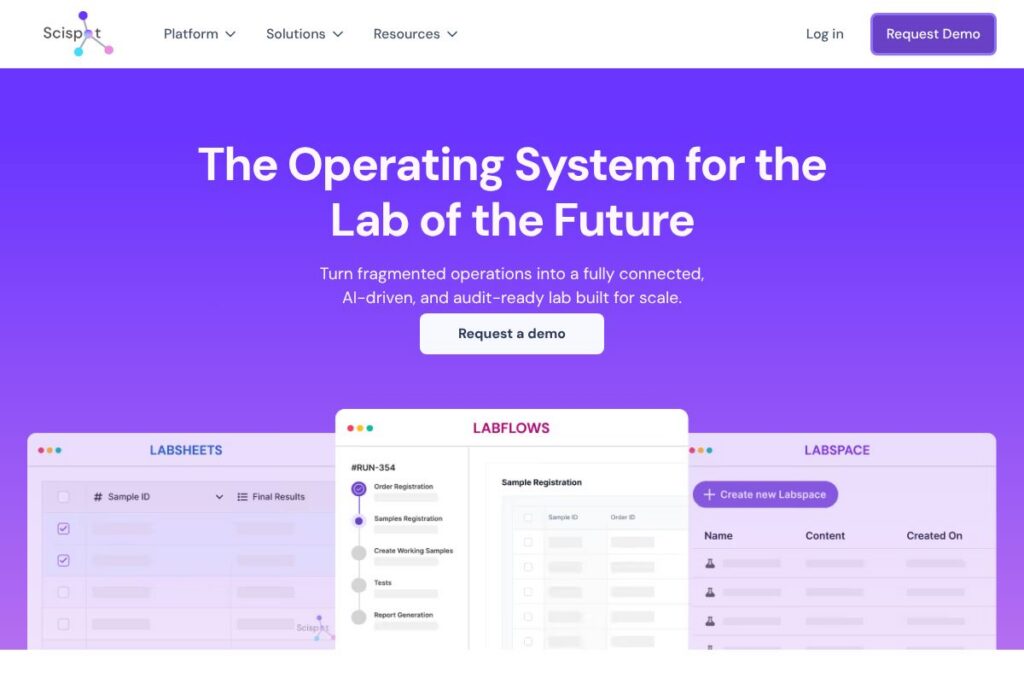
Scispot is built to replace fragmented lab software with a single platform that handles electronic lab notebook workflows, LIMS-style sample tracking, inventory control, instrument integrations, and data analytics. The platform emphasizes end-to-end traceability for samples and experiments, configurable workflows to match lab processes, and built-in compliance features to support audit trails and SOP management.
Compared with vendor offerings like LabWare, which is often positioned as a large-scale enterprise LIMS with longer deployment cycles, Scispot targets labs that want faster configuration and modular integrations. Against Benchling, which focuses heavily on molecular biology data models and sequence-level collaboration, Scispot puts more emphasis on sample logistics, inventory, and instrument connectivity through its GLUE integration layer. Compared with traditional laboratory software, Scispot aims to balance configurability and developer-friendly APIs so teams can automate unique workflows without heavy custom software projects.
All of this makes Scispot particularly useful for mid-size biotech teams, translational research groups, and distributed diagnostics operations that need real-time visibility across experiments, samples, and consumables. Its combination of ELN and LIMS capabilities, plus automation and AI-assisted analytics, suits organizations that must move quickly from experimental runs to reproducible results.
How Scispot Works
Scispot centralizes lab data by treating experiments, samples, inventory, instruments, and protocols as linked entities in a single system. Scientists plan and schedule assays in the platform, use configurable electronic lab sheets during execution, and have results automatically associated with the originating sample and protocol so downstream analysis and reporting stay connected.
Data flows into Scispot from instruments and external systems via the GLUE integration engine, where records are ingested, normalized, and mapped to the lab data model. The platform tracks sample locations and chain of custody, triggers inventory adjustments when reagents are consumed, and surfaces AI-driven recommendations and dashboards so teams can act on outliers or bottlenecks.
Implementation typically follows a pilot-to-production path: teams configure data models and workflows, connect core instruments and databases, run a pilot on a subset of assays, then expand to full lab operations. This staged approach helps reduce disruption while validating integrations and SOP alignment.
Scispot features
Scispot is organized around unified lab operations: experiment management, sample traceability, inventory, instrument integrations, and analytics. Recent platform enhancements emphasize automated sample intake, AI-powered search and recommendations, and a GLUE engine for real-time interoperability with instruments and third-party systems.
LabOS (Unified ELN + LIMS)
LabOS combines electronic lab notebook functionality with LIMS-style sample and project linking so experimental data, protocols, and sample histories live together. This reduces the need for manual cross-referencing between documents and databases, and makes audit-ready records easier to produce for compliant workflows.
Sample Tracking and Traceability
Scispot automates the full sample lifecycle from intake to storage to downstream consumption and disposal. Sample records include metadata, storage location, chain of custody, and links to experimental results, which cuts time spent searching freezers and reduces sample loss.
Inventory Management
Inventory features track reagents, consumables, and lot numbers, with threshold alerts and reorder triggers to prevent stockouts. The system can automatically decrement inventory when experiments run and can integrate with procurement or ERP systems to automate replenishment.
GLUE Integration Engine
GLUE provides a connector framework to sync instruments, LIMS, ELNs, and databases in real time, normalizing diverse data formats into a consistent lab data model. This helps eliminate data silos and enables downstream analytics to operate on a unified dataset; explore the GLUE architecture on Scispot’s GLUE information page for integration patterns and supported connectors.
Scibot Automation
Scibot automates repetitive lab tasks such as sample intake, metadata ingestion, file parsing from instruments, and routine data transformations. Teams use Scibot to remove manual data entry steps and to ensure consistent application of SOPs during routine tasks.
NLP Search and AI Recommendations
Natural language search lets users query the lab by asking for sample locations, recent experiment results, or reagent status and receive immediate answers. AI-driven recommendations surface optimizations for assay design, data processing pipelines, and potential issues in experimental runs, which helps teams prioritize follow-up work.
Analytics and Dashboards
Built-in analytics and customizable dashboards turn lab records into visual summaries for KPIs, assay performance, and inventory usage. Dashboards can pull together sample metrics, instrument uptime, and reagent consumption to support operational decisions.
With these capabilities, Scispot helps labs reduce time spent on manual tasks, improves data consistency across workflows, and provides a single place to manage science operations and compliance.
Scispot pricing
Scispot uses a bespoke enterprise pricing model, tailoring costs to lab size, integration scope, required modules, and support level rather than publishing fixed public tiers. This approach reflects typical enterprise lab software where deployments, instrument connections, and custom workflows drive implementation effort.
For details and to discuss options for pilot programs or ongoing subscriptions, contact Scispot through their sales and contact pages to request enterprise pricing and to review deployment options. Organizations can expect pricing conversations to cover seat counts, integration complexity, data migration needs, and service-level expectations.
What is Scispot Used For?
Scispot is used to manage the end-to-end lifecycle of experiments and samples, including planning, execution, sample tracking, and result consolidation. Labs use it to replace spreadsheets and disconnected ELN entries with a consistent, queryable system that links experiments to sample provenance and inventory consumption.
Typical users include biotech R&D groups, academic labs working on translational projects, contract research organizations, and diagnostic labs that need audit-ready data and instrument integrations. Teams adopting Scispot are usually looking to reduce time spent on manual data handling, improve reproducibility, and enable cross-team visibility into ongoing work.
Pros and cons of Scispot
Pros
- Integrated lab operations: Scispot combines ELN, LIMS-style sample management, and inventory tracking into a single system, which reduces data friction across workflows.
- Strong instrument and system connectivity: The GLUE integration layer makes it easier to ingest instrument output and sync with external databases, lowering the need for custom ETL work.
- Configurable workflows without heavy coding: Labs can adapt the platform to existing SOPs and processes, which is helpful for teams that cannot adopt rigid, one-size-fits-all systems.
- Traceability and compliance: Built-in audit trails and sample chain of custody features help meet regulatory and internal quality requirements.
- AI-assisted features: NLP search, AI-driven recommendations, and dashboarding accelerate data access and interpretation for scientists.
Cons
- Enterprise-oriented engagement model: Pricing and deployment are typically customized, which can lengthen procurement cycles for smaller labs seeking published self-serve plans.
- Implementation effort for complex integrations: Deep instrument connectivity and large-scale data migrations require planning and technical resources during rollout.
- Limited public pricing transparency: With no standard public price tiers, prospective buyers must contact sales to obtain concrete cost estimates and compare total cost of ownership.
Can You Test Scispot Before Buying?
Scispot does not provide a public free plan, but offers demos and custom pilot projects for evaluation. Prospective customers can request a demo or pilot engagement to validate integrations, run sample workflows, and evaluate the platform on a subset of assays before committing to full production.
Scispot API and Integrations
Scispot provides developer-facing APIs and a connector framework to link instruments, third-party software, and data repositories. The integration engine (GLUE) documents common connector patterns and supported instrument types, and Scispot works with teams to set up secure data flows and API-based automations.
For API details and integration examples, consult Scispot’s integration resources and technical documentation on their site to see supported endpoints, authentication modes, and webhook patterns.
10 Scispot alternatives
Paid alternatives to Scispot
- Benchling — A cloud-native platform focused on molecular biology collaboration, sequence data management, and experiment tracking for research teams.
- LabWare — An enterprise-scale LIMS vendor with a long history in regulated labs and deep functionality for complex workflows and validation requirements.
- LabVantage — A laboratory informatics suite that offers LIMS, ELN, and analytics for large-scale lab operations in pharma, clinical, and industrial settings.
- Thermo Fisher SampleManager — A mature LIMS product designed for instrument integration, sample lifecycle management, and regulatory compliance in large labs.
- Dotmatics — A scientific R&D informatics platform with data management, ELN, and chemistry-focused capabilities for discovery workflows.
- Labguru — A lab management platform providing ELN, inventory, and protocol management aimed at academic and startup research groups.
Open source alternatives to Scispot
- openBIS — A data management system for biological data that supports experiment tracking and data archiving with an open architecture.
- Bika LIMS — An open source LIMS that provides sample and workflow management for smaller labs and organizations with IT resources to self-host.
- LabKey Server — An open source platform for integrating, analyzing, and sharing biomedical research data with extensible modules for assays and workflows.
- Senaite — A web-based open source LIMS built on Plone, suitable for labs that prefer self-hosted, customizable solutions.
Frequently asked questions about Scispot
What is Scispot used for?
Scispot is used to unify lab operations, including experiment planning, sample tracking, inventory, and instrument data management. Teams use it to replace spreadsheets and disconnected systems with a single source of truth for lab records.
Does Scispot integrate with lab instruments and other software?
Yes, Scispot integrates with instruments and third-party systems via its GLUE integration engine and APIs. Integration work can include instrument data ingestion, database syncing, and webhook-based automations.
How is Scispot priced?
Scispot uses custom enterprise pricing tailored to lab size, integration needs, and support requirements. Prospective customers should contact Scispot’s sales team to request a quote and discuss pilot options.
Does Scispot provide an API for automation?
Yes, Scispot exposes APIs and connector frameworks for automation and data exchange. Developer documentation and integration guides outline endpoints, authentication, and common connector patterns.
Is Scispot suitable for regulated labs that need audit trails?
Yes, Scispot includes features for traceability and audit-ready records, such as chain of custody, versioned ELN entries, and SOP management. These capabilities help support compliance processes in regulated environments.
Final verdict: Scispot
Scispot excels at consolidating ELN, sample tracking, and inventory into a single, configurable platform that also prioritizes instrument connectivity and data interoperability. Its GLUE integration engine and automation tools reduce manual data handling, while NLP search and AI-assisted recommendations speed up access to lab information and analysis.
Compared with LabWare, which is typically sold as a large-scale enterprise LIMS with established enterprise licensing models, Scispot positions itself for faster configuration and modular integrations that can be more approachable for growing biotech teams. For organizations that need a modern, connected lab operating system and are prepared to engage in a tailored deployment, Scispot offers a practical alternative to traditional enterprise LIMS solutions.