Sinch: An Overview
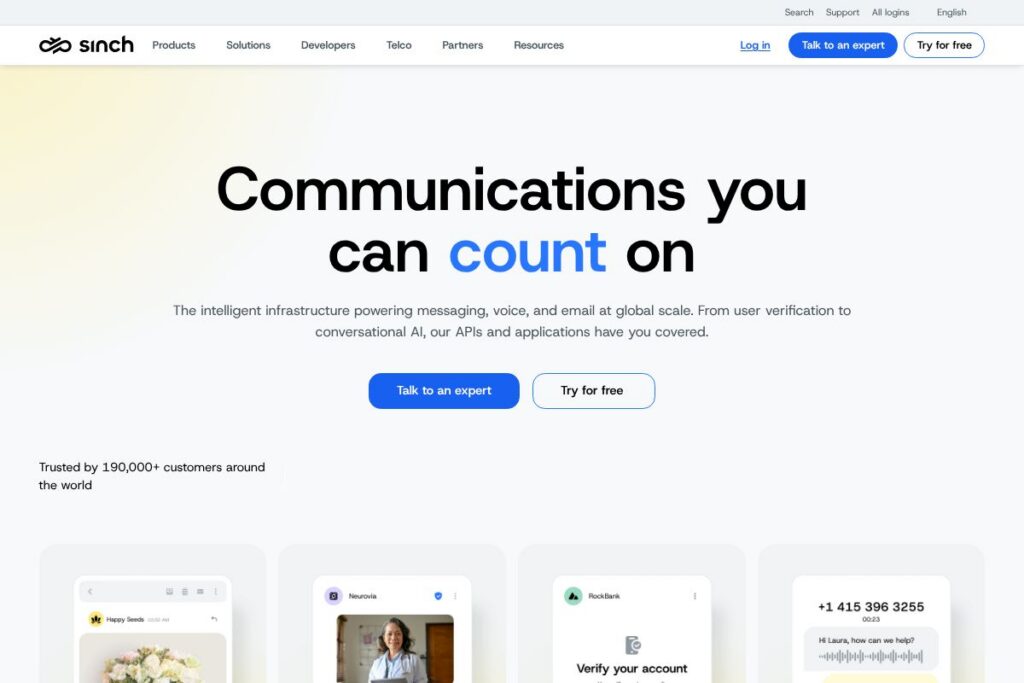
Sinch is a cloud communications provider offering programmable APIs for SMS messaging, voice, email, video, and verification. The platform combines developer-facing APIs and SDKs with a global connectivity layer called the Sinch Super Network, which provides direct operator connects and routing at scale. Sinch targets companies that need reliable global delivery, verification services, and richer messaging formats such as RCS for Business.
Compared with Twilio, Sinch emphasizes direct operator connectivity and global routing infrastructure to reduce intermediaries and improve delivery performance for high-volume messaging. Compared with Vonage (formerly Nexmo) and MessageBird, Sinch competes on carrier-grade reach and enterprise networking tools such as number provisioning and routing services. Each vendor has strengths: Twilio is often chosen for broad developer tooling and transparent per-message pricing; Sinch is selected where close carrier relationships and large-scale throughput are priorities.
All of this makes Sinch a strong option for enterprises and platform teams that need carrier-level reliability, multi-channel communications, and verification services. It is well suited to telecommunications providers, large retailers, fintech firms, and any organization that must deliver time-sensitive messages and authenticate users globally.
How Sinch Works
Sinch exposes REST APIs and SDKs for messaging, voice, email, video, and verification, plus webhook callbacks to report delivery and call events. Developers integrate with Sinch by creating service credentials, sending API requests for messages or calls, and receiving event notifications for delivery, status changes, or verification flows.
Underpinning those APIs is the Sinch Super Network, a global infrastructure with hundreds of direct operator connections that handles number provisioning, routing, and traffic normalization. For voice, Sinch offers Elastic SIP Trunking and programmable voice endpoints; for messaging, it supports SMS, MMS, RCS, and short codes; and for verification it provides phone number lookups and one-time passcode delivery. Typical workflows include automated OTP verification, transactional notifications, marketing campaigns with RCS-rich content, and voice call routing with IVR and recording.
Sinch features
Sinch groups its capabilities around programmable communications, applications for marketers and support teams, and network-level products for operators and carriers. Recent emphasis includes Sinch AI capabilities for fraud reduction and enhanced conversational routing, plus expanded RCS for Business support for richer messaging.
SMS Messaging API
The SMS API supports high-volume global text delivery with features for concatenation, delivery receipts, sender ID management, and carrier-aware routing. It is designed for transactional alerts, OTPs, and bulk notifications with programmatic control over throughput and throughput profiles for regulatory compliance.
Voice and Elastic SIP Trunking
Programmable voice APIs and Elastic SIP Trunking enable outbound and inbound call handling, conferencing, IVR flows, and call recording. Developers can provision numbers, route calls by geographic rules, and use webhooks to react to call events in real time.
Email API
The Email API provides transactional and programmatic email sending with delivery analytics, suppression lists, and templates. It integrates with messaging workflows so teams can combine SMS, voice, and email for multi-channel campaigns and confirmations.
Video SDKs and APIs
Sinch offers real-time video SDKs for web and mobile platforms that support peer-to-peer and multiparty sessions, session recording, and connectivity monitoring. The APIs are intended for in-app video support, telehealth, and customer support scenarios where low-latency media matters.
Verification APIs
Verification tools include phone number intelligence, carrier lookup, and one-time passcode delivery across SMS and voice channels. These APIs are built to reduce fraud, improve onboarding conversion rates, and meet compliance requirements for user identity verification.
RCS for Business
RCS support enables branded, verified, visually rich messages delivered into native messaging apps that look and behave like mini-app experiences. RCS is useful for brand messaging, interactive flows, and richer media engagement where supported by carriers and handsets.
Sinch Super Network
The Super Network is Sinch’s carrier-focused connectivity layer with hundreds of direct operator connects, large active number pools, and high-volume routing capacity. It aims to improve message delivery, reduce intermediaries, and offer one place to manage global routing and number provisioning.
Sinch AI
Sinch AI is applied across the stack to detect and reduce fraud, automate conversational routing, and assist with message personalization and response suggestions. AI features help reduce manual work in fraud detection and conversational automation while integrating into verification and messaging flows.
With these capabilities, Sinch provides a complete communications stack for teams that need to combine programmable APIs with network-grade routing, verification, and richer messaging formats to improve delivery and user experience.
Sinch pricing
Sinch uses custom and usage-based pricing models for most of its services, reflecting enterprise-grade connectivity, number provisioning, and per-message or per-minute fees. Pricing will vary by channel, geographic destination, volume, and whether you require dedicated routing, short codes, or operator-level connectivity.
Enterprise and volume pricing
Enterprise – Custom pricing (Volume discounts, direct operator rates, dedicated routing and SLAs). For tailored quotes and details on volume commitments, consult Sinch’s sales team and commercial documentation via the Sinch contact page.
For developer testing and smaller projects, Sinch provides accounts and usage tiers accessible through its developer portal; for production deployments where regulatory or carrier relationships matter, Sinch typically provides negotiated, account-specific rates. View the Sinch developer documentation for details on API usage and route options.
Sinch Use Cases
Sinch is commonly used for authentication and fraud reduction via verification APIs that deliver OTPs and perform phone number intelligence checks. Financial services, marketplaces, and apps with high-security requirements use these features to reduce account takeover and meet KYC needs.
Customer messaging is another major use case, including transactional alerts, appointment reminders, delivery updates, and marketing campaigns using SMS, email, and RCS where available. Telecommunications companies and platform businesses use Sinch’s Super Network and number provisioning tools to manage large fleets of phone numbers and complex routing requirements.
Pros and Cons of Sinch
Pros
- Carrier-grade global reach: Direct operator connections and a network layer that improves delivery and reduces intermediary hops, which helps with reliability and scale.
- Comprehensive multi-channel stack: APIs for SMS, voice, email, video, and verification let teams build multi-channel user journeys from a single provider.
- RCS and rich messaging support: Enables branded, app-like messaging experiences in compatible carriers and handsets, useful for marketing and engagement.
- Developer tooling and SDKs: REST APIs, mobile SDKs, and webhook-driven event handling make it straightforward to integrate into web and mobile applications.
Cons
- Enterprise-oriented pricing and onboarding: Custom pricing and operator relationships mean smaller teams may face a more involved procurement process compared with some competitors that publish simple per-message rates.
- Regional variation in feature availability: Features like RCS and direct operator routes depend on local carrier support, so capabilities can vary significantly by country and operator.
- Learning curve for advanced networking features: Number provisioning, operator routing, and SIP trunk configuration can require telecom knowledge to optimize and troubleshoot effectively.
Can You Test Sinch Before Buying?
Sinch provides developer accounts and sandbox/test credits to validate APIs and workflows before committing to production. These developer resources let teams send test messages, try voice and video SDKs, and exercise verification flows; for production or enterprise-level deployments you can contact Sinch sales for volume pricing and account setup via the Sinch contact page.
Sinch API and Integrations
Sinch provides a developer-focused REST API surface and SDKs for common platforms; the Sinch developer documentation covers endpoints, SDKs, and webhook usage. The APIs include messaging, voice, email, video, verification endpoints, and guidance for provisioning phone numbers and setting routing rules.
Integrations typically include CRM and marketing platforms through connectors and webhooks; common patterns pair Sinch with customer support and engagement systems to deliver notifications, automate verification, and route voice interactions into contact center platforms. For custom integrations, teams use the APIs and SDKs to build direct connections to systems such as customer databases and billing platforms.
10 Sinch alternatives
Paid alternatives to Sinch
- Twilio — Broad developer APIs for SMS, voice, email, and verification with transparent per-message and per-minute pricing and extensive documentation.
- Vonage — Voice and messaging APIs with programmable voice, number services, and communication APIs for global reach.
- MessageBird — Communications platform with a focus on omni-channel messaging and a unified API for SMS, voice, and chat channels.
- Infobip — Global cloud communications platform offering messaging, voice, email, and verification with strong enterprise routing capabilities.
- Plivo — Programmable voice and SMS APIs with a focus on cost-effective global messaging and voice services.
- Bandwidth — API-first communications provider with direct-to-carrier voice and messaging services and number management.
Open source alternatives to Sinch
- Jasmin SMS Gateway — An open source SMS gateway written in Python that supports SMPP clients and is used for self-hosted SMS routing.
- Kannel — Lightweight open source WAP and SMS gateway commonly used for on-premise SMS delivery and SMPP interconnects.
- Gammu — A command-line suite and library for SMS gateway functionality and phone modem management, useful for low-volume self-hosted setups.
Frequently asked questions about Sinch
What is Sinch used for?
Sinch is used for programmable messaging, voice, video, email, and verification. Businesses use Sinch to send transactional notifications, perform phone verification, run marketing campaigns, and power in-app communications.
Does Sinch have an API?
Yes, Sinch provides REST APIs and SDKs for messaging, voice, email, video, and verification. The Sinch developer documentation contains API references, SDK guides, and code samples.
How does Sinch pricing work?
Sinch uses usage-based and enterprise pricing models tailored to volume and features. Pricing varies by channel, destination, and required network services, so businesses typically request a custom quote via the Sinch contact page.
Can Sinch handle global messaging volume?
Yes, Sinch is built for high-volume global messaging and voice delivery. The Sinch Super Network and direct operator connections are intended to support large-scale campaigns and carrier-grade throughput.
Does Sinch support RCS for Business?
Yes, Sinch supports RCS for Business for rich, branded messaging where carrier and handset support exists. RCS lets teams send verified, interactive messages that behave more like app experiences inside messaging apps.
Final Verdict: Sinch
Sinch stands out as a communications platform that combines programmable APIs with a carrier-centric network layer, making it well suited to enterprises that need reliable global routing, number provisioning, and verification. Its strengths are operator connectivity, multi-channel coverage, and features such as RCS and AI-assisted fraud detection.
Compared with Twilio, which often appeals to teams that want transparent per-message pricing and a large ecosystem of plug-and-play integrations, Sinch is more focused on direct carrier relationships and enterprise routing. That focus can deliver better performance and compliance for very high-volume use cases, though procurement and onboarding may be more involved for smaller teams. For organizations that need carrier-grade delivery and comprehensive verification capabilities, Sinch is a compelling option; for smaller developer-first projects, competitors with published pricing may be an easier starting point.