Sleekplan: An Overview
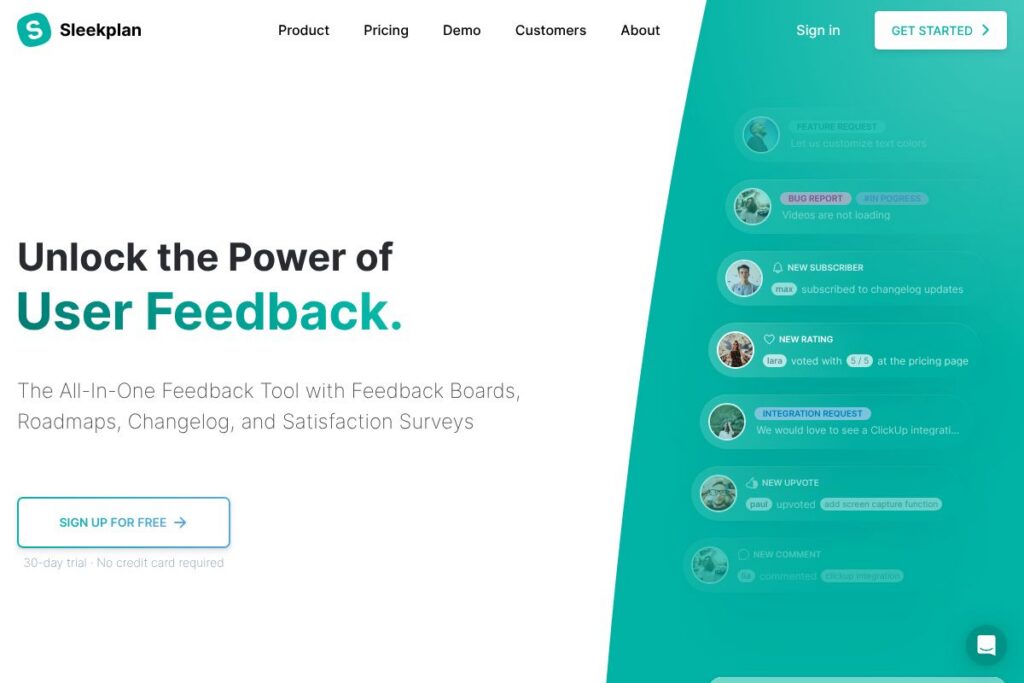
Sleekplan centralizes user feedback for web apps and websites into a single system that captures requests, enables voting and discussion, and ties items to roadmaps and changelogs. It is designed for product teams, customer success groups, and engineering teams that want a single source of truth for incoming feature ideas and customer sentiment.
Compared with competitors, Sleekplan occupies the product feedback board niche like Canny and Productboard, while also bundling a lightweight changelog and satisfaction survey features more commonly found in support platforms such as UserVoice and communication suites like Intercom. Compared to Canny, Sleekplan emphasizes an embeddable widget and a compact admin experience; compared to Productboard, it focuses less on deep product analytics and more on lightweight triage and customer-facing transparency.
Sleekplan works well for small to mid-size SaaS teams and digital product teams that need an integrated feedback loop without maintaining separate tools for voting, roadmaps, and release notes. Its combination of a public feedback board, private internal comments, and a changelog makes it a practical choice for teams that want to collect, discuss, and communicate product decisions in one place.
How Sleekplan Works
Feedback is captured through an embeddable widget or standalone board where users can submit ideas, vote, and comment. Submissions can be moderated, merged, or tagged by admins to reduce noise and group related requests.
On the administrative side, teams can triage items, add internal comments, and move accepted requests onto a shared roadmap. When features ship, teams publish entries to a changelog so users see the progression from suggestion to delivery.
Workflows commonly connect Sleekplan with third-party tools so feedback flows into issue trackers or chat channels. For example, teams often forward high-priority requests to GitHub or Jira, and use Slack or email notifications to keep stakeholders informed.
Sleekplan features
Sleekplan groups product feedback collection, prioritization, and communication into a compact set of capabilities that reduce the number of separate tools needed to run a feedback loop. Core elements include a voting board, roadmaps, a changelog, satisfaction surveys, and embeddable widgets, plus integrations and API access for automation.
Let’s talk Sleekplan’s Features
Feedback Board
The public feedback board lets users post ideas, vote, and comment, while admins can moderate posts, merge duplicates, add internal tags, and submit votes on behalf of customers. This keeps community input visible and helps teams surface the most requested improvements.
Roadmaps
Roadmaps provide a simple way to group prioritized items and share planned work with customers and stakeholders, keeping the status of initiatives visible and reducing ad hoc status questions. Roadmap entries can be public or limited to specific user segments to control visibility.
Changelog
The changelog documents shipped features and fixes in a user-facing timeline so customers see what has been released and when; entries can be linked back to the originating feedback items for context. This closes the feedback loop and reduces support inquiries about release contents.
Satisfaction Surveys
Built-in satisfaction surveys let teams measure sentiment after releases or during support interactions, capturing NPS or custom metrics that inform prioritization and feature decisions. Survey results can be combined with feedback data to identify areas for improvement.
Embeddable Widget and Standalone Board
The embeddable widget enables users to send feedback without leaving the product, available as a popup, inline iframe, or standalone board, which helps increase submission rates while preserving the user experience. Widget configuration supports custom prompts and user attributes to enrich submissions.
Integrations and API
Sleekplan integrates with tools teams already use and provides an API for automation and custom workflows, allowing feedback to be routed to issue trackers, CRM systems, and chat platforms. Integrations commonly used include Slack, Zapier, Intercom, GitHub, and Jira, and the API documentation explains available endpoints for programmatic access.
With these capabilities, the biggest benefit is a single place to collect, prioritize, and communicate product work, which reduces context switching and ensures feedback is traceable from idea to release.
Sleekplan pricing
Sleekplan uses a subscription SaaS model with multiple plan tiers to match different team sizes and feature needs. Specific plan rates and tier details are published by the vendor and updated periodically, so team leaders should check the vendor site for the most current options.
For current pricing and plan comparisons, view the current pricing options on Sleekplan’s website. The vendor typically documents which features are included in free or paid tiers and whether annual billing provides discounts.
What is Sleekplan Used For?
Sleekplan is used to capture customer ideas and bug reports, prioritize those items through voting and internal triage, and publish roadmaps and changelogs that keep customers informed. It reduces the manual work of collecting feedback from emails and support tickets by providing a central place for discovery and discussion.
Teams use Sleekplan to validate product concepts, test interest in potential features, and back product decisions with visible customer input. Support teams use it to gather context for recurring requests, and product teams use it to build a prioritized backlog that reflects real customer demand.
Pros and Cons of Sleekplan
Pros
- Unified feedback loop: Centralizes collection, voting, roadmapping, and changelog publishing so teams do not need separate tools for each step. This reduces tool fragmentation and preserves context across the product lifecycle.
- Embeddable widget: The widget captures feedback inside the product which increases submission rates and lowers friction for end users. Multiple display modes let teams choose inline, popup, or standalone board experiences.
- Lightweight admin controls: Moderation, merging, internal comments, and tagging help keep boards clean and actionable, which makes triage faster for small teams without heavy process overhead.
Cons
- Limited advanced analytics: For teams that need deep product analytics and feature-adoption metrics, Sleekplan focuses on feedback workflows rather than in-depth usage analytics, so you may need a separate analytics tool.
- Feature depth versus specialized platforms: While Sleekplan bundles roadmap and changelog features, specialized roadmap or roadmap analytics platforms may offer more advanced prioritization frameworks and integrations.
Does Sleekplan Offer a Free Trial?
Sleekplan offers a free plan and trial options for paid plans. The free plan covers basic feedback collection and a public board, while trial options allow evaluation of higher-tier features such as private boards, additional integrations, or expanded admin controls. For exact feature limits and trial duration, check Sleekplan’s subscription details on the pricing overview.
Sleekplan API and Integrations
Sleekplan provides API access and a set of integrations to connect feedback into existing workflows. The API documentation describes authentication, endpoints for managing posts and users, and webhooks for event-driven workflows.
Key integrations include Slack, Zapier, Intercom, GitHub, and Jira, which let you forward feedback into issue trackers, notify teams in chat, or automate ticket creation. Teams commonly use Zapier to connect Sleekplan to many other SaaS tools without custom development.
10 Sleekplan alternatives
Paid alternatives to Sleekplan
- Canny — A focused feedback board with voting, roadmaps, and changelogs aimed at product teams that need a mature, user-facing feature request workflow.
- Productboard — A product management platform that combines user feedback with product prioritization and feature-scoring for more data-driven roadmap planning.
- UserVoice — A long-standing feedback management system that emphasizes enterprise-grade customer feedback, ticketing, and support workflows.
- Upvoty — A simple feature voting board with embeddable widgets and basic roadmapping, targeted at smaller teams and startups.
- Nolt — A lightweight, affordable feedback board for public-facing voting and suggestions with a simple admin interface.
- Intercom — While primarily a messaging platform, Intercom includes product tours, surveys, and feedback capture that integrate with support workflows.
- Helprace — Combines feedback boards with helpdesk functionality and a knowledge base for teams that want feedback and support in one place.
Open source alternatives to Sleekplan
- Fider — An open-source feedback board you can self-host, providing idea submission, voting, and comment threads for teams that prefer control over hosting.
- Erxes — An open-source customer experience platform with modules for feedback, product management, and communication, suitable for teams able to self-host and customize.
- OpenProject — Primarily a project management suite with roadmap and issue-tracking capabilities that can be adapted for capturing and managing feedback in self-hosted environments.
Frequently asked questions about Sleekplan
What is Sleekplan used for?
Sleekplan is used to collect and manage user feedback for web applications and websites. Teams use it to capture ideas, run voting boards, publish roadmaps, and keep a changelog linked to customer requests.
Does Sleekplan integrate with Slack and Jira?
Yes, Sleekplan integrates with Slack and Jira among other tools. Integrations and automation options let teams forward feedback into issue trackers and notify channels about new or updated posts.
Can Sleekplan be embedded into my web application?
Yes, Sleekplan provides an embeddable widget and standalone iframe options. The widget supports popup and inline modes so users can submit feedback without leaving the application.
Is there an API for Sleekplan?
Yes, Sleekplan offers an API and webhooks for automation. The API documentation covers endpoints for posts, users, and event subscriptions.
How does Sleekplan handle private versus public feedback?
Sleekplan supports both public boards and private submissions with admin-only visibility. Teams can moderate posts, create internal comments, and restrict visibility to control what is shared publicly.
Final verdict: Sleekplan
Sleekplan is a compact, focused tool that brings feedback collection, voting, roadmaps, and changelogs into a single workflow that is easy to embed into web products. It does particularly well at closing the feedback loop by connecting user suggestions to public roadmaps and release notes while keeping admin controls lightweight.
Compared with Canny, Sleekplan offers similar feedback and changelog capabilities but positions itself as a lighter-weight and more integrated widget-first option for smaller product teams. In terms of pricing, Sleekplan typically presents accessible entry-level options and trial access so teams can evaluate the integrated feature set, while Canny often targets organizations willing to pay for more advanced segmentation and enterprise features.
Overall, Sleekplan is a practical choice when you want one tool to capture user ideas, prioritize work visibly, and communicate releases without building a custom feedback pipeline. For teams that need deeper analytics or extensive enterprise feature sets, pairing Sleekplan with analytics or a dedicated product management platform may be necessary.