What is Socket.IO
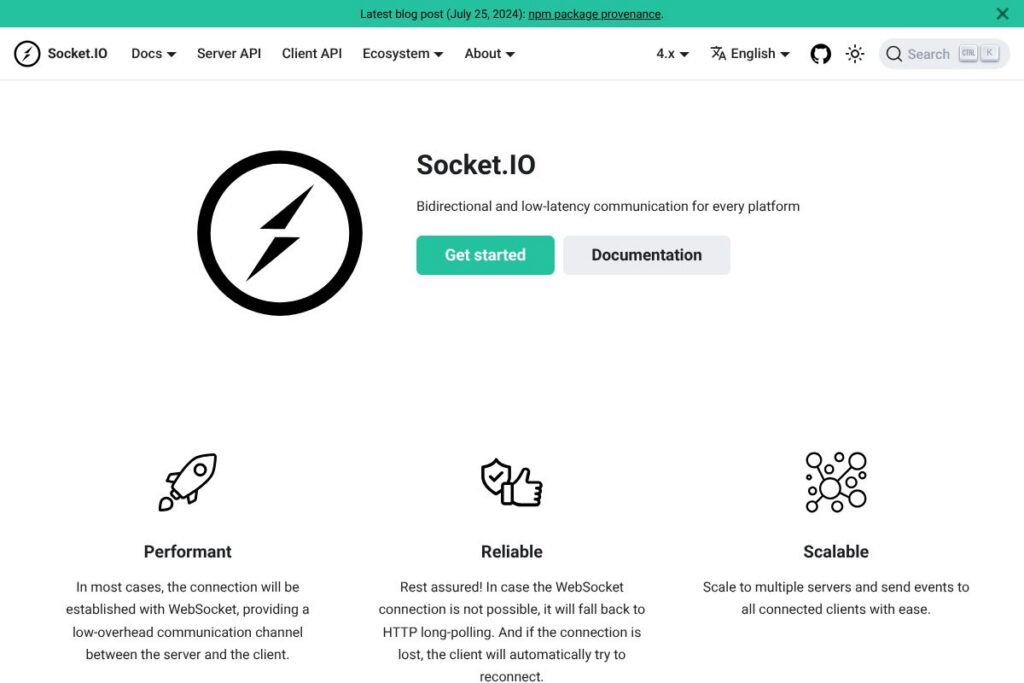
Socket.IO is a JavaScript library for real-time, bidirectional communication between clients and servers. It exposes an event-driven API on top of WebSocket and HTTP transports, handling connection setup, reconnection, and fallbacks so developers can focus on application logic rather than transport details.
Compared with Pusher, which is a managed realtime messaging service, Socket.IO is a self-hosted library that gives you full control of the server and message flow. Against Ably, which provides a global managed pub/sub network and features like message persistence and guaranteed delivery, Socket.IO trades those managed guarantees for lightweight control and lower infrastructure dependence.
All of this makes Socket.IO particularly well suited for web apps and services that need fine-grained, low-latency event delivery and custom server logic. It is a strong choice for development teams building chat systems, collaborative editors, live dashboards, and multiplayer interactions where control over the server runtime and protocol details matters.
How Socket.IO Works
Socket.IO establishes a client-server connection that negotiates the best available transport, usually WebSocket, then provides an event-based layer for sending and receiving messages. The client library connects to a server endpoint and both sides emit and listen for named events, carrying JSON or binary payloads as needed.
If a direct WebSocket connection cannot be established, Socket.IO automatically falls back to HTTP long-polling, and the client will attempt transparent reconnection when connectivity is lost. For multi-server deployments, the server can forward events across nodes using adapters such as the Redis adapter so emitted events reach all relevant clients.
A common workflow starts with a Node.js server that mounts Socket.IO on an existing HTTP server, registers event handlers for connection lifecycle and custom events, and uses namespaces and rooms to segment traffic for channels, private conversations, or game lobbies. On the client side, the library is used in browsers, Node-based clients, and native runtimes to connect and react to server events in real time.
Socket.IO features
Socket.IO is built around reliable, low-latency event delivery with broad platform support and server-side tooling for scaling and authentication. Core capabilities include WebSocket-first transports with long-polling fallback, automatic reconnection, namespaces and rooms for logical channeling, binary support, adapters for horizontal scaling, and middleware hooks for authorization and logging. Recent releases have focused on performance optimizations and modernizing protocol handling.
Real-time event API
The library provides a simple event-driven API for emitting and receiving named events on both client and server. This model maps naturally to application concepts like messages, presence updates, and remote commands, reducing boilerplate compared with raw socket handling.
Transport negotiation and fallback
Connections attempt to use WebSocket whenever possible to minimize overhead, and will fall back to HTTP long-polling when WebSocket is unavailable. That fallback behavior improves reliability across restrictive networks and older browsers.
Automatic reconnection and heartbeat
Clients automatically try to reconnect after network interruptions and use heartbeat messages to detect stale connections. This reduces the need for manual reconnection logic and keeps application state synchronized when connectivity is intermittent.
Namespaces and rooms
Namespaces allow logical separation of communication channels on the same server endpoint, and rooms provide lightweight grouping for broadcasting to subsets of connected clients. Together they enable organizing traffic for features such as topic channels, private rooms, and game lobbies.
Binary support and compression
Socket.IO supports sending binary payloads in addition to JSON, which is useful for file transfers, media streams, and compact binary protocols. Optional compression can reduce bandwidth for large or repetitive payloads.
Scaling adapters (Redis, etc.)
For multi-process or multi-server setups, adapters forward events between nodes so broadcasts and room membership work across the cluster. The Redis adapter is commonly used to synchronize state and route events between instances.
Middleware and authentication hooks
Server-side middleware lets you run authentication, rate limiting, and logging before a socket joins a namespace or room. This integrates with existing session stores or token-based auth systems for access control.
With these features, Socket.IO gives developers a pragmatic toolkit for building real-time apps that need both control over the runtime and robust behavior across networks and server topologies.
Socket.IO pricing
Socket.IO is free to use as an open-source library under the MIT license; there are no mandatory subscription fees to include it in projects. You can host and run Socket.IO on your own infrastructure with no licensing costs.
If you need documentation, deployment examples, or the source code, consult the official Socket.IO resources such as the Socket.IO documentation and the Socket.IO GitHub repository for installation steps and examples. For managed or hosted realtime services that provide additional SLAs and global delivery, consider paid alternatives listed below.
What is Socket.IO Used For?
Socket.IO is commonly used to add live features to web applications such as chat messaging, collaborative editing, real-time analytics dashboards, multiplayer game state synchronization, presence indicators, and live notifications. Its event model simplifies mapping application actions to network messages and vice versa.
Teams building single-page apps, progressive web apps, or native clients that require immediate feedback and low-latency interactions gravitate toward Socket.IO when they want direct control over server behavior and message routing. It is also useful in architectures where integrating with existing Node.js servers and middleware is important.
Pros and cons of Socket.IO
Pros
- Reliable transport fallback: Socket.IO automatically falls back to HTTP long-polling when WebSocket is unavailable, which improves connectivity across varied networks.
- Event-driven API: The named event model simplifies application logic and reduces boilerplate compared with working directly with raw sockets.
- Flexible scaling via adapters: Adapters such as the Redis adapter let you scale broadcasts and room membership across multiple servers with minimal change to application code.
- Cross-platform client support: Official and community client libraries exist for browsers, Node.js, and several native platforms, enabling consistent behavior across clients.
Cons
- Requires server hosting and operation: Unlike managed realtime services, you must provision, operate, and scale your Socket.IO servers and supporting infrastructure.
- Not a managed global network: Socket.IO does not provide out-of-the-box global message routing, persistence guarantees, or multi-region failover that commercial realtime platforms include.
- Protocol differences from raw WebSocket: Socket.IO adds a protocol layer on top of WebSocket, which means raw WebSocket clients are not directly interchangeable without using the Socket.IO client libraries.
Does Socket.IO Offer a Free Trial?
Socket.IO is free and open-source. There is no trial required to use the library; you can install it via package managers and run it locally or on your servers. See the installation guide in the official documentation for setup instructions.
Socket.IO API and Integrations
Socket.IO provides well-documented server and client APIs for JavaScript environments and several unofficial client implementations for native platforms. The Socket.IO documentation includes API references for server-side setup, client usage, middleware, and adapters.
Common integrations include mounting Socket.IO on existing Node.js HTTP servers or framework routers such as Express and Fastify, and using adapters like the Redis adapter guide to synchronize state across instances. Community connectors and wrappers exist for other ecosystems when needed.
10 Socket.IO alternatives
Paid alternatives to Socket.IO
- Pusher – A hosted realtime messaging service with simple SDKs and managed channels that removes the need to operate servers for realtime features.
- Ably – A global realtime pub/sub platform with message persistence, delivery guarantees, and client libraries for many platforms.
- PubNub – A realtime data stream network offering presence, history, and stream controller features for building live apps.
- Firebase Realtime Database – A managed cloud database with built-in realtime synchronization for data-driven use cases across clients.
- Supabase Realtime – A hosted realtime service built on Postgres WAL replication that streams database changes to clients.
- AWS AppSync – Managed GraphQL service with subscriptions for realtime updates integrated into the AWS ecosystem.
Open source alternatives to Socket.IO
- uWebSockets.js – A high-performance WebSocket server library for Node.js focusing on throughput and low overhead.
- SignalR – A Microsoft open-source library for ASP.NET that provides real-time web functionality with automatic reconnect and group management.
- SocketCluster – A scalable real-time framework with built-in clustering and pub/sub semantics for Node.js.
- Faye – A publish-subscribe messaging system for web applications with client and server libraries for JavaScript and Ruby.
- ActionCable – Rails built-in real-time framework providing WebSocket support and server-side channel abstractions for Ruby on Rails apps.
Frequently asked questions about Socket.IO
What platforms does Socket.IO support?
Socket.IO supports browsers and Node.js out of the box. Official client libraries target JavaScript environments and community clients extend support to native runtimes and other platforms.
Does Socket.IO require WebSocket to work?
No, Socket.IO does not require WebSocket specifically. It attempts WebSocket first but falls back to HTTP long-polling when WebSocket is unavailable, ensuring broader compatibility.
Can Socket.IO scale across multiple servers?
Yes, Socket.IO can scale across servers using adapters. The Redis adapter is commonly used to synchronize events and room membership between instances in clustered or multi-process deployments.
Is Socket.IO free to use in commercial projects?
Yes, Socket.IO is released under the MIT license. You can use, modify, and distribute the library in commercial applications without license fees.
How do I secure Socket.IO connections?
Socket.IO supports authentication and middleware for access control. Common approaches include using token-based authentication during the handshake, integrating with session stores, and applying server-side middleware to validate and authorize socket connections.
Final verdict: Socket.IO
Socket.IO stands out as a practical, developer-friendly library for building real-time, event-driven features with fine-grained control over server behavior. Its automatic transport negotiation, reconnection logic, namespaces, rooms, and adapter ecosystem make it a strong option when you want to self-host realtime functionality and integrate tightly with Node.js stacks.
Compared with managed platforms such as Pusher that charge for hosted delivery and provide SLAs, Socket.IO is free to use and gives you more control but requires that you manage scaling and reliability yourself. For teams that prefer a managed service, Ably or PubNub provide hosted guarantees; for teams that want control and light-weight integration in Node.js, Socket.IO remains a compelling choice.