STARLIMS: An Overview
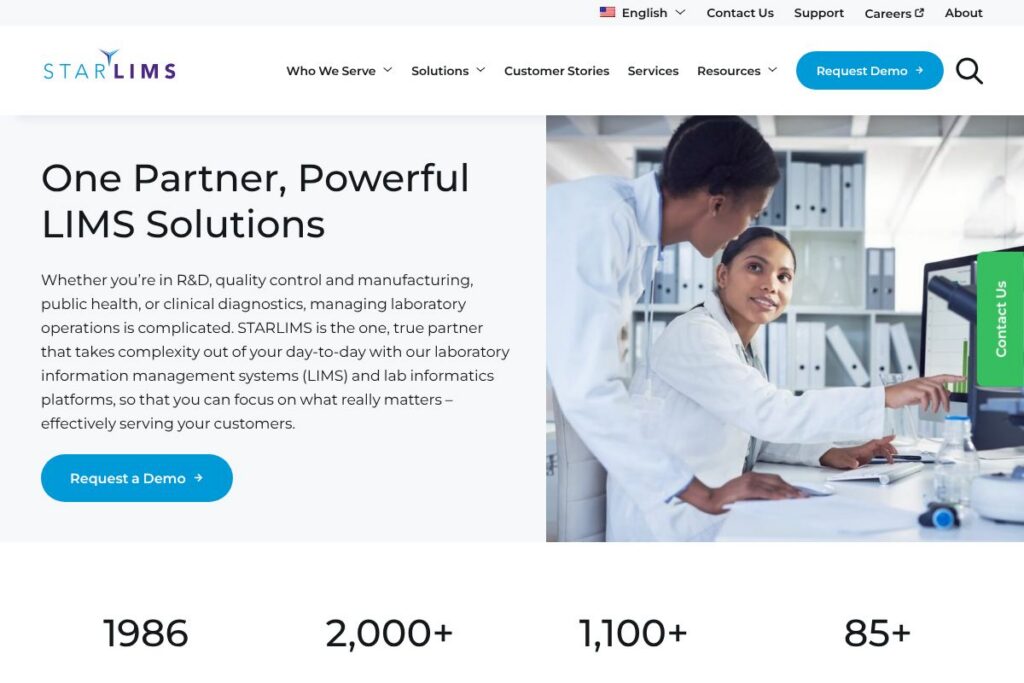
STARLIMS is a comprehensive laboratory informatics platform centered on LIMS capabilities, with complementary modules for electronic lab notebook (ELN), laboratory execution systems (LES), scientific data management (SDMS), and advanced analytics. The suite is used across clinical labs, public health laboratories, contract research organizations, and R&D groups to centralize sample and test workflows, preserve data integrity, and support compliance requirements.
Compared with other enterprise LIMS vendors, STARLIMS positions itself as an integrated platform with broad functionality beyond core LIMS. Compared to LabWare, which is widely known for deep configurability and an established install base, STARLIMS emphasizes end-to-end integration with SDMS and ELN modules. Against Thermo Fisher SampleManager LIMS, STARLIMS offers a comparable enterprise-grade LIMS experience while focusing on packaged integrations for clinical and public health workflows. Compared to LabVantage, STARLIMS aims to bundle analytics and document management tightly with sample management to reduce the number of separate systems to manage.
All of this makes STARLIMS well suited to laboratories that require regulated operations, instrument connectivity, and a single platform that covers both routine testing and research workflows. Organizations that want a single vendor for LIMS plus ELN and advanced analytics will find the platform particularly relevant.
How STARLIMS Works
STARLIMS implements a central data model that traces samples through collection, processing, testing, and reporting, while capturing metadata and audit trails at each step. Users interact with configurable workflows that map to lab processes, and the platform enforces role-based access, electronic signatures, and validation artifacts required for regulated environments.
Instrument connectivity and middleware components automate data capture from laboratory instruments, reducing manual transcription. STARLIMS integrates with document storage and SDMS to associate raw files and analytical outputs with sample records, and it exposes APIs and integration points for ERP, HIS, and external reporting systems to complete downstream workflows.
In typical deployments, labs onboard STARLIMS by defining core sample types and tests, connecting critical instruments, and migrating reference data. Once live, the platform is used for daily sample intake, test assignment via LES or worklists, result entry or automated result import, and final report generation that feeds into clinical or public health reporting pipelines.
STARLIMS features
STARLIMS groups laboratory capabilities into a unified platform that covers sample lifecycle, experiment documentation, execution, document management, and analytics. Recent platform emphasis includes cloud deployment options, expanded integrations, and improved analytics dashboards to support operational decisions.
Core LIMS
The core LIMS provides sample tracking, test management, worklist generation, and result management across the sample lifecycle. It enforces chain of custody, records lineage for aliquots and batches, and supports configurable workflows for different testing types to reduce variability in routine processing.
Electronic Lab Notebook (ELN)
The ELN module captures structured experimental data, protocol steps, and attachments while preserving timestamps and author metadata. It helps multidisciplinary teams consolidate research records and link experiments to sample and inventory entries in the LIMS for traceable R&D output.
Laboratory Execution System (LES)
LES delivers step-by-step work instructions, configurable SOPs, and interactive task assignment for technicians. It helps standardize manual procedures, integrates with instruments to reduce manual entry, and records execution details required for audits and troubleshooting.
Scientific Data Management System (SDMS)
SDMS centralizes storage of instrument output, chromatograms, images, and other scientific files while associating them with sample and test records. This simplifies retrieval for review, archival, and regulatory inspection, and reduces the need for ad hoc file servers.
Advanced Analytics and Reporting
Built-in analytics provide dashboards for throughput, turnaround time, quality control, and trending analysis to support operational and quality decisions. Reporting tools generate regulatory reports, custom exports, and data extracts for downstream systems or public health reporting.
Instrument Integration and Connectivity
STARLIMS supports instrument interfacing through standard laboratory protocols and middleware, enabling automatic result capture and status updates. That connectivity reduces transcription errors and speeds result availability for downstream review and reporting.
Data Integrity and Compliance
The platform includes audit trails, electronic signature support, configurable retention, and validation frameworks to help meet requirements such as GxP and ISO 17025. Those capabilities are designed to help labs demonstrate traceability and meet inspection expectations.
Deployment Models and Security
STARLIMS can be deployed on-premises or hosted in cloud environments, with security controls like role-based access, encryption, and network segmentation. Deployment choice allows labs to balance control, scalability, and internal IT policies.
With these capabilities, STARLIMS brings together sample management, execution, document control, and analytics in a single platform to reduce handoffs between systems and keep laboratory data connected and auditable.
STARLIMS pricing
STARLIMS uses an enterprise licensing and subscription model with pricing tailored to deployment type, module selection, user count, and required support levels. Pricing is not published as fixed tiers on a public pricing page; instead, license and subscription costs are determined during procurement based on scope and implementation needs.
For specific licensing options and to discuss deployment scenarios, contact the vendor via the STARLIMS product overview and contact pages to request a customized quote or a scope of work for evaluation and implementation.
What is STARLIMS Used For?
STARLIMS is used for sample and test management in regulated and high-volume laboratory environments where traceability, auditability, and controlled workflows are necessary. Common uses include clinical testing laboratories managing patient samples, public health labs handling surveillance workflows, and CROs tracking study samples and results.
Beyond routine testing, STARLIMS supports R&D and formulation labs by linking ELN content to sample records and inventory, enabling researchers to reproduce experiments and maintain IP records. The platform is also used for quality control workflows in manufacturing or environmental testing where instrument data and document control must be consolidated.
Pros and Cons of STARLIMS
Pros
- Comprehensive platform: STARLIMS bundles LIMS, ELN, LES, SDMS, and analytics which reduces the need for multiple disconnected tools and centralizes laboratory data management. This makes it easier to manage data lineage and reporting across workflows.
- Regulatory and compliance support: The system includes audit trails, electronic signature capability, and validation support that align with regulatory requirements common to clinical and public health laboratories. These features help labs prepare for inspections and maintain compliant records.
- Instrument connectivity and automation: STARLIMS integrates with instruments and middleware to automate result capture and reduce manual transcription, improving throughput and lowering error rates.
- Deployment flexibility: Availability of on-premises and cloud-hosted deployments gives organizations choice over infrastructure and data residency, which matters for regulated data and institutional policies.
Cons
- Enterprise procurement model: Licensing and implementation are tailored and typically require vendor engagement for pricing and deployment, which can increase lead time for evaluation compared with SaaS tools that offer self-serve plans.
- Implementation complexity: Comprehensive functionality and deep configurability can require significant implementation effort, workflow design, and validation resources for complex lab operations.
- Cost for smaller labs: The platform is primarily targeted at medium to large laboratories; smaller labs or single-site research groups may find the total cost of ownership higher than lighter-weight or cloud-native alternatives.
Does STARLIMS Offer a Free Trial?
STARLIMS offers enterprise licensing with evaluation and pilot options rather than a public free plan. Prospective customers can request demo environments and short-term evaluation pilots through STARLIMS’ contact and sales channels to validate fit, features, and integrations before committing to a full deployment.
STARLIMS API and Integrations
STARLIMS provides APIs and standard laboratory interfaces to connect instruments, middleware, and enterprise systems; integration options typically include RESTful APIs, HL7, and instrument protocol adapters. The vendor documents integration patterns and offers professional services to assist with complex integrations; see the STARLIMS integration resources for details.
Common integrations include instrument vendors, electronic health records, ERP systems, and third-party analytics or reporting platforms, enabling labs to embed STARLIMS into larger operational and IT ecosystems.
10 STARLIMS alternatives
Paid alternatives to STARLIMS
- LabWare — Enterprise LIMS known for deep configurability and a large global install base used across pharmaceuticals, clinical, and environmental labs. LabWare corporate site
- Thermo Fisher SampleManager LIMS — Enterprise platform that combines LIMS with scalable informatics and instrument integrations for regulated labs. Thermo Fisher LIMS offerings
- LabVantage — LIMS with configurable workflows and strong analytics aimed at life sciences and manufacturing labs. LabVantage solutions
- Benchling — Cloud-native R&D platform with ELN and sample tracking focused on biotech and research teams. Benchling platform
- PerkinElmer Signals — Integrated informatics for laboratory data management and analytics across scientific workflows. PerkinElmer informatics
- CloudLIMS — Cloud-first LIMS for smaller labs and biobanks with SaaS delivery and quick onboarding. CloudLIMS product page
- Core LIMS (QSol) — Commercial LIMS offering adaptable modules for clinical and environmental testing labs. Core LIMS overview
Open source alternatives to STARLIMS
- Bika LIMS — Open source LIMS targeted at clinical and research labs, providing sample tracking, instrument interfaces, and reporting. Bika LIMS project
- LabKey Server — Open source data management platform for biomedical research that supports specimen and assay data integration. LabKey Server community
- OpenELIS — Open source laboratory information system for public health and small clinical labs with specimen and result management features. OpenELIS project
Frequently asked questions about STARLIMS
What is STARLIMS used for?
STARLIMS is used for laboratory sample and data management across clinical, public health, and research settings. It centralizes LIMS workflows, links experimental records via ELN, and consolidates instrument files through an SDMS for traceable operations.
Does STARLIMS offer cloud deployment?
Yes, STARLIMS can be deployed in cloud-hosted environments as well as on-premises. Deployment choice depends on data residency, security requirements, and customer preference; discuss options with STARLIMS sales through their product overview.
How does STARLIMS handle instrument integration?
STARLIMS supports standard instrument interfaces and middleware integration to capture data automatically. Integrations commonly use RESTful APIs, HL7, and vendor-specific adapters to import results and files directly into sample records.
How much does STARLIMS cost?
STARLIMS uses custom enterprise pricing based on modules, users, and deployment model. To get an accurate estimate for your laboratory, request a tailored quote from STARLIMS via their contact page.
Can STARLIMS help with regulatory compliance?
Yes, STARLIMS includes features such as audit trails, electronic signatures, and validation support to assist with regulatory requirements. Those capabilities are designed to help laboratories meet standards like GxP and ISO 17025 and simplify inspection readiness.
Final verdict: STARLIMS
STARLIMS is a full-featured laboratory informatics platform that combines LIMS, ELN, LES, SDMS, and analytics into a single product suite, making it a suitable choice for medium to large laboratories that need integrated workflows and strict data governance. Its strengths include broad module coverage, instrument connectivity, and compliance-focused features that support regulated testing and reporting.
Compared with LabWare, STARLIMS offers a similarly enterprise-oriented approach with a focus on bundled capabilities such as ELN and SDMS. Both vendors use custom pricing models, so cost comparisons are made project by project; consult STARLIMS and LabWare directly to evaluate module costs and implementation scope. For labs seeking a one-vendor platform that links experimental records to sample management and analytics, STARLIMS is a strong candidate; for highly customized LIMS-only deployments, alternatives with heavier configuration ecosystems may be preferable.