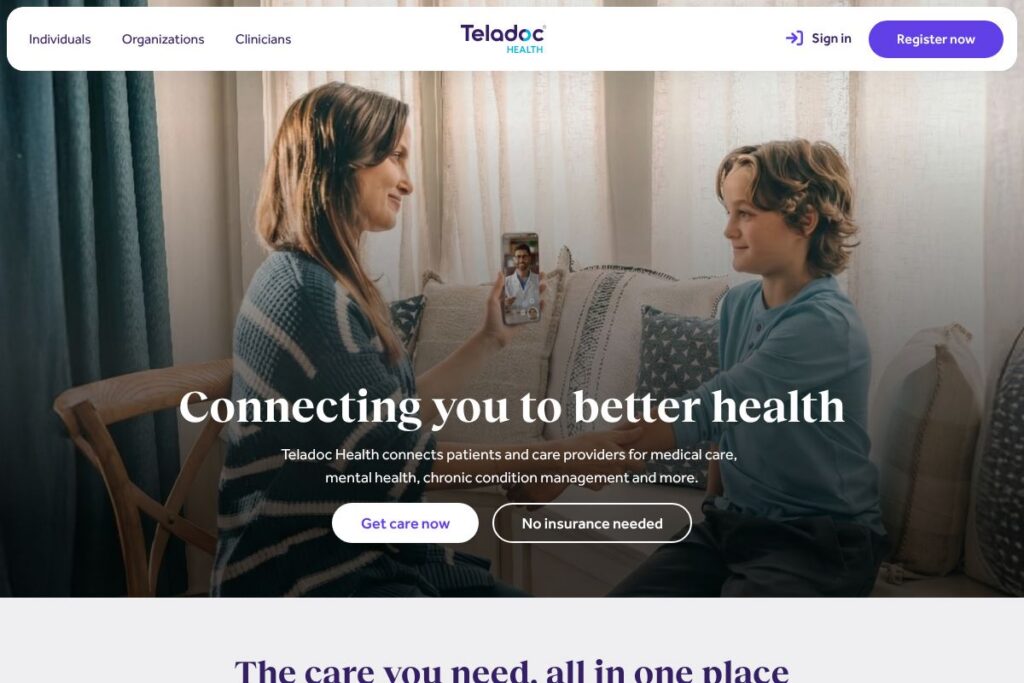
Teladoc Health: An Overview
Teladoc Health is a telehealth platform that connects patients with medical providers for on-demand care, scheduled primary care visits, mental health support, chronic condition management, and specialty consultations. The platform is used directly by patients and is also offered through health plans, employers, and health systems to provide a single virtual front door for a range of clinical services.
Compared with other virtual care providers such as Amwell, Doctor On Demand, and One Medical, Teladoc Health emphasizes enterprise and health-system integrations alongside consumer-facing services. Unlike some companies that focus primarily on direct-to-consumer urgent care, Teladoc Health combines employer and payer partnerships, hospital telehealth solutions, and a broad specialty network that is designed to scale for large populations.
All of this makes Teladoc Health particularly useful for organizations that need a consolidated telehealth partner and for individuals who want a single provider that covers urgent care, mental health, chronic disease programs, and specialist opinions in one platform.
How Teladoc Health Works
Users create an account via the mobile app or web portal, choose a service type, and connect with a clinician by video, phone, or chat depending on availability and the service selected. Visits can be on-demand for urgent issues, scheduled for primary care and mental health appointments, or coordinated as part of a chronic condition program that includes remote monitoring and coaching.
For employers and health systems, Teladoc Health integrates with benefits and clinical workflows to route patients to the right level of care and capture utilization data. Organizations typically configure which services are covered, how referrals are handled, and whether virtual visits are billed to insurance, an employer plan, or paid out of pocket. Learn more on the Teladoc Health homepage.
Teladoc Health features
Teladoc Health organizes care around a set of clinical services and platform capabilities that enable on-demand access, ongoing care programs, and integrations for enterprise customers. Core capabilities include virtual urgent care, primary care, licensed mental health clinicians, condition management programs, specialty consultations, and technology to connect devices and clinical records.
The platform includes several powerful capabilities worth highlighting:
Virtual urgent care
Virtual urgent care provides 24/7 access to clinicians for acute, non-emergency issues such as cold and flu symptoms, infections, or minor injuries. This feature shortens wait times, reduces unnecessary emergency visits, and can include prescriptions when clinically appropriate.
Primary care
Primary care services include routine checkups, preventative care, chronic disease follow-up, and medication management with board-certified providers. Patients can create longitudinal relationships with clinicians for continuity of care across virtual visits and in some markets blended in-person care.
Mental health services
A network of licensed therapists and psychiatrists supports treatment for anxiety, depression, stress, and other behavioral health needs. Services typically include therapy sessions, medication management, and referral pathways for higher levels of care when needed.
Condition management and remote monitoring
Programs for diabetes, hypertension, and weight management combine personalized coaching, connected devices, and data tracking to support long-term behavior change. Remote monitoring lets clinicians act on device data and intervene when a patient’s metrics fall outside target ranges.
Specialty consults
Specialist access lets patients and clinicians obtain second opinions, dermatology reviews, and expert case reviews without long referral wait times. These consults are useful for triage, diagnosis confirmation, and care planning when a local specialist is not readily available.
Enterprise and health system solutions
Teladoc Health offers technology and services designed to expand hospital capacity, unify patient experience across channels, and integrate with existing electronic health records. These solutions include clinical staffing support, care orchestration tools, and population health programs.
With these features, Teladoc Health aims to reduce barriers to care by delivering multiple clinical services through a single virtual platform, which helps employers, payers, and health systems manage utilization and improve access at scale.
Teladoc Health pricing
Teladoc Health uses a flexible pricing model that varies by customer type and deployment. Pricing is typically configured for employers, health plans, or health systems as part of a benefits or partnership agreement, while direct-to-consumer costs depend on insurance coverage and the specific service used.
For details on how services are billed and the options available for individuals and organizations, review Teladoc Health’s solutions and offerings or consult your employer or health plan for coverage specifics.
What is Teladoc Health Used For?
Teladoc Health is commonly used for urgent virtual visits, routine primary care, behavioral health therapy and psychiatry, chronic disease management programs, and specialty consultations. These use cases cover both episodic needs like colds or infections and longitudinal care such as diabetes management or mental health treatment.
Organizations use Teladoc Health to broaden access for employees or patients, reduce unnecessary emergency department visits, and extend care capacity without hiring equivalent onsite staff. Hospitals and health systems use the platform to offer telehealth-enabled follow-up care, remote monitoring, and specialist input across their networks.
Pros and Cons of Teladoc Health
Pros
- 24/7 access: Provides round-the-clock access to clinicians for urgent issues, which reduces time to care and supports employees and members outside normal business hours.
- Broad service mix: Combines primary care, mental health, chronic condition programs, and specialty consults into a single platform for smoother care coordination and fewer handoffs.
- Enterprise integrations: Offers tools and integrations that allow health systems and employers to embed virtual care into benefits and clinical workflows, improving utilization tracking and reporting.
- Remote monitoring support: Condition management programs include connected devices and coaching, which helps sustain long-term outcomes for chronic conditions.
Cons
- Variable out-of-pocket costs: Out-of-pocket cost for direct-to-consumer visits depends on employer benefits and insurance, which can be confusing for users who do not have clear coverage guidance.
- Limited in-person coverage: While Teladoc Health facilitates referrals, users requiring in-person diagnostics or procedures will need local care; virtual services cannot replace all hands-on care needs.
- Enterprise focus can complicate consumer pricing: The mix of employer, payer, and direct-to-consumer contracts means availability of specific services and pricing varies by user population.
Does Teladoc Health Offer a Free Trial?
Teladoc Health offers a paid service model with free account creation and select employer- or insurer-covered access. Many users access Teladoc Health through employer benefits or health plans that cover part or all of virtual visits, while others may pay per visit when using direct-to-consumer services; check your plan or the Teladoc Health homepage for specifics.
Teladoc Health API and Integrations
Teladoc Health provides integration options for health systems and enterprise customers and works with major EHRs and clinical workflows to exchange patient data and appointments. For details on available integration options and developer resources, review Teladoc Health’s solutions.
Integration capabilities typically include single sign-on, scheduling interfaces, EHR connectivity, and secure data transfer to support care coordination and reporting.
10 Teladoc Health alternatives
Paid alternatives to Teladoc Health
- Amwell — A broad telehealth platform offering urgent care, behavioral health, and telehealth infrastructure for health systems and payers, with separate enterprise and consumer offerings.
- Doctor On Demand — Focuses on urgent care and behavioral health with direct-to-consumer visits and employer partnerships for mental health and primary care services.
- One Medical — A membership-based primary care provider that combines virtual visits with in-person clinics and an emphasis on continuity of care.
- MDLive — Provides virtual urgent care, behavioral health, and dermatology services to consumers and enterprise customers with white-label options for partners.
- PlushCare — Direct-to-consumer primary care and urgent care with membership plans and prescription management, emphasizing quick access to clinicians.
- Babylon Health — Offers AI-assisted triage and telehealth services with an emphasis on digital-first consultations and symptom checking in some markets.
- Heal — Delivers both virtual visits and in-home primary care in select regions, focusing on convenience and continuity for primary care needs.
Open source alternatives to Teladoc Health
- OpenMRS — An open-source medical record system that can be adapted to support telehealth workflows when combined with video and communication tools.
- OpenEMR — A full-featured open-source electronic medical record and practice management system that organizations can extend to support telehealth scheduling and documentation.
- Jitsi — An open-source video conferencing platform that can be integrated into telehealth solutions to provide secure video visits when paired with clinical software.
- Rocket.Chat — An open-source messaging platform that can be adapted for secure patient-provider communication and telehealth workflows with proper healthcare compliance setup.
Frequently asked questions about Teladoc Health
What is Teladoc Health used for?
Teladoc Health is used for virtual medical visits, mental health care, chronic condition programs, and specialty consultations. Individuals and organizations use it to expand access to clinicians and to provide a unified virtual care experience across services.
Does Teladoc Health integrate with electronic health records?
Yes, Teladoc Health offers integrations for health systems and enterprise customers. Integration options include EHR connectivity, scheduling interfaces, and single sign-on to align virtual care with existing clinical workflows.
How does Teladoc Health pricing work?
Teladoc Health pricing is typically set through employer, payer, or health system agreements and can vary for direct-to-consumer visits. Coverage and out-of-pocket costs depend on the user’s benefits plan and the specific service accessed.
Can Teladoc Health be used for mental health treatment?
Yes, Teladoc Health provides therapy and psychiatry services through a network of licensed clinicians. Services include talk therapy, medication management, and care plans for common behavioral health conditions.
Is Teladoc Health available 24/7?
Teladoc Health provides 24/7 access for many urgent care services. Availability for scheduled primary care or specialty appointments follows clinician schedules and the specific program configuration for the user’s plan.
Final verdict: Teladoc Health
Teladoc Health stands out as a comprehensive virtual care platform that serves individuals, employers, payers, and health systems with a broad mix of services from urgent care to specialty consults and remote condition management. Its strength lies in combining clinical services with enterprise-grade integrations so organizations can offer consistent virtual care across populations.
Compared with a competitor like Doctor On Demand, Teladoc Health emphasizes broader enterprise and hospital partnerships while Doctor On Demand is often more transparent for direct-to-consumer per-visit access and focused behavioral health offerings. Organizations looking for an integrated partner that supports large-scale deployment and multiple clinical programs will find Teladoc Health’s platform well suited to those needs, while consumers deciding between direct-to-consumer options should compare coverage and per-visit costs with their insurer or employer.