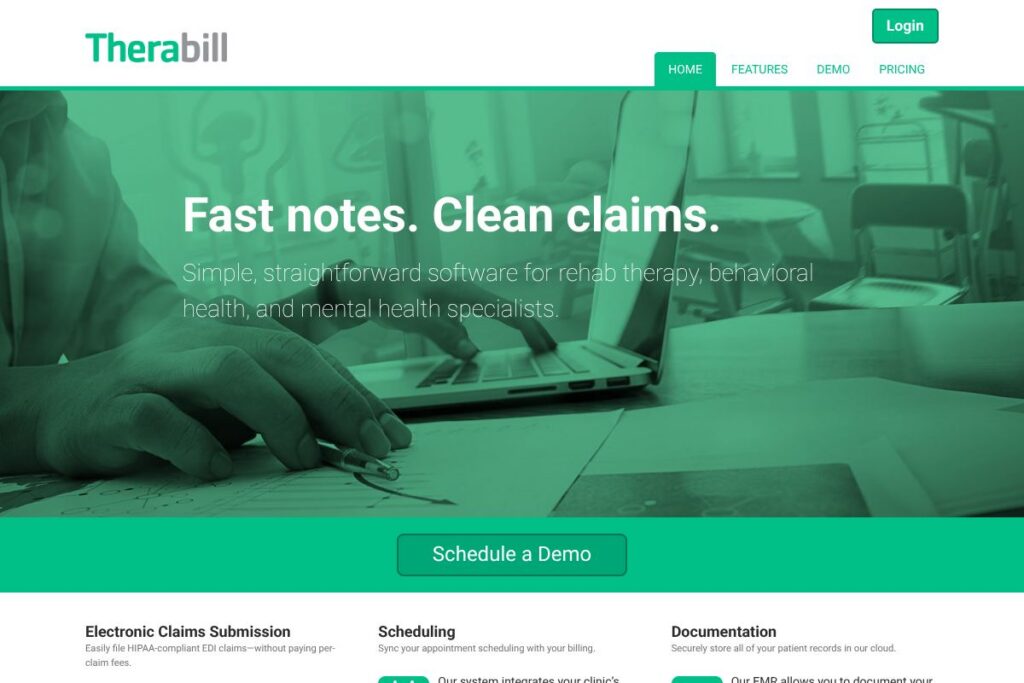
Therabill: An Overview
Therabill is designed as an all-in-one cloud platform for therapy-focused practices that need integrated billing, scheduling, and documentation. It centralizes electronic claims submission, appointment management, and electronic medical records so front office staff and clinicians work from the same dataset.
Compared with competitors such as TherapyNotes and SimplePractice, Therabill places stronger emphasis on claims routing and payer reach; TherapyNotes focuses on psychotherapy-centric documentation and client portals, while SimplePractice bundles telehealth and client intake in a user-friendly package. For practices that prioritize streamlined claims submission to a wide set of payers, Therabill is positioned as a specialist billing platform with EMR features.
All of this makes Therabill a practical choice for small to mid-size therapy clinics, rehabilitation providers, and solo mental health practitioners who want one platform to handle notes, appointments, and claims routing without maintaining separate systems. To see product details and sign up, visit the Therabill homepage.
How Therabill Works
Therabill routes electronic claims to payers using built-in EDI submission, removing the need for separate clearinghouse accounts and per-claim fees. Front desk staff enter appointments and patient insurance details, and the system validates claims, flags errors, and sends clean claims to thousands of commercial and government payers.
Scheduling is integrated with billing so changes on the calendar update the billing workflow automatically; clinicians document sessions using customizable templates that connect to claim codes and billing items. Typical daily workflows are: confirm appointments, document sessions using a template, generate charges from notes, and submit batch claims for electronic routing.
What does Therabill do?
Therabill combines three core capabilities in a single web application: electronic claims submission, appointment scheduling, and clinical documentation. The platform is built to reduce manual data entry between the front office and billing and to keep patient records stored securely in the cloud.
The platform includes EDI claims routing, calendar-based scheduling with drag-and-drop, customizable EMR templates, and secure faxing for sending documents to external recipients. Recent updates emphasize simplified claims routing and better calendar sync options for busy clinics.
Electronic claims submission
Therabill files HIPAA-compliant EDI claims directly to thousands of insurance companies and government payers without requiring separate clearinghouse accounts, which reduces setup overhead for clinics. Claims validation and automated edits reduce rejection rates and speed payment cycles.
Scheduling and calendar sync
The calendar supports drag-and-drop rescheduling, provider calendars, and appointment types that map to billing codes. You can sync schedules with external calendars such as Google Calendar to keep clinicians and administrators aligned.
Documentation and EMR
Clinicians compose session notes using customizable templates that are stored securely in the cloud and linked to patient records. Templates can be tailored for behavioral health, speech therapy, or rehab therapy so notes map consistently to billing codes.
Secure faxing and record exchange
Therabill includes secure cloud faxing so practices can transmit notes and authorizations to fax lines across the US without a physical fax machine. Faxing is integrated into the patient record workflow to simplify document exchange.
Billing workflows and AR management
The platform tracks claims status, remits, and denials, and provides tools to manage accounts receivable and follow up on unpaid claims. Staff can generate reports to prioritize denials and clean up outstanding balances.
Customizable templates and clinical forms
Therabill allows administrators to create and modify note templates, intake forms, and progress note structures so documentation reflects the practice’s standards. This customization reduces repetitive entry and helps standardize billing-relevant data capture.
With its combined billing and documentation capabilities, the biggest benefit of Therabill is reducing the handoffs between scheduling, documentation, and claims submission so clinics can process more claims with fewer rejections and less administrative friction.
Therabill pricing
Therabill uses a subscription-based SaaS model with pricing and plan structure that is not published on a dedicated pricing page. For current plan options, seat licensing, and any setup or transaction fees, check Therabill’s official site for the most up-to-date details at the Therabill homepage.
What is Therabill Used For?
Therabill is used to centralize the administrative operations of therapy practices, including claims submission, scheduling, and clinical note-keeping. Practices use it to reduce manual claim processing, maintain HIPAA-compliant records, and keep appointment data synchronized with billing.
Common users include private mental health clinicians, outpatient rehabilitation clinics, speech therapists, and small multi-provider practices that need a single system to handle both clinical documentation and payer-facing billing. Organizations with complex payer mixes benefit particularly from the platform’s broad EDI routing capabilities.
Pros and Cons of Therabill
Pros
- Integrated billing and documentation: Combining claims submission, scheduling, and EMR reduces duplicate entry and shortens the revenue cycle. This integration helps front desk staff and clinicians share one source of truth for appointments and charges.
- Wide payer reach for electronic claims: Automated EDI routing eliminates the need to manage multiple clearinghouse accounts, which can save time during onboarding and reduce per-claim complexity.
- Customizable templates: Administrators can tailor note templates for behavioral health, speech therapy, or rehab therapy so documentation maps clearly to billing requirements and clinical workflows.
- Cloud-hosted records and secure faxing: Storing records in the cloud and providing integrated secure fax options removes reliance on on-site servers and physical fax machines, which aids remote access and document exchange.
Cons
- Limited public pricing transparency: Pricing is provided via sales channels rather than a public pricing page, which can slow initial vendor comparisons for small practices. You will need to contact sales for a quote and plan details.
- Onboarding and configuration effort: Customizing templates and configuring payer routing can require time and administrative resources during implementation, especially for practices with complex payer mixes.
- Feature focus on billing over client-facing tools: Therabill emphasizes claims and documentation; practices seeking advanced client portals, intake forms, and integrated telehealth may prefer competitor platforms with stronger client-facing features.
Does Therabill Offer a Free Trial?
Therabill does not advertise a public free plan; contact sales for demo or trial options. Prospective customers should reach out to schedule a demo or request trial access through the Therabill contact channels to evaluate the platform against their workflows.
Therabill API and Integrations
Therabill supports integrations that are geared toward scheduling sync and claims routing, including calendar sync with Google Calendar and direct EDI connections to payers. For details on supported integrations and setup, see the Therabill features and integrations page.
If you need programmatic access or custom integration, contact Therabill to ask about API availability and developer resources through their support and integrations contacts listed on the site.
10 Therabill alternatives
Paid alternatives to Therabill
- SimplePractice — Practice management and billing focused on solo and small group therapists, with built-in telehealth, intake, and client portal features.
- TherapyNotes — A therapy-centered EMR with documentation, scheduling, and per-provider subscription pricing that is popular with mental health clinicians.
- Kareo — Medical billing software with strong practice management and billing services for small practices across specialties.
- WebPT Billing — A billing and revenue cycle solution tailored to rehabilitation and outpatient therapy practices, with claims management and payer connectivity.
- TheraNest — Practice management for behavioral health with integrated billing, progress notes, and client-facing tools.
- Athenahealth — Larger-scale medical billing and practice management with integrated EHR and billing services for ambulatory practices.
- PracticeSuite — A configurable practice management and billing platform that supports multiple specialties and payer types.
Open source alternatives to Therabill
- OpenEMR — An open source electronic medical record with billing modules; requires self-hosting or a managed provider for production use.
- OpenMRS — A modular open source medical record system aimed at global health settings that can be extended for clinic workflows.
- Oscar EMR — An open source EMR project used in some primary care settings; customization is required for therapy billing workflows.
Frequently asked questions about Therabill
What is Therabill used for?
Therabill is used for therapy practice billing, scheduling, and documentation. Clinics use it to submit EDI claims, manage appointments, and store customizable clinical notes in a cloud-based EMR.
Does Therabill integrate with Google Calendar?
Yes, Therabill supports calendar sync with Google Calendar. The integration lets providers keep external calendars aligned with the practice schedule to reduce double booking and missed appointments.
Can Therabill submit electronic claims to government payers?
Yes, Therabill routes HIPAA-compliant EDI claims to both commercial insurers and government payers. The platform handles claim validation and automated routing to reduce manual submission tasks.
How does Therabill handle documentation templates?
Therabill offers customizable documentation templates for different therapy disciplines. Administrators can tailor forms and progress notes so clinical entries map consistently to billing codes.
Is Therabill suitable for small private practices?
Yes, Therabill works well for small and mid-size therapy practices that need combined billing and documentation. Its integrated approach reduces the need for separate billing platforms and simplifies claims workflows.
Final Verdict: Therabill
Therabill is a focused billing and EMR solution for therapy and rehabilitation practices that need reliable electronic claims routing combined with scheduling and documentation. Its strengths are its EDI claims reach, integrated scheduling workflows, and customizable clinical templates which reduce errors and speed up the revenue cycle.
Compared with a competitor like TherapyNotes, Therabill leans more heavily toward billing and payer connectivity while TherapyNotes emphasizes psychotherapy-specific documentation and a published per-provider subscription model. For practices that prioritize broad electronic claims routing and a single system for billing plus notes, Therabill is a sensible choice; if you need advanced client-facing features and transparent per-user pricing, evaluate platforms such as TherapyNotes and SimplePractice alongside Therabill.