What is Toast
Toast is a unified point-of-sale and restaurant management platform that centralizes order processing, payments, kitchen workflows, staffing, and reporting. It is built for both full-service and quick-service restaurants, as well as hybrid and multi-location operators, with hardware and software designed to withstand restaurant environments.
Compared with general-purpose POS systems like Square and Clover, Toast places more emphasis on restaurant-specific features such as menu modifiers, course timing, kitchen display integration, and delivery/online ordering workflows. Compared with restaurant-focused competitors like TouchBistro and Upserve, Toast is positioned as a broader platform that bundles hardware, payment processing, payroll, and marketing add-ons into a single vendor experience.
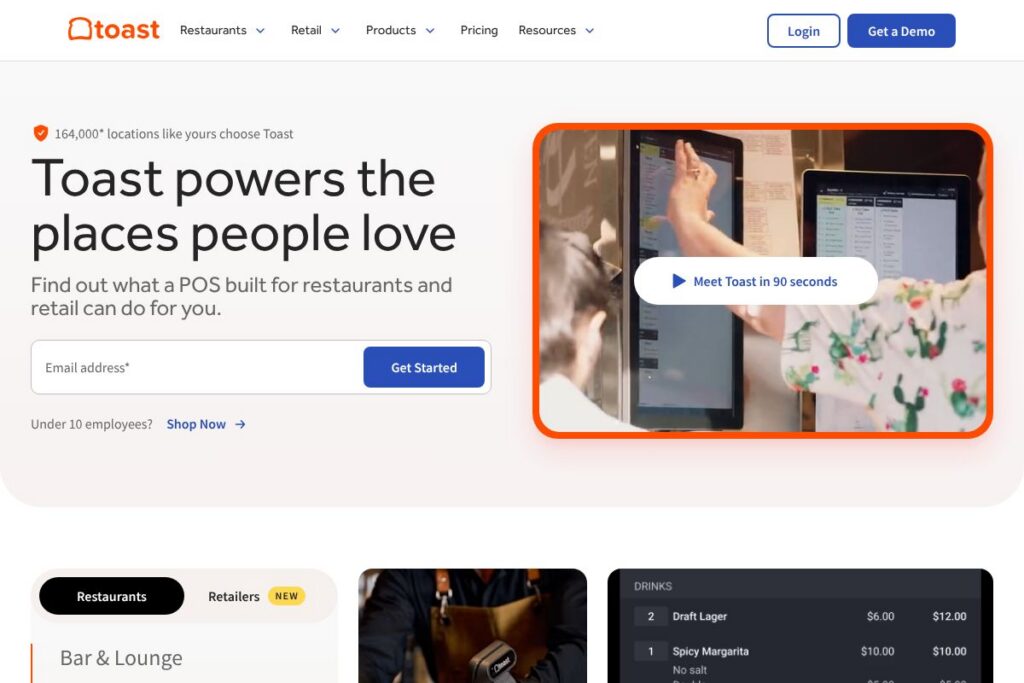
Toast is strongest where restaurants need an integrated stack from front of house to back of house, combined with hardware options and support for multi-location scaling. It is appropriate for independent restaurants, chains, and hospitality groups that want restaurant-specific workflows and an ecosystem of third-party integrations. For a quick look at the company site, visit the Toast homepage.
How Toast Works
Toast runs from the cloud while also supporting local offline operation so orders, payments, and kitchen routing continue if an internet outage occurs. A restaurant deploys Toast terminals and handheld devices, configures menus and modifiers in the cloud console, and connects processors, printers, and kitchen displays to create live order flows.
Operational data syncs to Toast’s back-end for reporting, payroll and inventory reconciliation. Staff use POS terminals or handheld devices to seat guests, fire courses to the kitchen, accept payments at table or counter, and manage takeout or delivery. Managers use the web dashboard or mobile app to adjust menus, review sales and labor, and launch promotions.
Toast features
Toast’s product is organized around point-of-sale operations, payments, online ordering, inventory and labor management, and reporting. Core capabilities include a cloud POS, offline mode, hardware designed for restaurants, integrated payments, online ordering and delivery tools, payroll and team management, and a partner ecosystem with over 200 integrations.
Let’s talk Toast’s Features
Cloud POS
The cloud POS centralizes order entry, modifiers, course timing and menu versions across terminals and handhelds. It supports table management, check splitting and fast barcode or touchscreen order entry to speed the guest experience and reduce order errors.
Reliable Offline Mode
Toast continues to accept orders and process card transactions locally when connectivity is lost, then synchronizes transactions when the network returns. This keeps service running during short outages and preserves sales data for reconciliation.
Integrated Payments
Payments are built into the platform so terminals and handhelds process cards without separate routing between POS and processor. Integrated payments simplify reconciliation and reduce the number of vendors to manage.
Online Ordering and Delivery Tools
Toast supports in-house online ordering plus integrations with third-party delivery platforms to consolidate pickup and delivery orders into the same kitchen workflows. That reduces double entry and helps track digital order performance alongside in-person sales.
Labor, Scheduling and Payroll
Built-in labor tools let managers build schedules, track time punches, and push payroll data into payroll workflows or third-party payroll providers. This reduces manual timesheet reconciliation and tightens labor cost control.
Reporting and Analytics
Real-time sales reporting, item-level performance, labor cost dashboards and end-of-day summaries help operators monitor margins and identify menu opportunities. Managers can pull data by location, shift or server to diagnose issues quickly.
Restaurant-grade Hardware
Toast offers terminals and handheld devices designed for high-traffic restaurant environments with durable housings and food-safe screens. Hardware bundles combine terminals, printers and network components for faster setup.
With these features combined, Toast’s biggest benefit is providing a single vendor stack that ties POS, payments, online ordering and operations data together, making daily management and multi-location oversight simpler.
Toast pricing
Toast uses a subscription and hardware bundle model with options tailored to business type and scale, plus add-ons for payroll, online ordering, marketing and other services. Rather than a single public price sheet, Toast typically provides quotes based on hardware choices, the number of terminals, and which add-on services a restaurant needs.
For the most accurate information and to compare starter options or hardware bundles, see the Toast homepage for current pricing options or request a personalized demo to get a tailored cost estimate.
What is Toast Used For?
Toast is used to process in-person and online orders, manage payments, and run kitchen and front-of-house operations. Restaurants use it to standardize order flows, manage modifiers and courses, and integrate delivery and takeout with the same system used for dine-in service.
Beyond transactions, Toast helps with staffing and payroll, inventory tracking, menu engineering, and marketing campaigns. Operators use the reporting tools to analyze check averages, item performance, and labor percentages to improve margins and operational efficiency.
Pros and Cons of Toast
Pros
- Restaurant-focused feature set: Toast includes menu modifiers, course management, kitchen display integration and ordering workflows built specifically for restaurants, which reduces the need for extensive customization.
- Integrated ecosystem: With payments, hardware, online ordering and payroll available from the same vendor, restaurants can consolidate billing and support under one contract, simplifying vendor management.
- Offline reliability: Local offline operation keeps orders and payments moving during short internet interruptions and reduces service disruption.
- Large partner network: Integration with hundreds of partners means restaurants can add delivery, accounting and labor tools that fit their stack.
Cons
- Vendor lock-in potential: Using Toast as a single-vendor stack can make switching providers more complex if a restaurant later wants to migrate to a different POS or payments provider.
- Custom pricing model: Because pricing varies by hardware and service bundles, it can be harder to compare total cost to competitors without a personalized quote.
- Hardware dependency: Some features are tied to Toast-specific hardware, which can increase upfront capital expense if replacing existing terminals is required.
Does Toast Offer a Free Trial?
Toast offers a personalized free demo and a ‘Start for $0’ entry option. You can schedule a no-credit-card demo to see the platform in action and discuss starter bundles; for details and to request a demo, visit the Toast homepage.
Toast API and Integrations
Toast provides developer resources and an integrations ecosystem to extend the platform and connect third-party apps. The developer documentation describes available endpoints and integration patterns for partners and custom development.
The platform connects with common restaurant tools including payroll and scheduling, accounting, delivery marketplaces and loyalty platforms. Popular integrations include partners for online delivery and labor management, enabling consolidated order and staff workflows.
10 Toast alternatives
Paid alternatives to Toast
- Square: A simple, widely used POS with transparent per-transaction pricing and hardware options suited to small restaurants and cafes.
- Clover: A modular POS platform with a marketplace of apps and flexible hardware bundles for merchants and restaurants.
- Lightspeed: A cloud POS targeted at hospitality and retail with advanced inventory and e-commerce capabilities for multi-location operators.
- TouchBistro: A restaurant-focused POS that emphasizes table management, menu engineering and hospitality-friendly workflows.
- Upserve: Restaurant management software with integrated analytics, payments and guest management aimed at full-service restaurants.
- Revel Systems: An enterprise-capable hybrid POS with strong inventory and reporting tools for chains and complex operations.
- ShopKeep: A merchant-friendly POS with easy setup and essentials for independent restaurants and quick-serve businesses.
Open source alternatives to Toast
- Odoo POS: Part of the Odoo open-source ERP suite, offers POS functionality with inventory and accounting integration for businesses that want self-hosted control.
- uniCenta: An open-source POS that supports multiple terminals and basic retail and hospitality workflows suitable for small operations.
- Floreant POS: A free, open-source restaurant POS with core order management and ticketing features for independent establishments.
- Chromis POS: A Java-based open-source POS with touchscreen support and configurable layout for simple restaurant and retail use.
Frequently asked questions about Toast
What is Toast used for?
Toast is used for restaurant point-of-sale and operations management. It handles order entry, payments, kitchen routing, online ordering and reporting for restaurants of all sizes.
Does Toast offer offline mode?
Yes, Toast supports a reliable offline mode. The system continues to accept orders and process card transactions locally when connectivity is lost, then syncs data when the network returns.
How does Toast handle integrations with delivery platforms?
Toast integrates with delivery and online ordering partners to centralize takeout and delivery orders. That integration reduces duplicate entry and consolidates digital orders into kitchen workflows.
Does Toast provide an API for developers?
Yes, Toast provides developer resources and an API. Developers can consult the developer documentation to learn about available endpoints and integration patterns.
How much does Toast cost per month?
Toast offers tailored pricing based on hardware and service needs. For a precise quote that matches your location count, hardware choices and add-ons, request a personalized demo via the Toast homepage.
Final verdict: Toast
Toast is a comprehensive, restaurant-first POS and operations platform that brings together POS, payments, online ordering, labor and reporting in a single vendor experience. Its strengths are restaurant-specific workflows, durable hardware options and a large partner network, which together reduce integration friction for operators.
Compared with a generalist provider like Square, Toast focuses more on kitchen and service workflows and typically sells via hardware bundles and custom quotes, while Square publishes simpler pricing and suits very small or mobile operations. For restaurants that need an integrated, restaurant-grade platform and are prepared to work with a single vendor for hardware and software, Toast is a strong choice. For very small operators who prefer transparent per-transaction pricing and minimal hardware changes, competitors like Square or lightweight POS systems may be a better fit.