What is Twilio
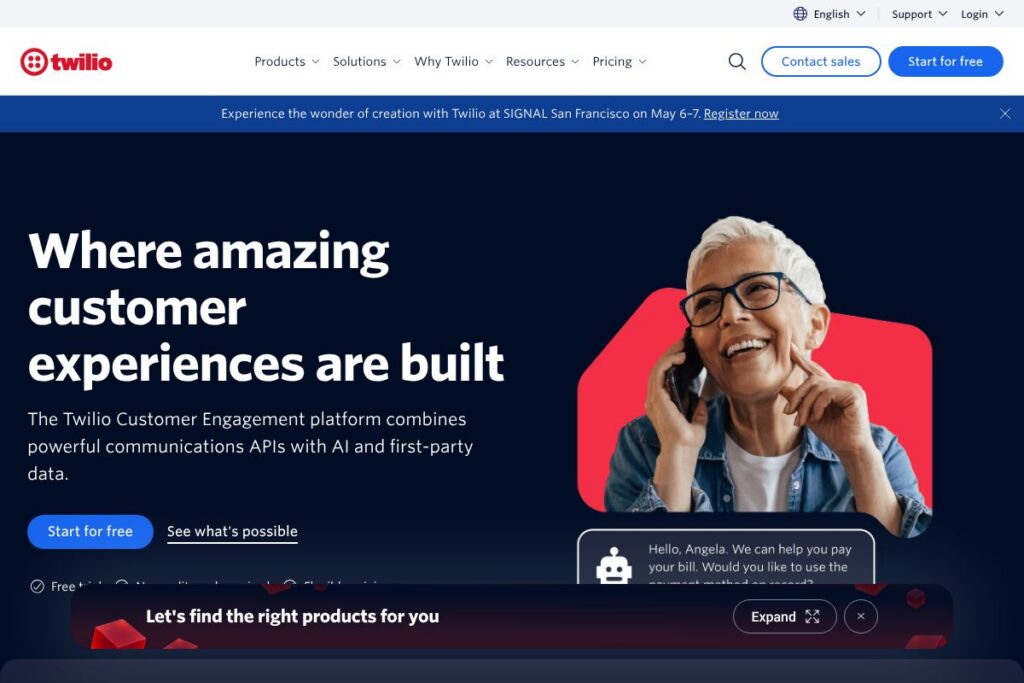
Twilio is a communications platform that exposes APIs for messaging, voice, video, and email, and layers AI and customer data tools on top to help teams build personalized interactions. It bundles channel-specific APIs with developer SDKs, a customer data offering, and orchestration tools so teams can route and personalize communications using real-time signals.
Twilio competes with other CPaaS and messaging providers such as Vonage, MessageBird, and Infobip. Compared with Vonage, Twilio emphasizes a broader set of developer SDKs and a larger ecosystem of add-ons; compared with MessageBird, Twilio generally offers deeper programmatic control and a larger global footprint; compared with Infobip, Twilio provides a wider set of integration paths into customer data and AI tooling.
All of this makes Twilio a practical choice for product and engineering teams that need granular, programmatic control of communications across multiple channels and want to combine those channels with customer profiles and AI-driven routing.
How Twilio Works
Twilio exposes channel-specific REST APIs and SDKs that let applications send and receive SMS, MMS, WhatsApp messages, voice calls, and email programmatically. Developers authenticate with API keys, provision phone numbers, and call API endpoints to create messages or initiate calls; responses and events are delivered via webhooks for real-time handling.
In production, teams typically combine Twilio APIs with a customer data layer to inform routing and content. For example, an application can query a unified customer profile, decide which channel to use, call the Messaging API to send a personalized SMS, and log the interaction back to the Customer Data Platform for later analytics. Twilio also provides server-side helper libraries and CLI tooling to accelerate common workflows, and trucking of events is supported through webhook callbacks and event streams.
Twilio features
Twilio centers its platform on channel APIs, identity and verification, customer data, and developer tools that connect them. Core features include messaging at global scale, a programmable Voice API, an Email API through SendGrid, verification and lookup tools for identity, a Customer Data Platform for unified profiles, and managed AI capabilities and SDKs for rapid integration.
Key functionality includes:
Messaging API
Twilio’s Messaging API enables sending and receiving SMS, MMS, and WhatsApp messages across many countries, with features for concatenation, media attachments, delivery status callbacks, and message templates. It benefits teams by providing programmatic control over message content, receipts, and delivery tracking so you can automate notifications and transactional messages reliably. Check the Messaging API documentation for channel specifics and country restrictions.
Email API (SendGrid)
Twilio’s Email API via SendGrid focuses on high-volume delivery, deliverability tools, and template management so engineering teams can send transactional and marketing messages from the same stack. It includes features for suppression management, bounce handling, and delivery analytics, which are useful for maintaining sender reputation. Review the Email API docs for implementation patterns.
Voice API
The Voice API provides programmatic call control for inbound and outbound voice, interactive voice response, and media streaming, with support for recording, transcription, and SIP interconnect. This allows teams to build IVR flows, contact center integrations, or voice-based verification that tie into customer context. See the Voice API documentation for examples and webhook behavior.
Authentication and Identity
Twilio offers phone verification, two-factor authentication, and number lookup tools to help reduce fraud and confirm identity during account sign-up or sensitive transactions. These tools integrate with customer profiles and can trigger or block flows based on risk signals, improving security and reducing manual review. Explore the Verification and Lookup docs for common flows.
Customer Data Platform
Twilio’s Customer Data Platform (originating from Segment) centralizes first-party, consented customer data into unified profiles for real-time decisioning and personalization across channels. Teams use CDP profiles to drive routing rules, personalize content, and feed analytics or ML models without building separate ETL pipelines. See Segment’s CDP documentation for ingestion and identity resolution patterns.
AI and Automation
Twilio provides managed AI tools and integrations that help scale conversational and routing logic, including programmable chat routing, message generation, and transcription-based classification. These capabilities let teams apply consistent language models to automate responses or summarize interactions while keeping programmatic control. Visit the AI and automation resources for integration options.
Developer SDKs and Helper Libraries
Official server-side SDKs and client libraries for languages such as Python, Node.js, Java, and PHP reduce boilerplate for authentication, error handling, and calling APIs, and are complemented by CLI tooling and quickstart guides. This lowers the initial build time for prototypes and production services and helps align teams on consistent usage patterns. See the developer documentation for SDK download and examples.
With these capabilities, the biggest practical benefit is that developers can orchestrate multichannel communications programmatically while keeping customer context and automation logic in a single platform, reducing integration overhead and duplicated data flows.
Twilio pricing
Twilio uses a flexible, usage-based pricing model with pay-as-you-go rates for channel usage and optional enterprise agreements for large customers. Pricing varies significantly by channel, country, phone number type, and volume, so the right model depends on which APIs and geographies you use.
Pay-as-you-go
Pay-as-you-go: Usage-based fees apply per message, per call minute, or per API request depending on the product, with additional charges for phone numbers, short codes, or premium channels. Volume discounts and committed use agreements are commonly available for higher throughput customers.
Enterprise and Contracts
Enterprise: Custom pricing is available for organizations that require dedicated SLAs, private networking, compliance features, or large-volume discounts. Enterprise contracts can bundle support, dedicated onboarding, and managed services.
For detailed, channel-specific rates and examples that match your use case, review Twilio’s guidance on pricing and product costs on the Twilio homepage or consult sales for a tailored quote.
What is Twilio Used For?
Twilio is commonly used for transactional notifications, alerts, and operational messaging such as delivery updates, appointment reminders, password resets, and incident alerts. Its programmability makes it suitable for integrating communications into product workflows where automation and auditability are important.
Beyond notifications, Twilio is used to build conversational interfaces and contact center features, including IVR systems, call recording and analytics, two-way SMS support for customer service, and omnichannel routing tied to customer profiles. Marketing teams also use Twilio SendGrid for campaign delivery and deliverability optimization.
Pros and cons of Twilio
Pros
- Extensive channel coverage: Twilio supports SMS, MMS, WhatsApp, voice, and email with deep developer tooling, which lets teams build consistent cross-channel workflows without multiple vendors. This reduces integration complexity and centralizes event handling.
- Developer-focused APIs and SDKs: Twilio provides well-documented REST APIs, official helper libraries, and code samples that accelerate implementation and make it straightforward to automate common tasks. The wide language support shortens onboarding for engineering teams.
- Customer data and AI integration: Twilio’s CDP integration and managed AI features let teams route messages and personalize content using unified profiles and automation, helping maintain consistent experiences across channels.
Cons
- Usage-based pricing can be complex: Cost management requires careful planning because per-message and per-minute fees vary by country and channel, and high-volume usage can be hard to forecast without monitoring and governance. This means organizations must implement usage controls to avoid unexpected bills.
- Operational complexity at scale: Running geographically distributed communications with compliance, local carrier rules, and number provisioning can add operational overhead, especially for teams without prior telecom experience. Enterprise customers often need dedicated account support.
Does Twilio Offer a Free Trial?
Twilio offers a free account with trial credits and no credit card required. New users can sign up for a free account, use trial credits to test messaging, voice, and email, and upgrade to a pay-as-you-go plan when ready; sign up at the free account page.
Twilio API and Integrations
Twilio provides comprehensive APIs for each channel and publishes detailed developer documentation; the API documentation includes endpoints, SDK usage, and webhook behavior. The platform also exposes event streams and webhooks for real-time integrations.
Twilio integrates with common business systems and CRMs such as Salesforce, Zendesk, and analytics pipelines via Segment, and there are ecosystem connectors for marketing automation, contact centers, and orchestration platforms. Many integrations are available through official libraries or community-built plugins.
10 Twilio alternatives
Paid alternatives to Twilio
- Vonage – Offers programmable voice, SMS, and verification services with SDKs and a focus on predictable bundled plans and contact center integrations.
- MessageBird – Provides multichannel messaging and omnichannel routing with a strong presence in EMEA and tools for conversational workflows and chat apps.
- Infobip – Enterprise messaging and omnichannel engagement platform with a large operator network and managed services for global reach.
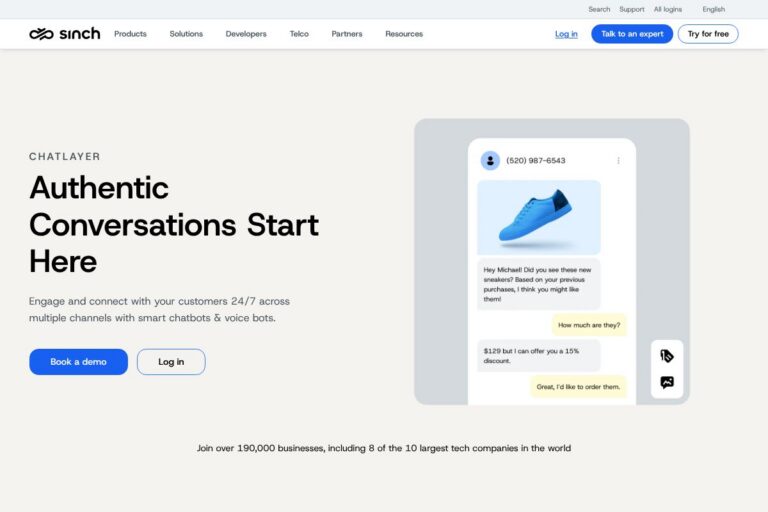
- Sinch – CPaaS provider that focuses on messaging and verification services with carrier-grade routing and fraud prevention features.
- Plivo – Developer-centric APIs for SMS and voice with simplified pricing for businesses looking for straightforward integrations and global reach.
- Bandwidth – Operator-level voice and messaging APIs with direct PSTN access and features aimed at service providers and large-scale users.
- AWS Pinpoint – Part of Amazon Web Services, Pinpoint offers messaging and campaign management with close integration into AWS analytics and data services.
Open source alternatives to Twilio
- Asterisk – Open source telephony platform for building voice applications, IVR systems, and PBX functionality; requires self-hosting and telecom integration.
- FreeSWITCH – Scalable open source telephony engine for building custom voice layers and media services; suitable for teams that want full control over call flows.
- Kamailio – High-performance SIP server used for SIP routing and carrier-scale voice services, often paired with media servers for full telephony stacks.
- SIP.js – JavaScript library for browser-based WebRTC and SIP integrations that can be used with self-hosted signaling and media infrastructure.
Frequently asked questions about Twilio
What is Twilio used for?
Twilio is used to programmatically send and receive SMS, voice calls, WhatsApp messages, and email, and to orchestrate those channels with customer data and automation. It is commonly embedded into products for notifications, customer service, authentication, and conversational experiences.
Does Twilio have an API for voice calls?
Yes, Twilio provides a Voice API for inbound and outbound calls, IVR, recording, and media streaming. The Voice API documentation includes examples for SIP interconnect, conferencing, and webhook handlers.
Can Twilio integrate with customer data platforms?
Yes, Twilio integrates with CDPs and includes Segment as its customer data offering. You can use unified profiles to personalize messages, drive routing decisions, and export events to analytics systems.
Is Twilio suitable for global messaging campaigns?
Yes, Twilio supports global messaging but pricing and compliance depend on destination countries. You should review country-specific rules, registration requirements, and message template restrictions before large campaigns.
How does Twilio pricing work?
Twilio uses a usage-based pricing model with pay-as-you-go rates and custom enterprise contracts. Costs vary by channel, phone number type, and geography, and volume discounts are available for high-throughput customers.
Final verdict: Twilio
Twilio excels at providing programmatic access to multiple communication channels combined with developer tooling, customer data integration, and managed AI features that help teams build personalized experience flows. Its strength is the breadth of APIs, reliable global routing, and an ecosystem of SDKs and documentation that speed up implementation.
Compared with Vonage, Twilio tends to offer a broader set of integrations and data tools while both use usage-based pricing models. If you need tight integration with a CDP and broad channel coverage, Twilio is a solid option; if you prefer a different pricing packaging or a regionally focused provider, evaluate Vonage or MessageBird to compare commercial terms and local carrier relationships.
Overall, Twilio is well suited to engineering-led teams and enterprises that require fine-grained control over messaging, voice, and email workflows and want to tie those interactions back to unified customer data for personalization and analytics.