What is WinePOS
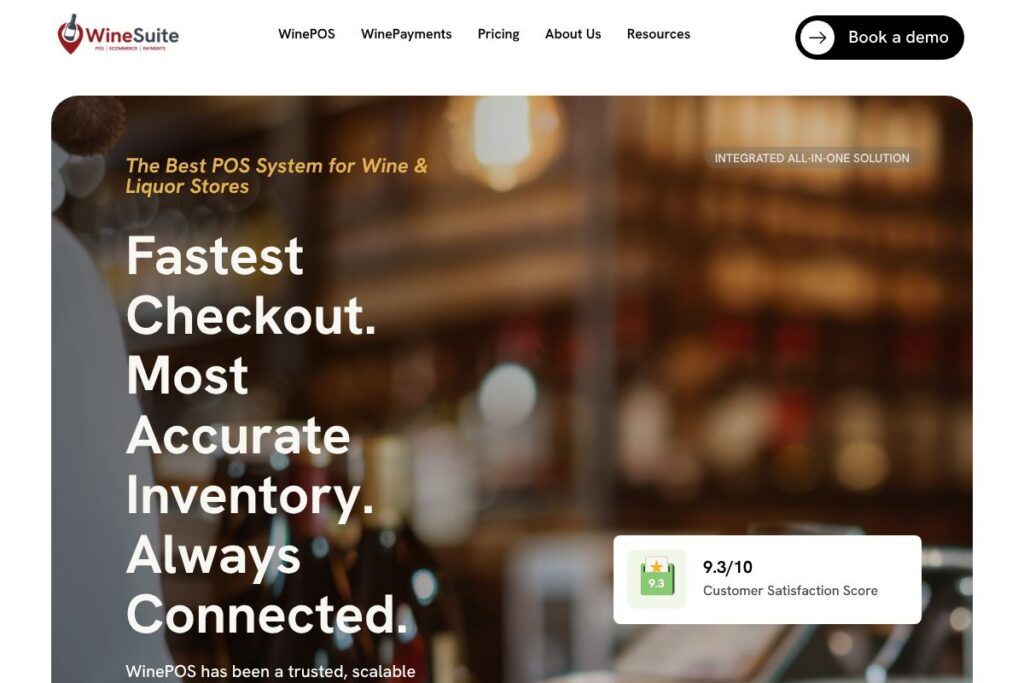
WinePOS is a point of sale system and retail management platform designed specifically for wine shops, liquor stores, and beverage alcohol retailers. It combines register functions, inventory control, customer management, and age-compliance features in a single solution tailored to the needs of regulated alcohol sales.
Compare to general-purpose POS options such as Lightspeed, Square, and Revel Systems, WinePOS focuses on industry-specific workflows like bottle-level and case inventory, age verification, state reporting, and case-break handling. Unlike turnkey consumer-focused POS apps, WinePOS prioritizes compliance features and store-level merchandising that liquor retailers typically require.
What WinePOS does especially well is provide a scalable, industry-aware platform for single stores and multi-location chains, backed by decades of operational experience. This makes it a practical choice for independent retailers, regional chains, and franchise operations that need point-of-sale features keyed to beverage alcohol rules and inventory complexity.
How WinePOS Works
WinePOS runs as an integrated POS platform where the register, inventory system, customer database, and reporting modules share a single data model. Staff ring sales at the register or mobile terminals, with item-level controls for bottles, cases, kegs, and mixed-pack pricing, while inventory counts and cost-of-goods are updated in real time.
For multi-location retailers, WinePOS synchronizes inventory and sales across stores and channels so transfers, centralized purchasing, and consolidated reporting work without manual reconciliation. Workflows include barcode scanning, case-break conversion, promotions at item or case level, and loyalty or customer account handling directly at checkout.
Implementation typically includes data migration from legacy systems, configuration of tax and state compliance rules, and on-site or remote training; WinePOS support and implementation teams handle migration to avoid downtime and help map store-specific processes to the platform. Ongoing tasks such as price changes, vendor ordering, and reporting are handled through the administrative console or web portal.
WinePOS features
WinePOS centers on retail and compliance capabilities for the beverage alcohol trade. Core functionality covers point-of-sale transactions, detailed inventory control, multi-store management, integration connectors, and reporting tools that help with state filings and business analytics. Additional features include customer loyalty, e-commerce connections, and hardware support for scanners, scales, and payment terminals.
Inventory management
The platform supports bottle-level, case-level, and mixed-pack inventory with case-break handling, per-item cost tracking, vendor ordering, and cycle-count workflows. These controls reduce stock discrepancies and make margin tracking for high-value bottles and limited releases easier for store owners.
Age verification and compliance
WinePOS enforces age checks at the point of sale with prompts and electronic recordkeeping to support compliance with local and state regulations. The system also supports custom rules for restricted SKUs and can generate audit-ready reports for regulatory inspections.
Multi-location management
Centralized purchasing, pricing, and reporting allow chains to manage assortments across stores while keeping local pricing and promotions flexible. Inventory transfers, stock rebalancing, and consolidated sales dashboards help reduce shrink and improve product availability across a footprint.
Integrations and connectors
WinePOS integrates with accounting systems, electronic shelf tags, mobile apps, and e-commerce sites to create a unified retail stack. Integration resources and partner connectors are listed on the WinePOS integration page for common workflows like accounting reconciliation and online order fulfillment.
Reporting and analytics
Reporting tools cover daily sales, margin analysis, inventory valuation, vendor performance, and compliance reports required by regulators. Customizable reports and scheduled exports help finance teams and store managers keep a close view on cash flow and product performance.
E-commerce and omnichannel
The platform connects to web stores so inventory and pricing stay synchronized between in-store and online channels, supporting click-and-collect, local delivery, and shipping where permitted. This helps retailers sell limited releases online while enforcing legal shipping and pickup rules.
Support and implementation
WinePOS provides migration services, training, and ongoing support intended to minimize downtime when switching systems or adding terminals. Their customer-focused onboarding helps map store processes to the software and transfer historical inventory data.
With these capabilities, WinePOS delivers a feature set that matches the operational needs of beverage alcohol retailers while reducing manual work across sales, inventory, and compliance.
WinePOS pricing
WinePOS uses a custom pricing model tailored to store size, hardware needs, and integration requirements, typically favored by independent stores and regional chains rather than fixed per-seat plans. For detailed rates and configuration options, consult the vendor directly to match plan scope to your store footprint and required integrations.
For current pricing and package options, view WinePOS’s current pricing options.
What is WinePOS Used For?
WinePOS is used to run day-to-day retail operations in wine shops, liquor stores, and specialty beverage stores, handling sales, returns, and customer accounts at the point of purchase. Retailers rely on it to manage bottle- and case-level inventory, enforce age verification, and run promotions tied to specific products or vendors.
Beyond checkout, the system is used for inventory planning, vendor purchasing, multi-store stock allocation, and regulatory reporting. Owners use reporting to track high-margin SKUs, forecast replenishment for limited-release products, and reconcile daily sales across terminals and locations.
The platform is best suited for independent store owners, regional chains, and franchise operators that require beverage-alcohol-specific workflows, regulatory features, and integrations with accounting or e-commerce systems.
Pros and Cons of WinePOS
Pros
- Industry-tailored functionality: Built specifically for wine and liquor stores, the platform includes bottle-level inventory, case-break handling, and built-in age verification that map to real retail tasks.
- Multi-location capabilities: Centralized inventory, pricing, and reporting make it easier for chains to manage stock and financials across multiple stores.
- Compliance support: The software includes features to help retailers meet PCI requirements, age restrictions, and common state-specific regulations, reducing manual compliance work.
- Integration ecosystem: Connectors for accounting, e-commerce, and store hardware simplify combining POS with existing systems and online channels.
Cons
- Custom pricing model: Pricing is tailored per customer which can make upfront comparison with off-the-shelf POS solutions difficult for some buyers.
- Niche focus may limit broader retail features: Because WinePOS concentrates on beverage alcohol workflows, retailers with extensive non-alcohol assortments or hospitality-heavy operations may need supplementary tools for those areas.
- Vendor dependency for integrations: Some advanced integrations or custom workflows may require professional services or partner connectors to implement.
Does WinePOS Offer a Free Trial?
WinePOS offers demo access and trial arrangements through its sales team. Prospective customers can request a live demonstration and arrange trial or pilot deployments to validate workflows, data migration, and hardware compatibility before committing to a full rollout.
WinePOS API and Integrations
WinePOS supports integrations with accounting packages, e-commerce platforms, electronic shelf tags, and mobile apps to connect in-store operations with back-office systems. Details about available connectors and partner integrations are published on the WinePOS integration resources page.
For custom integrations and automation, WinePOS provides developer and partner options to exchange inventory, sales, and customer data with third-party systems; contact their support or integration team to access API documentation and implementation guidance via the WinePOS support portal.
10 WinePOS alternatives
Paid alternatives to WinePOS
- Lightspeed: A full-featured retail POS with multi-store inventory, e-commerce, and reporting, used by specialty retailers and hospitality outlets. Lightspeed offers modern cloud-based tools with tiered pricing and add-on modules.
- Square: A broadly used POS with simple onboarding, transparent transaction-based pricing, and a free basic POS app; best for smaller merchants or those prioritizing low upfront costs and integrated payments.
- Revel Systems: An enterprise-capable iPad POS with strong reporting, inventory, and multi-location features that scales for larger retail and restaurant operations.
- Shopify POS: Integrated with Shopify’s e-commerce platform, suitable for retailers who want tight online and in-store synchronization and unified customer and order management.
- Clover: A modular POS hardware and software family offering app-based extensions for payments, inventory, and loyalty for small to mid-sized retailers.
- Vend (by Lightspeed): A retail-first POS with strong inventory features and multi-location management, now part of the Lightspeed ecosystem.
- Toast (for hospitality crossover): While primarily restaurant-focused, Toast provides strong POS and payments capabilities for retailers with food or tasting-room components.
Open source alternatives to WinePOS
- Odoo POS: The open source Odoo platform includes a POS module that integrates with inventory, accounting, and e-commerce within a single open source ERP suite.
- Unicenta: A flexible open source POS that supports retail workflows, barcode scanning, and multi-terminal deployment, suitable for technical teams that can manage self-hosting.
- Chromis POS: A Java-based open source POS with a focus on retail and hospitality, offering a lightweight solution for stores willing to self-host and customize.
- Floreant POS: An open source POS traditionally focused on restaurants but adaptable to retail use cases with community-driven plugins and integrations.
Frequently asked questions about WinePOS
What is WinePOS used for?
WinePOS is used to run point-of-sale operations and inventory management for wine and liquor stores. It handles bottle- and case-level inventory, checkout, compliance, and reporting tasks specific to beverage alcohol retailers.
Does WinePOS support multi-location stores?
Yes, WinePOS supports multi-location management. The platform centralizes inventory, pricing, and reporting so operators can manage stock transfers and consolidated analytics across stores.
Can WinePOS integrate with accounting and e-commerce systems?
Yes, WinePOS integrates with accounting packages and e-commerce platforms. Integration options and partner connectors are listed on their integration resources page for common workflows like order synchronization and financial reconciliation.
Is WinePOS compliant with age verification and PCI requirements?
WinePOS includes features for age verification and PCI-aware payment processing. The system prompts staff for age checks, supports restricted-SKU controls, and includes practices to support secure payment handling.
How do I get pricing for WinePOS?
WinePOS uses custom pricing tailored to each customer. For a quote and package details matched to your store size and hardware needs, request pricing and options through their main site contact options.
Final Verdict: WinePOS
WinePOS stands out as a specialized POS and retail management system for beverage alcohol retailers, combining bottle-level inventory, compliance controls, and multi-location features that general-purpose POS systems do not emphasize. Its decades of industry experience and migration support make it a solid choice for stores and chains that need workflows built around liquor retailing.
Compared to Square, which offers a free POS app plus pay-as-you-go processing and clearly published fees suitable for small shops, WinePOS follows a custom pricing approach with deeper industry-specific features. If you need off-the-shelf simplicity and low startup cost, Square may be more attractive; if your operation requires regulatory workflows, case-break inventory, and multi-store commerce, WinePOS provides targeted capabilities that justify a tailored deployment and pricing discussion.
Overall, WinePOS is most appropriate for independent wine shops, established liquor stores, and regional chains that prioritize compliance, bottle-level inventory control, and integrated store management over a simple, low-cost register solution.