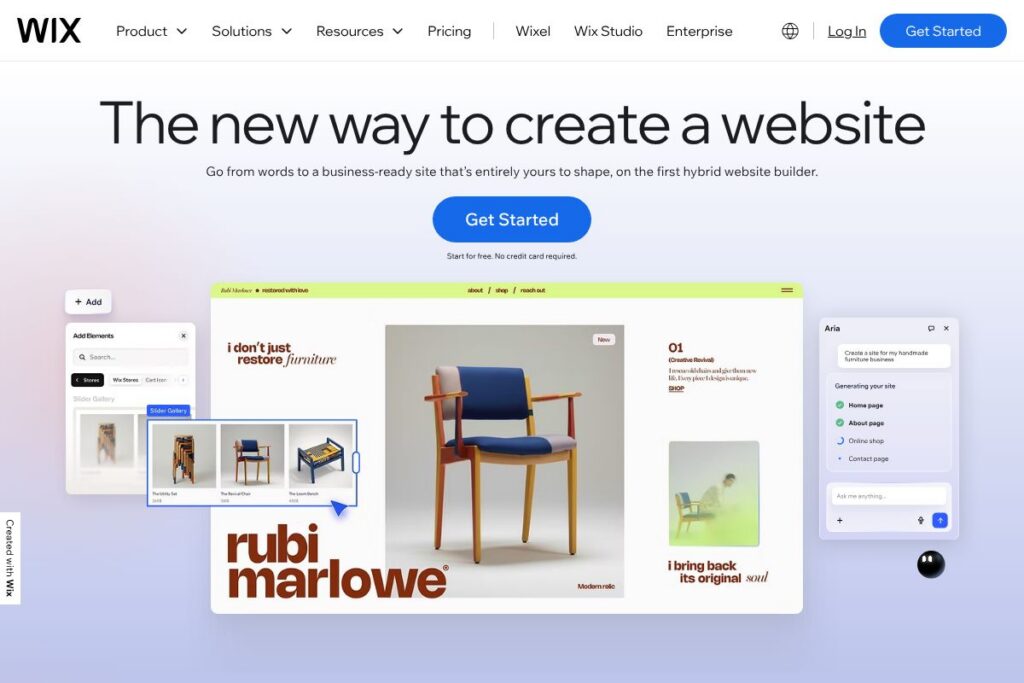
Wix: An Overview
Wix is a cloud-based website builder that combines an intuitive drag-and-drop editor, a large template library, and AI-assisted site generation to help people and businesses build websites without coding. It is positioned as a one-stop platform that includes hosting, security, ecommerce, marketing, and CRM capabilities so users can create, publish, and grow sites from a single dashboard.
Compared with Squarespace, which emphasizes designer templates and curated styling, Wix gives more granular design control with a fully fluid canvas and pixel-level placement. Against WordPress.com, Wix simplifies setup and hosting by bundling infrastructure and visual tools, while WordPress.com offers more extensibility through plugins and self-hosted WordPress. Compared with Shopify, Wix is broader in use cases beyond ecommerce and includes a free plan, while Shopify centers on large-scale online stores and commerce-first features.
Wix works particularly well for small businesses, creatives, consultants, and solopreneurs who want visual control without hiring a developer. Its combination of templates, AI site generation, and an app ecosystem makes it useful for users who need a fast path to a business-ready site plus room to add ecommerce, bookings, or online courses later.
How Wix Works
Wix lets you start by choosing a template, using the AI website builder, or starting from a blank canvas. The AI website builder asks a few questions about your goals and content, then generates a ready-to-edit site; alternatively, the drag-and-drop Editor gives direct control to move, layer, and style elements across pages.
Once your pages are in place you add functionality through built-in features or the Wix App Market, for example enabling ecommerce, bookings, or email campaigns. You manage hosting, domain connections, SEO settings, marketing campaigns, and customer data from the Wix dashboard or the Wix mobile app for on-the-go updates.
Wix features
Wix groups core capabilities around visual design, content generation, business features, and platform services. Core functionality includes an AI website builder, a 2,000+ template library, a WYSIWYG Editor with pixel-level placement, ecommerce and bookings modules, a marketing suite with AI-generated emails and ad tools, a CRM with automations, and a large app marketplace for add-ons.
Let’s talk Wix’s Features
AI website builder
The AI site generator asks for business details and design preferences, then produces a complete, editable website within minutes. This accelerates initial setup for non-designers and creates a base you can refine in the Editor or hand off more work to Wix’s AI assistant for content and layout tweaks.
Template library
Wix offers over 2,000 designer-made templates across industries that are fully customizable, making it faster to start with a layout suited to your niche. Templates include prebuilt sections and content patterns to reduce setup time and follow modern UX practices.
Drag-and-drop Editor
The Editor provides a free-form canvas with tools for precise placement, layered elements, and responsive adjustments for mobile and desktop. This design freedom is useful when you need custom layouts without editing code, while still allowing global style changes for fonts and colors.
eCommerce and payments
Wix includes an integrated ecommerce module that supports product management, checkout, shipping rules, taxes, and order tracking. You can sell products, subscriptions, and digital goods, and connect major payment providers from the dashboard to manage transactions and fulfillment.
Bookings and scheduling
Built-in scheduling tools allow service providers to accept bookings, manage staff calendars, and process payments for appointments. This feature suits freelancers, salons, tutors, and any business that needs calendar-based bookings and client management.
Marketing and SEO tools
Wix provides SEO helpers, AI-generated meta tags, homepage indexing, and integrations with Google Search Console and SEMrush to support organic visibility. Marketing tools include AI-generated email campaigns, social post creation, and the ability to run Google and Facebook ads directly from the dashboard.
App Market and integrations
The Wix App Market connects hundreds of Wix-made and third-party apps to extend functionality, including analytics, chat, forms, and automation tools. These integrations let you add features such as Google Analytics, Facebook Pixel, and Zapier workflows without custom development.
Hosting, security, and performance
Wix includes managed hosting, HTTPS and SSL, DDoS protection, and a multi-cloud setup with a global CDN to improve load times and reliability. These platform services handle infrastructure, backups, and uptime so you do not manage servers directly.
With these features, Wix covers the full website lifecycle from design to marketing and CRM, making it suitable for users who want an integrated solution with both AI-assisted and hands-on design control.
Wix pricing
Wix uses a freemium subscription model with optional Premium plans for commerce and advanced business features. For current plan tiers, feature comparisons, and any promotional offers, see the Wix plans and pricing information on their site.
What is Wix Used For?
Wix is commonly used to build business websites, online stores, portfolios, blogs, event pages, and course sites. Its built-in ecommerce, booking, and membership features let users add transactional functionality quickly while maintaining visual control via the Editor.
It is also used by agencies and freelancers to prototype client sites fast, by creators to showcase work with gallery and portfolio layouts, and by local businesses that need an online presence combined with scheduling and appointment management features.
Pros and Cons of Wix
Pros
- Extensive template library: A large collection of industry-specific templates reduces setup time and provides professional design starting points.
- AI-assisted site creation: AI tools can generate a functional, editable site from simple prompts, lowering the barrier to getting live quickly.
- All-in-one platform: Hosting, security, ecommerce, marketing, and CRM are integrated in one dashboard, reducing the need to stitch multiple services together.
- Flexible design control: The drag-and-drop Editor and pixel-level adjustments let non-developers create highly customized layouts without code.
Cons
- Template switching limitations: Once you commit to a template and customize heavily, switching to a different template can require manual rebuilding of content and layout.
- Learning curve for advanced features: The Editor and many platform features are powerful, but mastering advanced layout and business tools takes time.
- Platform lock-in for some features: Deep use of Wix-specific apps and components can make migrating a site to another platform more involved.
Does Wix Offer a Free Trial?
Wix offers a free plan that lets you build, publish, and host a website on a Wix subdomain with Wix branding; Premium plans are optional to connect a custom domain, remove ads, and unlock ecommerce and advanced business features. The free plan is sufficient for testing the Editor and basic site builds, while upgrades are available when you need custom domains, commerce, or higher resource limits.
Wix API and Integrations
Wix provides developer tools through Velo by Wix, a full-stack development platform that lets you add custom code, serverless functions, and integrations to Wix sites. The Wix Velo developer documentation details available APIs, site events, and examples for extending the platform.
For non-developers, the Wix App Market lists hundreds of apps and third-party integrations such as Google Analytics, Facebook Pixel, and Zapier to connect Wix with external services and automate workflows.
10 Wix alternatives
Paid alternatives to Wix
- Squarespace — Template-first builder with strong design aesthetics and integrated commerce tools aimed at creative professionals.
- Shopify — Commerce-focused platform with advanced store management and payment processing for businesses prioritizing online sales.
- Weebly — A simpler drag-and-drop site builder with basic ecommerce and lower-cost plans suitable for small shops and portfolios.
- Webflow — Visual design tool with production-grade HTML and CSS control, suited to designers who want code-level precision and CMS capabilities.
- WordPress.com — Hosted WordPress with themes and plugins managed for you, offering a middle ground between ease of use and extensibility.
- GoDaddy Website Builder — Fast setup and marketing-focused features, aimed at users who want quick, basic sites with domain services.
- Squarespace Commerce — The commerce tier of Squarespace for sellers who want a design-forward store with subscription and digital product support.
Open source alternatives to Wix
- WordPress — Self-hosted WordPress is highly extensible with themes and plugins and is commonly used when full control and custom hosting are required.
- Drupal — A powerful CMS for complex sites and enterprise needs, offering granular control over content models and permissions.
- Jekyll — A static site generator useful for developers who prefer Git-based workflows and very fast, low-maintenance hosting.
- Hugo — Another static site generator focused on speed and simplicity for content-heavy sites with developer-oriented build pipelines.
Frequently asked questions about Wix
What can I build with Wix?
Wix supports many site types including business sites, ecommerce stores, portfolios, blogs, and event pages. The platform includes specialized modules for bookings, courses, and memberships to expand basic websites into business tools.
Does Wix offer a free plan?
Yes, Wix has a free plan. It includes hosting on a Wix subdomain with Wix ads, and it is intended for testing the platform or building basic sites before upgrading to a Premium plan for custom domains and commerce.
Can I sell products on Wix?
Yes, Wix supports ecommerce through built-in store features. You can manage products, payments, shipping, taxes, and orders from the Wix dashboard and integrate third-party payment providers.
Does Wix provide developer APIs?
Yes, Wix offers Velo, a developer platform with APIs and serverless functions. Velo lets developers add custom code, integrate external services, and create advanced site behavior beyond the visual Editor.
How does Wix handle SEO?
Wix provides built-in SEO tools and AI assistance for meta tags, sitemap management, and indexing. It also supports integrations with Google Search Console and SEMrush to help monitor and improve organic search performance.
Final Verdict: Wix
Wix is a versatile, user-friendly website builder that combines visual design freedom with AI-assisted site generation and a broad set of business features. It does especially well at getting a working, branded site online quickly while offering the tools needed to add ecommerce, bookings, marketing automation, and analytics as a business grows.
Compared to Squarespace, Wix provides a more flexible free tier and a larger app ecosystem for third-party integrations, while Squarespace leans toward polished templates and a tighter design system. For users who value a mix of fast AI-driven creation, deep visual control, and an integrated business toolset, Wix is a practical choice.