WorkWave: An Overview
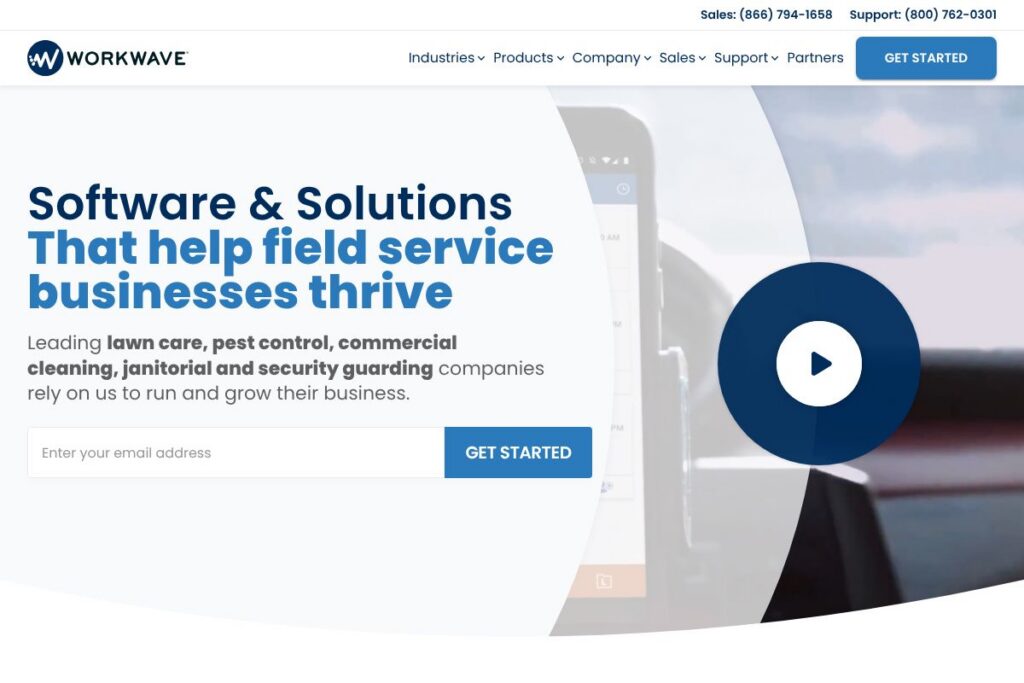
WorkWave is a suite of business management solutions for field service companies, combining CRM and ERP capabilities with routing, mobile operations, billing, payroll, and analytics. The product family targets verticals such as lawn care, pest control, janitorial, commercial cleaning, and security guarding, and is designed to centralize customer data, job dispatching, and financial workflows.
Compared with competitors, WorkWave focuses on industry-specific feature sets rather than generalist scheduling tools. For example, ServiceTitan emphasizes plumbing and HVAC contractor workflows with deep integrations into estimating and marketing; Jobber targets small to midsize home service businesses with a simpler, cost-conscious UI; Housecall Pro offers an easy-to-use mobile-first experience for small service teams. WorkWave sits between those approaches with stronger vertical customization and broader back-office capabilities.
WorkWave does well at combining field operations with back-office functions into a single platform, making it useful for companies that need routing, mobile timekeeping, billing, and industry-tailored workflows together. That combination makes it a practical choice for medium to large field service organizations that expect to scale and require reporting, payment processing, and industry-specific features in one platform.
How WorkWave Works
WorkWave centralizes work in a shared platform where office staff schedule and assign jobs, and technicians access job details from mobile apps. Dispatchers use routing and scheduling tools to group stops by geography and skill set, then push assignments to technicians who receive job notes, customer history, and digital forms on their handheld devices.
Back-office teams reconcile completed work with invoicing and payments, while integrated timekeeping syncs payroll and labor costs. Data flows into analytics and reporting so managers can monitor KPIs, job profitability, and customer retention without switching between multiple disconnected systems.
WorkWave features
WorkWave’s platform covers operational, financial, and field-facing features that address the full service delivery lifecycle. Core capabilities include CRM and ERP modules, routing and scheduling, mobile operations, billing and payments, AI-driven analytics, timekeeping and payroll, and marketing services for field service businesses.
The platform includes several powerful capabilities worth highlighting:
CRM & ERP
WorkWave provides customer records, job history, contracts, and invoicing within a single system to replace fragmented spreadsheets and separate billing systems. The ERP components manage inventory, purchase orders, and account balances so finance and operations teams share the same source of truth.
Routing & Scheduling
Advanced routing groups jobs by location, technician availability, and required skills, producing optimized routes to reduce drive time and travel costs. Dispatchers can run scenarios, create recurring routes, and adjust assignments in real time to respond to emergencies or cancellations.
Mobile Operations
Technicians use mobile apps to receive assignments, capture signatures, fill inspection forms, and record time on site, enabling paperless workflows and faster invoicing. Offline access and local caching keep crews productive in low-coverage areas and sync back to the office when connectivity returns.
Billing & Payments
Built-in billing supports invoicing, payment collection, and reconciliation with accounting systems, helping teams close the loop from service completion to payment. Integrated payment options and earned wage access tools help companies manage cash flow and pay employees faster.
Timekeeping & Payroll
Time tracking ties technician hours to jobs so payroll and job costing are accurate, with options for overtime rules and labor allocations. Time entries flow into payroll exports and accounting ledgers to reduce manual reconciliation work.
Data Insights & Analytics
Dashboards and reports surface operational KPIs, route efficiency, revenue per tech, and customer retention metrics to guide decision making. AI and analytics features translate raw data into actionable recommendations and trend visualizations.
AI Technology
WorkWave applies machine learning to forecasting, route optimization, and capacity planning, which helps reduce manual scheduling and improve resource utilization. AI-assisted insights help managers identify underperforming routes, opportunities for upselling, and seasonal demand patterns.
Financial Services and Fintech Tools
The platform includes financial tools such as invoicing workflows, payment processing, and options for earned wage access to support employee financial needs. These features reduce friction between completed work and collected revenue and offer additional employee-oriented fintech capabilities.
Print & Digital Marketing
WorkWave provides marketing support for customer acquisition and retention, including targeted digital campaigns and print collateral designed for service businesses. These capabilities help field service companies drive recurring business and seasonal promotions.
WorkWave’s biggest benefit is an end-to-end platform that links field execution to back-office processes, reducing handoffs and duplicate data entry while improving visibility across the business. That integration helps operations managers, finance teams, and service technicians work from a single system of record.
WorkWave pricing
WorkWave offers flexible pricing tailored to different field service needs, with plans and commercial terms typically set through sales conversations rather than public list pricing. The platform is positioned as an enterprise-ready SaaS solution for growing service businesses and includes optional add-ons such as financial services and marketing.
For details on available packages, deployment options, and any promotional offers, view WorkWave’s current pricing options or contact their sales team through the WorkWave site to request a customized quote.
What is WorkWave Used For?
WorkWave is used to centralize and automate core operational processes for field service businesses, including scheduling, dispatch, mobile job execution, invoicing, and payroll. Companies use it to replace disconnected point solutions and reduce administrative overhead associated with managing mobile workforces.
Typical users include operations managers who need route optimization and workforce visibility, finance teams that require integrated billing and accounting workflows, and technicians who need mobile access to customer history, forms, and job details. It is particularly suited to businesses scaling beyond small-team tools and looking for industry-specific functionality.
Pros and Cons of WorkWave
Pros
- Industry-specific functionality: WorkWave includes vertical features for lawn care, pest control, janitorial, and security guarding that reduce customization time and match common operational needs.
- End-to-end operations coverage: The platform ties CRM, routing, mobile work, billing, and payroll into one system which lowers manual handoffs and improves data accuracy.
- Scalable for growth: The system supports larger fleets and offers reporting and analytics to manage multi-location operations and multi-service offerings.
- Mobile-first field tools: Robust mobile apps for technicians support signatures, forms, photos, and offline work to keep field crews productive.
Cons
- Custom pricing and sales process: Pricing is not publicly listed which requires organizations to engage sales for quotes and may slow initial evaluation for budget-conscious buyers.
- Implementation complexity: Deploying a full-featured ERP-style solution can require configuration and training, particularly for companies migrating from manual processes.
- Learning curve for advanced features: Teams may need time to adopt AI-driven routing and analytics features to realize full benefits, requiring change management.
Does WorkWave Offer a Free Trial?
WorkWave does not publish a public free plan; it provides demos and trial arrangements through sales for qualified businesses. Prospective customers can request a personalized demo and short-term trial arrangements by contacting WorkWave via their contact page to evaluate fit for their operations.
WorkWave API and Integrations
WorkWave provides integration capabilities and APIs that let teams connect back-office systems, accounting packages, payment processors, and mapping services to the platform. The integration surface typically includes connectors for accounting, payment gateways, route mapping, and workforce tools to keep systems aligned.
Key integrations commonly used with WorkWave include accounting systems like QuickBooks, mapping and routing services such as Google Maps, payment processors for card transactions, and payroll or HR systems for timekeeping exports. For developer access and integration options, review the WorkWave developer and integration resources on the main site at WorkWave’s integration and developer information.
10 WorkWave alternatives
Paid alternatives to WorkWave
- ServiceTitan — An operations and business management platform focused on contractors and technical trades with deep estimating, dispatch, and marketing capabilities.
- Jobber — A scheduling and invoicing system aimed at small to midsize field service businesses with a simple interface and faster onboarding.
- Housecall Pro — Mobile-first field service management with SMS notifications, payments in the field, and a focus on user-friendly mobile workflows.
- FieldEdge — A technician-focused platform with dispatching and integration with accounting systems, commonly used by HVAC and plumbing companies.
- ServiceM8 — A lightweight solution for small service teams that need fast quoting, dispatch, and job management from mobile devices.
- mHelpDesk — Combines job management, invoicing, and scheduling for small to mid-market service companies.
- SAP Field Service Management — Enterprise-grade field service solution with extensive integration and scalability for large organizations.
Open source alternatives to WorkWave
- ERPNext — An open source ERP with field service, inventory, and accounting modules that can be adapted for service workflows.
- Odoo — Open source ERP with modules for field service, CRM, invoicing, and project management that can be extended for mobile operations.
- OpenMAINT — Asset and maintenance management platform designed for facility and maintenance workflows that can be repurposed for recurring service scheduling.
Frequently asked questions about WorkWave
What is WorkWave used for?
WorkWave is used to manage field service operations end to end. Companies use it for dispatching, mobile job management, billing, payroll, and reporting across service crews.
Does WorkWave integrate with QuickBooks?
Yes, WorkWave integrates with common accounting systems including QuickBooks. Integration syncs invoicing and financial data to reduce duplicate entries and reconciliation work.
How much does WorkWave cost?
WorkWave uses customized pricing based on company size, features, and deployment needs. For tailored quotes and package options, contact WorkWave through their sales and contact channels.
Does WorkWave have mobile apps for technicians?
Yes, WorkWave provides mobile applications for field technicians. Mobile apps deliver job details, forms, photos, signatures, and offline capabilities to support crews on site.
Can WorkWave handle payroll and timekeeping?
Yes, WorkWave includes timekeeping features that feed payroll and job costing. Time entries tie to jobs and labor rates and can be exported to payroll systems to simplify payroll processing.
Final Verdict: WorkWave
WorkWave stands out as a comprehensive platform for field service organizations that need industry-specific features combined with back-office automation. Its strength lies in unifying dispatch, mobile execution, billing, and analytics so teams work from a single operational system that supports growth across multiple service lines.
Compared with ServiceTitan, WorkWave typically emphasizes broader vertical coverage and integrated fintech services, while ServiceTitan may offer deeper trade-specific estimating and marketing integrations at a similar enterprise pricing tier. If your priority is a platform that bundles routing, payroll, billing, and marketing for vertical service businesses, WorkWave is a strong candidate; if you need contractor-focused estimating and marketing depth, evaluate ServiceTitan as an alternate.
Overall, WorkWave is best suited for medium to large field service businesses that require an integrated, industry-tailored system and are prepared to engage with a sales-led purchasing and implementation process. For more details about feature sets and to request a demo, visit WorkWave’s solutions and product overview.