What is BigCommerce
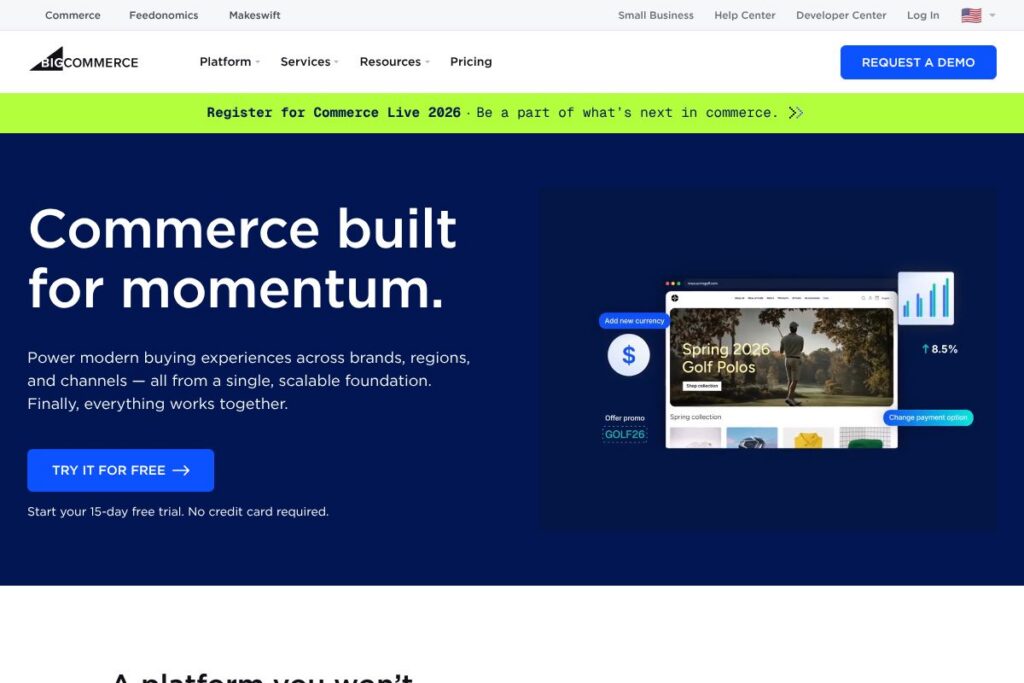
BigCommerce is a cloud ecommerce platform that helps retailers and manufacturers run online stores, marketplaces, and B2B storefronts from a single, scalable system. It supports multi-brand and multi-region setups, includes a visual page builder, and exposes APIs for headless and custom-checkout implementations.
Compared with Shopify, BigCommerce emphasizes native extensibility and B2B capabilities out of the box rather than relying solely on third-party apps. Compared with Adobe Commerce (Magento), BigCommerce provides a hosted SaaS experience that reduces infrastructure management while still supporting advanced customizations via APIs. Compared with Salesforce Commerce Cloud, BigCommerce is positioned for companies that want a balance of enterprise features and faster time to launch with fewer managed-service dependencies.
What BigCommerce does particularly well is enable multi-store and multi-catalog scenarios, provide a flexible checkout surface with many payment provider options, and support B2B flows like custom catalogs and quote management. This makes it a strong choice for brands that plan to scale across channels or need unified commerce for both B2C and B2B buyers.
How BigCommerce Works
BigCommerce runs as a hosted SaaS platform with a modular architecture where storefronts and administrative features connect to interchangeable services via APIs. Merchants manage products, pricing, promotions, and orders in a centralized control panel while exposing front-end experiences through the built-in theme system, the drag-and-drop visual editor, or headless storefronts using the Storefront API.
For integrations, stores connect to ERP and PIM systems, payment gateways, and marketplaces through the native app marketplace or custom integrations. Example workflows include migrating a legacy store to BigCommerce, configuring separate catalogs for each brand, syncing inventory to marketplaces using feed management tools, and implementing a custom checkout using BigCommerce APIs and Checkout SDKs.
BigCommerce features
BigCommerce groups commerce functions into storefront management, checkout, catalog and pricing controls, B2B functionality, and integrations. Core capabilities include the visual page builder for non-technical teams, API-first headless options, a marketplace of apps, B2B Edition features for catalogs and quotes, and support for more than 130 payment providers to address regional and channel requirements.
Multi-store and multi-brand management
Manage multiple storefronts and brands from a single backend to avoid duplicating product, catalog, and inventory systems. This reduces overhead when expanding into new regions or launching sister brands, while still allowing unique storefront customizations per site.
Custom Checkout and Payments
BigCommerce supports a flexible checkout surface with options to plug in hosted payment providers or build a custom checkout experience using its Checkout SDKs and APIs. Supporting 130+ payment providers makes it easier to localize payment methods and reduce checkout friction for international shoppers.
B2B Edition (catalogs, quotes, terms)
Built-in B2B features let merchants create customer-specific catalogs, pricing, and payment terms, and handle quote and invoice workflows without separate systems. This reduces manual sales work and keeps sales, finance, and operations aligned within the same commerce platform.
Headless commerce and APIs
A full set of REST and GraphQL APIs enable headless storefronts, progressive web apps, or mobile-native shopping experiences that decouple presentation from commerce logic. Developers can use the APIs to integrate with CMSs, front-end frameworks, and custom services while keeping commerce data centralized.
Visual Page Builder and Theme Tools
The drag-and-drop editor allows marketing and design teams to build landing pages and product experiences without code, while theme tooling and SDKs support deeper front-end customization. This split enables faster iteration on merchandising and content while preserving developer control where needed.
Integrations and App Marketplace
BigCommerce connects with ERPs, PIMs, tax engines, shipping providers, and marketing platforms via its marketplace and APIs. For feed and channel management, BigCommerce works with partners such as Feedonomics to synchronize catalogs across marketplaces and advertising channels for wider distribution.
Scalability, performance, and security
The hosted architecture handles infrastructure concerns like scaling, caching, and security for high-traffic stores, while providing controls for performance and compliance. This lets teams focus on business features and integrations rather than maintaining servers.
With these capabilities, BigCommerce is built to scale commerce operations across brands and channels while providing the APIs and tools teams need to customize checkout, integrate back-office systems, and launch new storefronts quickly.
BigCommerce pricing
BigCommerce uses a subscription-based, enterprise-focused pricing approach with options that scale by feature set and business needs rather than a one-size-fits-all fee. Pricing is typically tailored to the size of the business, required features, and whether you choose standard SaaS tiers or the enterprise B2B Edition.
For the most accurate and current rates, check BigCommerce’s homepage for plan summaries and contact options via the BigCommerce homepage to request a custom quote or details about enterprise agreements.
What is BigCommerce Used For?
BigCommerce is commonly used by direct-to-consumer brands, wholesale manufacturers, and distributors that need to run multiple storefronts or sell through many channels. Teams use it to centralize product data, manage localized pricing and tax rules, and maintain consistent inventory across web stores, marketplaces, and social commerce surfaces.
It is also used for B2B commerce by organizations that require customer-specific catalogs, negotiated pricing, quote workflows, and buyer role management. Agencies and systems integrators often choose BigCommerce for projects where a hosted platform with strong APIs reduces time to market but still allows complex integrations.
Pros and cons of BigCommerce
Pros
- Multi-store and multi-brand support: You can run several storefronts and brands from one backend, reducing duplication of catalog and inventory systems.
- Strong B2B capabilities: Built-in support for custom catalogs, pricing tiers, and quote workflows removes the need for many third-party B2B workarounds.
- API-first and headless-friendly: Robust REST and GraphQL APIs let engineering teams build custom front ends and integrate with existing back-office systems.
- Wide payment provider support: Support for over 130 payment providers helps with internationalization and localized checkout options.
Cons
- Enterprise orientation can complicate small merchant decisions: Smaller businesses may find the platform richer than they need and may require guidance to select the right plan and integrations.
- Customization can require developer resources: While the visual editor covers many use cases, advanced custom checkout experiences and deep integrations typically need engineering effort.
- App ecosystem fragmentation: Some advanced capabilities still require third-party apps or partners, which can add to total cost of ownership when compared to platforms with different ecosystems.
Does BigCommerce Offer a Free Trial?
BigCommerce offers a free trial for new merchants and demo options for enterprise buyers. The trial gives access to core store features and the visual page builder so teams can validate storefronts and integrations, while enterprise buyers can request a guided demo and custom onboarding from BigCommerce’s services team.
BigCommerce API and Integrations
BigCommerce provides developer APIs for store data, checkout, and storefronts; the BigCommerce developer documentation describes available endpoints, SDKs, and best practices for building headless or custom-checkout experiences.
The platform integrates with ERPs, PIMs, marketing platforms, payment gateways, and marketplaces via native connectors and marketplace apps; Feedonomics is a common partner for catalog distribution and feed management to advertising and marketplace channels.
10 BigCommerce alternatives
Paid alternatives to BigCommerce
- Shopify Plus – Enterprise-grade version of Shopify with a large app ecosystem and managed hosting that simplifies operations for high-volume merchants.
- Adobe Commerce (Magento) – Self-hosted and cloud-hosted options with deep customization and an extensive extension marketplace for complex commerce requirements.
- Salesforce Commerce Cloud – A CRM-integrated enterprise commerce platform focused on large retailers with global commerce needs and managed services.
- CommerceTools – A headless, microservices-first commerce platform suited for teams building bespoke commerce architectures.
- SAP Commerce Cloud – Enterprise commerce solution oriented to complex product catalogs and deep ERP integration for large global brands.
- Shift4Shop – A hosted ecommerce solution with built-in features for merchants looking for an all-in-one SaaS option.
Open source alternatives to BigCommerce
- Magento Open Source – Developer-first ecommerce platform offering full control over code and hosting, suitable for teams that want self-hosted customization.
- WooCommerce – WordPress-based ecommerce plugin that is flexible and widely adopted for content-driven commerce projects.
- PrestaShop – Open source platform with modular architecture and a marketplace for add-ons, well-suited to mid-market sellers.
- Saleor – Modern, GraphQL-first open source commerce platform focused on headless implementations.
- Solidus – A Ruby on Rails open source platform used by merchants that require custom, high-control commerce implementations.
Frequently asked questions about BigCommerce
What is BigCommerce used for?
BigCommerce is used to run ecommerce stores, multi-store deployments, and B2B commerce on a single platform. It centralizes product, catalog, and order management while supporting channel expansion to marketplaces and social commerce.
Does BigCommerce support B2B features?
Yes, BigCommerce includes B2B capabilities such as customer-specific catalogs, custom pricing, and quote management. These features are designed to reduce manual sales tasks and support complex buying structures.
Can BigCommerce integrate with my ERP or PIM?
Yes, BigCommerce is built to connect with ERP and PIM systems via native connectors and APIs. Integration partners and the app marketplace provide pre-built connectors, and custom integrations are possible using the developer APIs.
Does BigCommerce have an API for headless storefronts?
Yes, BigCommerce exposes REST and GraphQL APIs for storefronts, catalog management, and checkout. The BigCommerce developer documentation covers endpoints, SDKs, and examples.
How much does BigCommerce cost?
BigCommerce uses subscription and enterprise pricing that is tailored to business needs. For current plan options and to request a custom quote, visit the BigCommerce homepage.
Final verdict: BigCommerce
BigCommerce is a practical choice for merchants that need a single commerce foundation to run multiple brands, expand across channels, and support B2B and B2C buyers without rebuilding systems. Its strengths are multi-store management, flexible payment and checkout options, and an API-first architecture that supports headless deployments.
Compared with Shopify Plus, BigCommerce often provides more out-of-the-box B2B and multi-store controls while still offering hosted convenience; Shopify Plus focuses on a broader app ecosystem and operational simplicity. For organizations that require deep customization and enterprise integrations, BigCommerce delivers a balanced platform that reduces infrastructure overhead while enabling extensive integrations and customized checkout workflows.